Thursday, January 2, 2014

The Nine Deaths

Some have been considered sacred:  others have been thought infernal.  They can survive falls out of nine story windows. Their poop may control minds.

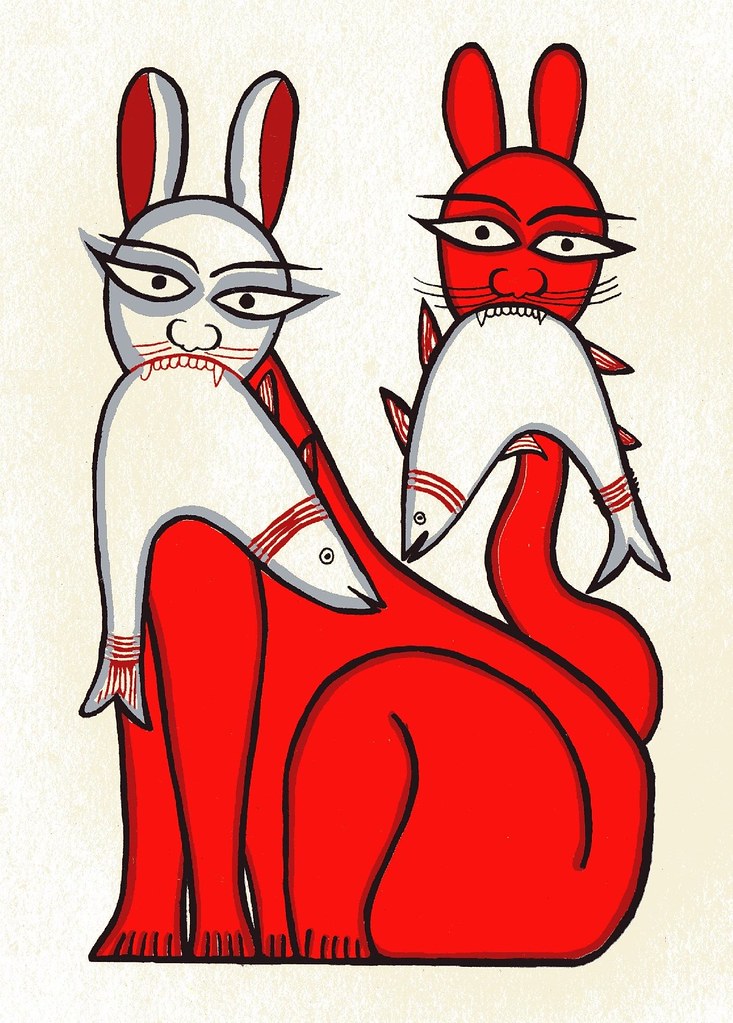
Cat, the cutest domestic bringer of death ever.  Image from the book I Like Cats, found on the great BibliOdyssey
I refer (of course) to the humble house-cat, click-bait before there even was the internet, nine-lifed check on rodent populations from Maine to Manchuria.  While most cat-obsessives fawn over the live specimen, some have found themselves obsessed with cat death.

Robert Darnton studied a ritual massacre of cats done by print-makers' apprentices in eighteenth century France.  Curiosity can kill the cat, at least proverbially.  Yet that little bit of lore has been twisted by history.  At the beginning of the twentieth century, the phrase was Care killed the cat.  So cats die because we loved them too much?  Not so fast.  When the phase was first recorded way back in Shakespeare's day, the care in care killed the cat referred not to love and affection, but rather to worry and affliction.  So which one is the cat's kryptonite?  Fear, love, or curiosity?  Or Frenchmen?

Before you mourn for the cats, know that they are not innocent of death.  A study suggests that one in three house-cats are killers, and these cats average two kills a week.  This accounts for the deaths of an estimated 4 billion birds every year.  In Australia the feral cat is guilty of extinguishing countless native bird species.  The Caribbean Hutia (which may have its last remaining home in Guantanamo bay), the Guadalupe Storm Petrel, and the Stephen's Island Wren are all victims of the cat's menace, at least according to Wikipedia.

Tuesday, September 3, 2013

Gustav Jaeger And The Undead Fads Of The Past

Gustav Jaeger (1832-1917) trained for the priesthood, started a zoo, settled for a position as a professor of zoology, eventually hung up his academic robes, and became a practicing physician.  Jaeger's mind was fertile.  He wrote about the impact of Darwin's theory on morals and religion, he pondered the mysteries of heredity, and, in a book modestly entitled the Discovery of the Soul, he came up with ideas about what are now called pheromones.  Yet none of those ideas are the reason why he deserves a blog post today, almost a century after his death.

After a bout of ill-health brought on by a long period of inactivity, Jaeger became obsessed with health.  Jaeger reasoned that the animals he had studied in his zoological positions were healthier than humans.  Animals do not get love handles, they do not complain of aches and plains, they do not  wince when they stand, they never (as far as we can tell) suffer from vague dyspepsias.  The difference, Jaeger reasoned, is hair.  Modern humans dressed in unnatural vegetable fibers, while animals were clothed in their natural hair.  All humans needed to get healthier was to change their couture.

Jaeger's solution was animal hair for everything.  Animal hair shirts, pants, and underwear.  Animal hair hats, coats, underwear and bedding.  Jaeger tried it first himself, and declared his health returned.  He laid out his system in another modestly-titled book (My System, 1880),  for all the world to see.
Jaeger, in all his whiskered glory
My System was a success.  Oscar Wilde was a proponent of Jaeger's all-wool hygienic clothing idea, a fact Jaeger's British agents did not know what to do with.  The socialist and textile designer William Morris was also an avowed fan.  Yet even more enthusiastic a supporter was G.B. Shaw, dramatist, socialist, and co-founder of the London School of Economics, who wore a specially-made woolen one-piece suit, sans collar and tie.  Thus, according to the Dictionary of National Biography (paywall):
He was likened variously to ‘a brown gnome’ and a ‘Jaeger Christ'. Seen walking down Regent Street in this suit his tall leggy figure and red hair suggested to one observer that he looked ‘exactly like a forked radish’.
A proponent of the "woolener" craze, Lewis Tomalin, was in 1883 licensed by Jaeger to manufacture and sell clothes based on the principles of My System in Britain.  Soon one store turned to two, and then the idea caught on in the whole of the British commonwealth.

In 1983 the clothing store which is the grand-child of My System, Jaeger celebrated its centenary.  The high-street store does not limit its clothing purely to wool anymore--although the majority of its clothes are woolens--and all memory of its namesake's now-obsolete ideas have been stripped away by the inconsiderate passing of time--though the store still bears Jaeger's name.  A shadow of Jaeger's all-wool health fad remains in the 90-odd stores Jaeger boasts world-wide.

Old ideas stalk the living, like slowly loping yet inescapable zombies.  How many other dead, obsolete, debunked, and careworn ideas still exert themselves over us, their anachronism buried under decades or centuries of habit?  Graham crackers famously began their lives as a diet regimen to prevent 'self-abuse'.  The inventor of the birth control pill established a period of week-long placebos every month in order to ensure women menstruated--arguing that "women would find the continuation of their monthly bleeding reassuring."  Though some contemporary doctors argue that such fastidiousness unnecessary, we still do it--because that's what we do.  More seriously, penitentiaries originated as a humane alternative to torture and the workhouse--a place of refuge for prisoners where they could learn the errors of their ways through peaceful thought.  Today prisons are society's living-room rug, under which we sweep those we no longer want to deal with.

Feel free to comment with more zombie ideas.

Friday, December 14, 2012

Come One, Come All--If Your Name Is Greg.

The fun starts here.  If you're name is Greg.

In 1673 the Society of Gregories--a club made up of men named Gregory--met in St Michael's Church in Cornhill, London for a celebratory meaning.  A sermon was given by one, Francis Gregory.  After listening to this learned discussion on 'the spiritual watch' (in printed form running to twenty seven pages) the club members celebrated the baptism of a baby--baby Gregory.

The Society of Gregories' other activities are obscured by the inattention of history.  The number of Gregs filling St Michaels that day is unknown, and we can only guess why they came together on that day to celebrate the virtues of Gregness.  Yet this gaggle of Gregs was not alone in celebrating gatherings of their namesakes.  There is evidence of other patronymic societies in London in the late 17th Century--one for Adams, another for Lloyds, and one for Smiths.  Yet these societies made on first-name-basis did not last long.  This fad soon lifted, becoming little more than a historian's curiosity.  Perhaps some Gregory online with time on his hands want to resurrect this ancient and once-proud rite?

This information comes from Peter Clark's British Clubs and Societies 1580-1800.

Monday, October 15, 2012

The Precious Beaver Testicles of Gerald Of Wales


History remembers the killer apps which remade the world--the printing presses, the cotton gins, the fire.  The conquering army, the victorious legislator, the trailblazing poet--these are the names that will live on forever.

And you're not one of them.  And I'm not one of them.  And nobody you've ever met is one of them.  (Probably.)
Clio, muse of history, probably doesn't even know your goddamn name.
No, our world is rich in folly and failure.  Medical researchers calculated the half life of a given truth to be 45 years.  That is, of any given set of facts (all things being equal) half will be disproved in a little less than half a century.  So in forty-five years, half of everything you think is true will be proven wrong.  No wonder old people get so cranky.

Brilliance, humility and genius prove no antidote to failure.  Take the ebullient medieval scholar Gerald of Wales, who lived in the 12th Century.  Tall and fearsome and erudite, Gerald became a churchman and a politician.  The undisputed 'universal scholar' of his age travelled to the peripheries of the British Isles.  These trips resulted in exemplary, entertaining and learned histories of Ireland and Wales which remain go-to historical sources.  In addition to these travelogues Gerald published about twenty other tomes on topics ranging from theology to hagiography to biography.  (It was the 12th Century:  there wasn't really any wiggle room about genre).  Gerald of Wales combined his era's best learning with keen empirical observation.  If anyone should have avoided folly, it would have been Gerald of Wales.

But even poor Gerald fell prone to mistake.  Here's just one.  Nestled at the end of a fine description of a European beaver colony, Gerald goes off on a tangent about how when beavers are frightened they bite off their own testicles.

Wait, what?

Yes, you read right.  Gerald of Wales thought that when hunted, male beavers chomped off their own balls with their sharp sharp teeth.

Gerald's peculiar observation has some source.  He is going off a description of beavers in Aesop's fables, in which the beavers, hunted for their useful testicles, wisely detached their gonads from their bodies and offered them to the slavering dogs--gratis--so that they could go on their merry way, alive but gelded.  This is backed up in Pliny's Natural history which tells pretty much the same story.
Now you can wear the unmistakable scent of beaver anal glands!
And even this is not as crazy as it seems at first blush.  Beavers were hunted for a thing called castoreum--which Pliny, Aesop, and Gerald all misidentified as the beaver's balls.  Actually castoreum comes from glands in the beaver's anus and it proves incredibly useful--it remains in use today as a perfume base (giving 'animal notes') and a food additive.  A Scandinavian schnaps called Bäverhojt is flavored with castor.
Now you can taste the unmistakeable relish of beaver anal glands!
So the myth of beaver's self-castrating self-preservation is explained, if not excused.

And this is how the parade of folly makes its march down the avenue of history:  a misheard word, a bad joke, a good guess that turns out wrong--repeated again and again until it assumes the air of truth.  And in forty-five years, if the scientists have it right, half of what I've written here will also be filed away in the ignoble archives of idiocy.

This post was inspired by the always-inspiring In Our Time with Melvyn Bragg, which recently ran an episode on Gerald of Wales.

Tuesday, October 2, 2012

Letters, Lies and Calculus


In 1696 Guillaume de l'Hôpital published one of the first calculus textbooks, euphoniously entitled Analysis of the Infinitely Small for the Understanding of Curved Lines--or the Analyse for short.  In the Analyse's pages l'Hôpital laid out a method of figuring out the limits of indeterminate forms that was a huge deal in the burgeoning field of calculus.  It made L'Hôpital a star.

With all the linguistic verve of mathematicians, the rule was dubbed l'Hôpital's Rule, and ever since it has been rammed into the heads of calculus students, where it remains, a bit of discarded fact lodged somewhere between first girlfriend's middle name and capital of Peru.

As you can probably tell from the de appended to l'Hôpital's name (and the frothy wig perched on his head) good old Guillaume was a nobleman.  More than that, he mixed a genuine mathematical curiosity with the ability to straightforwardly explain the stuff he was interested in.  But while l'Hôpital was undoubtably a very good mathematician, and his textbook remained required reading for a hundred years, it turns out that all of the great discoveries that l'Hôpital is known for--including the eponymous rule--weren't actually discovered by l'Hôpital.  He merely owned them.

It all started in the salon of Malebranche, where the aristocratic thirty-something savant l'Hôpital met the 24-year old wannabe math nerd Johann (sometimes John) Bernoulli.  At some point in the night Bernoulli whipped out his 'secret weapon'--an unpublished forumla on how to figure out the radius of the curvature of a curve.   L'Hôpital, impressed, signed Bernoulli up to be his calculus tutor for ten months.  In 1694 l'Hôpital offered Bernoulli a further three hundred francs a year if he would tell him everything he could about this new-fangled calculus--and not tell anyone else.  Bernoulli agreed, and produced a series of brilliant letters explaining everything l'Hôpital could hope to know--and then some.  L'Hôpital would then take the insights Bernoulli told him and pass them off as his own, reaping the fame.

When l'Hôpital died, Johann Bernoulli claimed much of the content of l'Hôpital's work.  The famous textbook?  Actually that amounted to the ten-month course Bernoulli taught l'Hôpital.  The rule?  It should be Bernoulli's Rule.  L'Hôpital's work on conic sections?  That was Bernoulli's work.  But no one believed him.

There was good reason for this.  Johann Bernoulli was an irascible  thin-skinned man who involved himself in quite a few mathematical kerfuffles.  One acrimonious struggle was with his own son Daniel.  To win the argument (against his own son!) over who came up with some principle of hydrodynamics first, Johann resorted to forgery.

So clearly Bernoulli was jealous of his reputation.  Since he didn't claim l'Hôpital's discoveries with any special grievance, people just thought Johann's claim was just Johann being Johann again.

But Johann Bernoulli was right.  And nobody realized until 1922, when Bernoulli's first calculus lectures were discovered in a musty archive somewhere.   They were written before l'Hôpital's textbook.  And they were undoubtedly l'Hôpital's inspiration for the Analyse.  The L'Hôpital's Rule is really Bernoulli's Rule.

But I suspect that renaming l'Hôpital's Rule is just plain greedy.  The Bernoullis claim a menagerie of grey matter so quirky and brilliant that the three generations of genius could easily make up the cast of a Wes Anderson film.  (Bill Murray as Johann Bernoulli; Jason Schwartzman as Daniel Bernoulli.  Right?)  Because of this tons of stuff is already named after them.  There's the Bernoulli Effect.  The Bernoulli Principle.  The Bernoulli Distribution.  The Bernoulli Theorem.  These range over the domains of statistics, fluid dynamics, and calculus--and they are only a small sampling of the discoveries pinned with the Bernoulli name.  Do we really need a Bernoulli Rule?  Really?  The rule itself is confusing enough as it is.  We don't need to go messing around with its name.

My primary source for this story is an article by C. Truesdale.  I learned about l'Hôpital's Rule in Mark Hansen's math for social scientists class.

Monday, August 20, 2012

The Emperors Of Ice Cream


One of the most profound things I've ever seen took place on a guided tour of Queensland.  In amongst the usual touristic sights of natural beauty--the LOTR-worthy lakes, the picture-book rain forests, and the prehistoric cassowaries--we stopped to get ice cream.

One of my fellow tourists was a young woman toting a squint-faced newborn.  The new mother scooped some ice cream up in one of those diminutive plastic ice cream shovels, then held it out to the child.

The baby's lips puckered.  She blinked.  Once the ice cream was on her lips, there was a moment of tension.

"This is her first ice cream," mom drawled.

The baby's eyes grew as large as baby eyes can go.  She laughed.  She reached out before.  This new stuff--it was good!  This new stuff--it was more than good!  It was fantastic!

I felt lucky to watch this--a person realizing that existance is awesome enough to include ice cream.

On the face of it, ice cream seems like it must go hand-in-hand with the glories of electric refrigeration.   Human beings are a crafty bunch however, and our sweaty summers have been relieved by ice-cooled treats for at least four millennia.

The Chinese--first at everything--produced the earliest recorded ice confection, made by taking milk, overcooked rice, and spices, and throwing the mix all together with some fresh snow.  Yum!

The Chinese practice of mixing snow with sweets passed along to the Persians, who add fruit juice to snow to refresh themselves during the summer.  This is the origin of the word sherbet--a Persian word meaning 'he drank.'  From here, the technology passed on to Alexander the Great who--in addition to his usual claim to fame of having one of the largest land Empires ever, must add 'bringer of iced delicacies to Europe.'  Alexander's gift to the western world shows up again in the reign of the maligned Emperor Nero, whose bacchanals often were accompanied by refreshing mixtures of fruit juice and snow.

But where did the snow come from in the summer?  The mountains.  In Rome's case, the ice came from the alps.  Back in the ancient world, there existed an ice trade.  Entrepreneurial mountain-dwellers would collect snow or lake ice, cover it with a thick sheet, then transport it to the the sweltering metropole for the refreshment of the pest-ridden city-dwellers. The ice was stored in icehouses--insulated sometimes underground storage rooms, in which a cache of ice could remain frozen even in the hottest month of summer.  The first recorded building of an ice house goes all the way back to 1700 BC, when the snow-loving Persians constructed one 'which never before had any king built.'

The Turkish Sultan so loved ice that they had an entire class of servant dedicated to the upkeep of the ice and snow stores.  (This was just some of the 1570 people who as of the 16th century were employed in the Sultan's kitchens, others including the oh-so-necessary yogurt makers, simit bakers, and wheat pounders.)

Simits, though not involving ice or ice cream in any way, remain food fit for a Sultan.
The Chinese came up with a further ice confection improvement around the 17th Century.  Salt.  You may remember making 'home made' ice cream back in school, and, because of the infinite cruelty of the education system, this somehow involving turning a crank.  You also for some reason needed salt.  No one could tell me why this was so.
Notice the hand-crank of cruelty.
Adding salt to ice reduces the freezing point of water.  Immersing a thing into this super-cooled brine allows for the freezing of more than just ice--now people could freeze ice or custard.  Sometime in the 18th Century a Sicilian Procopio Cuto at the Parisian Cafe Procope made some of the first for-sure European ice cream available to non-royalty.  (Cafe Procope is named after the Byzantine historian Procopious, he of the Secret History fame.)

Ice cream was an ever-popular dish for the illustrious rich.  George Washington spent over two hundred dollars on ice cream one summer.  Thomas Jefferson was such a fan of ice cream that, in very Jeffersonian fashion, he laid out an 18-step process on how to make the perfect ice cream.  Supposedly it tastes a little bit like a baked alaska.
Ice cream recipe written in the same hand as the Declaration of Independence.

It took until the middle of the Nineteenth Century for ice cream to reach the common people.  Then, a Baltimore man named Jacob Fussel, a dairy merchant, needed a way to get people to buy cream.  He started the world's first ice cream factory, became rich by selling affordable cream, and gave middle class America a taste for what Wallace Stevens called 'concupiscent curds.'  A devout Quaker, Fussel took time out of being an ice cream impresario by also supporting the underground railroad.

Ice cream is one of those parts of human life so unabashedly wonderful, so flawless, so pure, that it is certain to accompany human culture to the very twilight.  Indeed, in that last age, when man crouches in some burnt-out wasteland, if he still has culture, he will sometimes wipe the sweat off his brow and get a double scoop of chocolate.

Saturday, August 18, 2012

New Novel: Starseed


I recently finished a science fiction book.  And now you can read it in the comfort of your own home because of this cool new technology they call the Internet.

The book's called Starseed.  It's available on Smashwords.

So what do you get in Starseed?

Packed into 85,000 words of fine Mackie-crafted prose there's...

  • Psychics in cryogenic stasis.
  • Sex AND violence!
  • A singularity-eque Artificial Intelligence.
  • Metaphors!  Smiles!  Extended metaphors!
  • Deep-space travel.
  • Discussion of the nature of the human soul!
  • One hundred and seventy four (174) exclamation marks (!)

And more, much more.

I know you folks at home are already asking:  how much money do I need to throw at you so that I can get this marvelous e-Book?

The answer will leave you spraying Mountain Dew all over your monitor.

The book is pay-what-you-want.  So you can just pay nothing at all for the enjoyment of nearly two-hundred pages of finely written science-fiction action.  You can also pay fifty dollars.  Somewhere between those two numbers is probably a fair middle ground.

So don't wait a second more!  Click.  Buy.  Read.  Tell your friends.  Leave a nice review.  Name your first born in my honor.

A NOTE TO MY PUBLISHING FRIENDS:  You probably know that I've recently finished an ambitious manuscript I'm trying to get looked at by agents and editors.  Starseed is NOT it.  Though Starseed is cool, if you are an agent or editor, I'd much rather you take a peek at my fat big American novel, Please Give Me Money--contact me personally and I'll send you a copy.

Thursday, August 16, 2012

The Wallpaper That Named America


Columbus discovered America.  America is named after Amerigo Vespucci, who did not discover America.  In the lacuna between these two well-known facts there hides a story of adventurers, pickle-sellers, forged letters--and wall-paper.

Before the story begins, a Roman prologue.  In the Second Century AD there was a Greek-speaking Roman citizen from the province of Egypt named Ptolemy.  (Students of ancient history know that this is not anything unusual:  almost every Greek-speaking Egyptian ever was named Ptolemy.)  This Ptolemy, Claudius Ptolemy, put all of his era's geographical knowledge into a single book titled, with characteristic Roman creativity, the Geography.

Ptolemy's Geography mapped the known world, and mapped it well.  Europe is drawn with care.  The Persian Gulf looks suitably gulf-like.  Important rivers are all in the right places, including some in the far east.  The Indian Ocean exists.  The map even shows parts of China, though in blurry, uncertain haziness.

For more than a thousand years the Geography was the Google Maps of princes, merchants and explorers from Bruges to Baghdad.  In the late 15th Century, Christopher Columbus turned to it as he was trying to convince European kings to bankroll his ambitious globe-crossing voyage.  Columbus--who we've written about before--was the last man on earth to find the Geography useful.

That was because of what Columbus discovered once he sailed deep into the Western Ocean:  the New World.  But Columbus never knew the significance of his discovery.  When he first made landfall on that first unnamed idyllic Caribbean island, he assumed he was on East Coast of Japan, and that the Caribs were vassals of the great Khan.

Enter Amerigo Vespucci, a man Emerson derided as a mere "pickle seller" and a "thief."  Vespucci was a Florentine explorer who made two trips West.  A certain air of vibrant disreputableness hangs around him.

Amerigo Vespucci:  Explorer.  Lover.  Seller of pickles.
In the early 1500s, Vespucci wrote letters from the New World, describing a huge continent extending south of the Indies, bordered on both sides by ocean.  In Ptolemy's Geography--a book, remember, that had been state-of-the-art for 1,300 years--there was no huge southern continent that extended past the equator.  The conclusion was mind-blowing.  The world was big.  There was a whole new continent.  Florentine printers gathered these letters together, spiced them up a bit, and in 1502 or 1503 published them as a book called Mundus Novis.  The New World.

Instantly, people demanded an update to Ptolemy's previously immortal map.  A flurry of sextants and compasses scribbled across pages as publishers and map-fanciers rushed to be the first to make a accurate map of the new earth.

Enter two Germans--Martin Waldseemuller and Matthias Ringmann, cartographers.  They produced a map now known as the Waldseemuller map.  It was printed on 12 sheets measuring a massive four and a half by eight feet.  It was probably the largest map then made, and like all cool maps, it was meant for display as much as it was meant for navigation.  It was wallpaper.  If it were around now, it would be advertised in the Skymall catalogue.

The modern-day equivalent of the Waldseemuller map.
The Waldseemuller map was more than just big.  It was more than just cool.  It also included a certain brand new exciting continent hanging out to the far right, stretching below the Equator.  There, in the mostly empty space, was printed a name in serifed all-caps.  America.  The name was probably made up by Ringmann--a feminization of Amerigo.

The first printed instance of the name America.
The map was popular.  German universities clambered to pick up one of the thousand printed copies.  Students made copies of it and showed it to their friends.  In modern parlance, the map went viral.  As the map spread, so did the name America.  In the middle of the century Gerardus Mercador--he of the projection and a cartographical superstar in his own right--decided that the whole landmass of the New World should be called America.  Despite two centuries of Spanish complaints to the contrary, America would be America forever.

But a further twist complicates the story.  Remember those letters that Vespucci sent back to Europe?  The ones that inspired Waldseemuller and Ringmann to believe that South America was a distinct continent?  Those turned out to be faked.  Waldseemuller flip flopped, and when he published a new set of maps after Ringmann's premature death, South America was not shown a separate continent--indeed, no mention word America was made.  Waldseemuller explained the change:
As we have lately come to understand, our previous representation pleased very few people. Therefore, since true seekers of knowledge rarely color their words in confusing rhetoric, and do not embellish facts with charm but instead with a venerable abundance of simplicity, we must say that we cover our heads with a humble hood.
The inspiration for this post comes from Backstory's segment on Vespucci and the Waldseemuller map.  The always fantastic Smithsonian Magazine has an article on the Waldseemuller map, which proved to be a great trove of facts.

Tuesday, August 14, 2012

The Arm That Wasn't Paralyzed


An intelligent, lucid 60 year old named Nora was interviewed by the neuroscientist V.S. Ramachandran.  Ramachandran tells the story in his book, the Tell-Tale Brain.
"Can you walk?"
"Yes." (Actually, she hadn't taken a single step in the last week.)
"Nora, can you use your hands, can you move them?"
"Yes."
"Both hands?"
"Yes."  (Nora hadn't used a fork for a week.)
[...]
"Touch my nose with your left hand."
Nora's hand reamins motionless.
"Are you touching my nose?"
"Yes."
"Can you see your hand touching my nose?"
"Yes, it's now almost touching your nose."
Nora's left side is paralyzed.  But she won't admit it.  This is a more common phenomena than you'd think.  After suffering a stroke in the right hemisphere of the brain, many people suffer paralysis of the left-hand side of their bodies.  About one in twenty of these people will insist that they are not in fact paralyzed.  This is called anosognosia, which is medical-speak for denial-of-illness.

Anosognosia does not necessarily go along with any other mental impairment.  A person can be psychologically completely normal in every respect--except when it comes to the inert mass of their paralyzed left half.

A notable sufferer of anosognosia was Woodrow Wilson who became paralyzed in 1919 after being smitten with a flu-related.  He was bedridden, blind in his left eye, and paralyzed on the left side of his body.  He remained in office, even as he was on the brink of death, mumbling limericks to himself, his wife serving as his 'steward' (read: regent).  He didn't attend any cabinet meetings for a full half year, and when he finally presented himself to his cabinet, his staff were shocked at the frail state of his heath, and at the secrecy which had covered it up.  But Wilson grew angry with any mention of his incapacities, and fired many functionaries who dared suggest that there was something wrong with him.  He even pondered running for a third term.

Anosognosia can come in many exotic flavors.  Some anosognosiacs will refuse to admit that other paralytics are paralyzed.  A syndrome called somatoparaphrenia often accompanies anosognosia, in which a person will deny all ownership of their paralyzed arm.  Nora, mentioned above, had somatoparaphrenia.  "Whose arm is this?" Dr. Ramachandran asked her.  "That's my mother's arm," she replied.  "Where's your mother?"  "She's under the table."

People can be anosognosiac about more than just paralysis.  Patients with Wernicke's aphasia--brain damage which limits their communication to a fluent stream of babble--are often anosognosiac about their condition, nodding and smiling and talking even though they have no content to their speech.


Sources today are V.S. Ramachandran's the Tell-Tale Brain, and Errol Morris' five-part blog post on anosognosia which is fun, philosophical, and exhaustive--not words you usually associate with five-part blog posts, I know.

Monday, August 13, 2012

Puppies in a pool! (Open thread)

From r/aww
Hey reader!  I'd like to hear from you.  So I have a few questions.  Answer as many or as few as you'd like or just write a hello.

What do you like to eat for breakfast?  If you could be reincarnated in any historical period, when would you live?  Puppies or kitties?  Tapatio, tabasco, or siracha?  Cherries or peaches?

Also, if you happen to know any literary agents, I finished a novel I think is pretty damn good, and I'd like to show it to someone who can turn it into a real book.  Just sayin'.

Friday, August 10, 2012

The Almost Cure-All Urine of Albert Alexander

Hennig Brand, playing with pee, discovering the philosopher's stone.
Urine is useful.  The Latin poet Catullus mocked the Spanish for brushing their teeth with their own pee.  Drinking your mid-stream morning tinkle is recommended by some practitioners of yoga.  The Roman world collected piss to use for washing clothes--the ammonia would help bleach the coarse fibres.  And it was curiosity about the magical properties of wee which led Hennig Brand in the 17th Century to experiment with urine and so discover phosphorous.

None of this mattered for Albert Alexander, an Oxford County policeman who in 1941 was hospitalized with a severe infection resulting from an unfortunate rosebush scratch on his mouth.  He came down with vicious blood poisoning, and his face became so matted with weeping red abscesses that one of his eyes had to be removed.  The infection then spread to his lungs.  If he was not cured, he would die in writhing agony.  But the only cure at the time, the drugs called sulfonamides, were not effective with cases when the patient was as utterly suffused with pus as Alexander was.  He had no hope at all.

Enter Howard Florey and Ernst Chain, two scientists who had been experimenting with a drug that could very well become the magic bullet--the medicine that would destroy all infection.

To make the drug, they'd been culturing 500 liters of mold every week.  They hired three or four girls to grow the mold in every receptacle they could find--they used baths, bed pans, pie dishes, and even food trays, before finally settling on a purpose-made ceramic jar.

After successful trials on rats, Florey and Chain were finally ready to try the panacea on a human subject.  But they were concerned.  The drug was so strong it would probably reveal itself to be highly toxic to humans.  Would the cure be worse than the disease?

The mold was penicillin, and Albert Alexander was going to be the first person to be cured by it.

The magic mold itself.
On February 12th 1941, Florey injected Alexander with a large dose of penicillin, and the results were considered miraculous.  By the next morning Alexander's temperature had returned to normal and he had even regained his appetite.  He was cured!  But there was a problem.  To fight off the infection Alexander required an injection of about a gram of penicillin a day, and there just wasn't that much penicillin to go around, no matter how fastidiously the three or four 'penicillin grils' tended to their mold vats.

Enter urine.  The enterprising scientists collected Alexander's urine and processed it, retrieving whatever penicillin Alexander happened to piss out.  This was duly injected into Alexander again, and for nearly a week, his infection was beaten back.

But it was not beaten.  After five days, with their reserves of penicillin completely depleted and longer able to retrieve more penicillin from Alexander's urine, Alexander was left with his infection.  He succumbed to it on March 14th.

Albert Alexander did not die in vain.  His initial miraculous recovery was proof that penicillin actually worked in humans, and more--it proved non-toxic to people.  The next person to be treated with the magic bullet, a teenager whose temperature had shot up to almost 100 degrees as a result of an infected hip--was back to normal in two days.  A new era opened up in human history--one where we didn't ever have to worry about death from rose-thorn scratches.  In part, for this we have to thank that first brave medical guina pig, Albert Alexander, the constable from Oxford County who had an unfortunate pruning accident.

I heard about the case of Albert Alexander from Dr. Karl's Podcast.  My other sources are an interview with Norman Heatly on Science Watch, and the article the Discovery of Penicillin from the American Chemical Society.

Wednesday, August 8, 2012

Plato's Less-Than Ideal Arithmetic

Philosophy is nothing more than footnotes to this guy, so they say.
Plato rightly deserves his central place in the Western canon.  He founded a school--the Akademia--from which we get both the word and the inspiration for the modern academy.  His insistance on the immorality of the soul so suffused the Greek-speaking world--including the authors of the New Testament--that Nietzsche dismissed Christianity as mere 'Platonism for the masses.'  Plato wrote over thirty dialogues that survive as masterpieces of argument and storytelling--a feat made all the more striking by the fact that back when Plato lived there were no paper mills, no printers, no bookstores, and no pens.  Plato pretty much set the aims, the methods, and the questions of philosophy for the next two thousand years.

But despite his heavyweight resume, Plato seems to have flubbed his math a bit.

Here's Plato calculating the exact amount that the philosopher's life is better than the tyrant's, from Book nine of the Republic.
Or if some person measures the interval by which the king is parted from the tyrant in truth of pleasure, he will find him, when the multiplication is complete, living 729 times more pleasantly, and the tyrant more painfully by this same interval.

What a wonderful calculation! And how enormous is the distance which separates the just from the unjust in regard to pleasure and pain!

Yet a true calculation, and a number which nearly concerns human life, if human beings are concerned with days and nights and months and years.
Plato's math, according to the footnotes in the second edition of the Grube translation of the Republic are "hard to follow."  Here's a try.  The tyrant experiences only two-dimensional pleasures, while the philosopher experiences three dimensional pleasures.  Additionally, the philosopher is nine times away from the tyrant in terms of pleasure, so the philosopher's pleasure is represented by a nine-unit cube, while the tyrant's pleasure is represented by a one-unit square.  But Plato flubbed things getting to the number 729, which was sacred to the Pythagoreans.  He miscounted the number of times removed the tyrant was from the philosopher (it should have been five, not six) and multiplied where he should have merely added.  Sadly, it turns out that the philosopher is only 125 times happier than the tyrant!

But we can't blame Plato for having trouble with his sums.  In Plato's time, before zero, before calculators, before arithmetic notation, math was decidedly hard to do.  Here's another example of Plato doing math, from the Republic, Book 8:
Now that which is of divine birth has a period which is contained in a perfect number, but the period of human birth is comprehended in a number in which first increments by involution and evolution, obtaining three intervals and four terms of like and unlike, waxing and waning numbers, make all the terms commensurable and agreeable to one another. The base of these with a third added when combined with five and raised to the third power furnishes two harmonies; the first a square which is a hundred times as great, and the other a figure having one side equal to the former, but oblong, consisting of a hundred numbers squared upon rational diameters of a square (i. e. omitting fractions), the side of which is five, each of them being less by one or less by two perfect squares of irrational diameters ; and a hundred cubes of three. Now this number represents a geometrical figure which has control over the good and evil of births.
What Plato's trying to say--again according the Grube Edition's footnotes--is that the human number is the product of three, four and five raised to the power of four, or (3*4*5)^4, which comes to 12,960,000.  This can be shown geometrically in two ways.  First, by the area of a square with the sides of 3600 or as a rectangle with sides 4800 and 2700.  Simple enough for us moderns.  But we have the ease of working with arabic numerals.  You can see how Plato--even Plato!--can be forgiven for messing up his math.

And you thought math was hard in high school!  Sacrifice a cock to Asclepius in thanks that you were never a math student in ancient Athens.

Sunday, August 5, 2012

In Soviet Russia, Punchline Laughs At You


The dead do not laugh.  Everyone else does.  Earlier this year, we talked about the legendary humor of the Spartans and the world's oldest jokes.  Today we'll be talking about jokes so funny they could get you sent to the Gulag.  We're going to delve into the humour of Stalinist Russia.

Many of the jokes had to do with the Stakhanovites--workers who achieved supernaturally high production levels, becoming a legion of pseudo-celebrities.  Often Stakhanovites would get special privileges and gifts.
Four Stakhanovite milkmaids were getting prizes at a public ceremony.  The first got a radio receiver.  The second got a gramophone.  The third got a bicycle.  Finally the fourth came onstage, the leading pig-tender of the whole kolkhoz.  The audience held its breath.  Wiping tears from his eyes, the kolkhoz director shook her hand with great pride.  "I present to you the collected works of our beloved comrade Stalin!"  Silence.  A voice peeped up from the back of the hall.  "Just what the bitch deserves."
Others had to do with the tension that came from the suddenness of soviet-style repression.
"Did you hear that Petrov's been shot?"
"Nonsense!  That's Petrov himself walking on the other side of the street!"
"Yes, he hasn't heard yet."
Fear might make us try to stifle our laughter, but a few snickers always get out.  Here's another.
1937.  Night.  A ring at the door.  The husband answers it nervously.  He returns to his wife, glowing with relief.  "Don't worry, darling.  It is only bandits who have come to rob us."
Finally, jokes can offer us a way to imagine hope in a hopeless situation.
A riddle:  Stalin, the entire Politburo, and their whole entourage are on a steamer going down the Volga.  If the steamer were to sink, who would be saved?
Answer:  The peoples of the USSR.
My sources today were Sheila Fitzpatrick's Everyday Stalinism and Political Humour Under Stalin, edited by Michael Brandenburger.

Saturday, July 28, 2012

Three Things The Ancient Olympics Can Teach The Modern Olympics

The Olympics started in the seventh century before Christ, when young women completed a footrace to see who would become a priestess of Hera.  From these humble beginnings, the Olympics became the foremost of the four pan-Hellenic games, a ceremony so important to the Greek-speaking world that truces were called in order for athletes to arrive at the games safely.

These Olympics were not the familiar biennial show-case of brute physical competition that we know and love.  The race with the Olympic torch--now so engrained in our image of the Olympics that is has become a synecdoche for the festival--was an innovation brought in by Hitler in the 1936 games.  The gold, silver and bronze medallions replaced the traditional reward of an amphora of olive oil and a sprig of olive.  In the translation between ancient celebration and modern spectacle, some important aspects of the competition were lost.

Today we'll look at three aspects of the Ancient Olympics I think should be returned to the modern Olympics.


The first is Athletic Nudity.  The Greeks competed buck naked, slathered in olive oil.  The origins of this practice are murky.  Thucydides said that the Spartans "were the first to bare their bodies and, after stripping openly, to anoint themselves with oil when they engaged in athletic exercise."  Other sources point to the Athenians, whose government, after a guy tripped over his shorts while running, decreed that all sports should be conducted naked.


The explanation for the nakedness, according to John Mouratidis, was to either to "inspire fear or horrify their enemies."  He quotes L Bonafante suggesting that Hellenistic nakedness resulted from the "apotropaic use of the phallos, gestures against the evil eye, etc."  That et cetra is enticing--what other apotropaic uses can the phallos be put to?  But we must move on.

My reason for advocating a naked Olympics is transparent.  No one worries about the evil eye anymore, and there have been no notable short-tripping incidents in any Olympics I can remember.  But I think that athletic nudity would make the games more entertaining, more beautiful, and more exciting.  Especially the pommel horse.

A Pankration competition depicted on a vase.
The second ancient innovation is Pankration, which is Greek for "savage unrelenting beat-down."  Actually it is Greek for "all powers."  Pankration was a mix of boxing and wrestling, whose rules were easy to learn but hard to master.  Two men squared off against each other, trying to inflict so much pain against his opponent that he would submit by holding up his index finger.  The fighters could do anything to inflict this pain--barring biting and the gouging of the eyes, nose and mouth--and while they did not have weapons, in later years, the pankratiasts wrapped their fists with leather and metal.  You heard right, they could do anything.  They could kick the stomach or the testicles, they could inflict chokeholds and armlocks and brutal throws.  Many competitors died.

Pankration produced its heroes.  One man won a match even though he was dead.  Arrachion of Phigalia was in the Pankration finals for the third time running, and after an evenly-fought bout his opponent held him in a neck hold from which he could not escape.  Arrachion's trainer called out "What a fine funeral if you do not submit at Olympia!"  With that, Arrachion twisted his body around, kicking his opponent's foot, breaking it.  His opponent, in unbearable pain, gave up the match.  But Arrachion had broken his own neck and lay there, dead.  His limp head was donned with the laurel leaves of victory, and he became a legend across Greece.

Modern-day Mixed Martial Arts (or MMA) is similar to Pankration.  The sheer undaunted brutality of these competitions should be enough to inspire the "pity and fear" that Aristotle said good tragedy should inspire in us.  So why not let it become an Olympic sport?


The third innovation that the ancient Greeks can give the modern Olympics is not as cool as nakedness and bloodthirsty lawless death-matches.  It's poetry.

The ancient Olympic Games were closed by a competition among poets to see who could best praise the winning athletes.  These poems, called epinicians, were dreadfully popular, and have survived thousands of years.


In the modern Olympics, art competitions were held from 1912 to 1948, for sport-inspired architecture, painting, sculpture, music, and literature.  The competitions were called off because, in the opinion of the Olympic committee, the artists were all professionals.  The 1952 Olympics in Helsinki boasted a non-competitive art show, but without the agony of struggle, victory and defeat, the artistic side of the Olympics sputtered out.

Modern art is moribund, sealed air-tight in an ivory sarcophagus of academic rigor and bloodless cerebral muttering.  Our generation might be one of the first in human history for which poetry has no popular charm--and the fault is the poets, who insist on being daringly arty, when they should work to be beautiful.  A poetry competition celebrating the accessible agony of athletic competition, done in all the languages of the world, would help a little in giving feeling back to poets.

Wednesday, July 25, 2012

Short Of Giants


In the 17th Century there was a shortage of giants in Europe, and only one man was to blame.  The giant-greedy Fredrick the First of Prussia.

Fredrick was into war.  And he had assembled a regiment of extraordinarily large soldiers called the ‘Grand Grenadiers of Potsdam.”  The king’s agents fanned out across Europe, on the look out for tall men who would be offered huge amounts of money to join the regiment.  If they refused the king’s generosity, they would simply be kidnapped.  Diplomats trying to get on his good side learned to send Freddy larger-than-normal men to add to his regiment.  Every year the Russian Tsar Peter the Great—who stood at six foot seven inches tall himself—would send the Prussians fifty giants.  Once, when Peter took back an especially large specimen and replaced him with a shorter one, Fredrick refused to speak to any Russian diplomat for months.  “The wound,” he explained, “is still too raw.”  Fredrick even tried to ensure a race of giants by forcing all the tall men in Prussia to marry and breed with tall women.  In this way, he collected over 2,400 giants.
A Grand Grenadier in all his mitred glory.
King Fredrick didn’t let his giant army just gather dust in a cupboard.  He trained with the regiment every day, and showed them off to foreign dignitaries.  Whenever he was feeling gloomy, laying in bed ill or morose, he would have the regiment march through his rooms—led by the regiment’s mascot, an actual live bear.  But protective of his huge charges, Fredrick would never let them fight in anything close to a real battle.

Monday, July 16, 2012

The Amazing Awesome Anatolian Road Trip Diary

Two weeks.  One country.  Five people.  Three thousand kilometers.  Three pairs of sunglasses lost.  Sunscreen.  Goats.  An excessive number of kebabs.  And as many historical monuments as a land settled for over twelve centuries could throw at us.

If you're into that sort of thing, you can read the diary on your e-reader of choice.


Day One: Trabzon and Sümela Monastery
In which our heros assemble and visit a monastery clinging to the side of a mountain.  Also, impromptu mountain dancing.

Day Two: A Lesson In Turkish Automotive Adventure. Afterwards, Erzurum.
Our heros brave the Turkish roads, heading to the city Erzurum where they find a madrassa, and three kumbats.  They also figure out what a kumbat is.

Day Three: Scavenger Hunts For Car-Bound Tourists.
Driven crazy by boredom, the adventurers play a scavenger hunt in the car.  Spoiler alert:  the winner of this game is this blogger's girlfriend, who always wins everything.


Day Four: Mardin, Too Marvelous.
The heroic travelers venture to the hilltop town of Mardin, overlooking the Mesopotamian plain.  This is pretty marvelous.


Day Five: Urfa, A City Of Pilgrims, A City Of People.
The birthplace of Abraham.  Cannibal fish.  Columns.  A spice market.  What more do you want from your travel writing?  Bears?  Well there are no bears.  Tough luck.


Day Six: Gobekli Tepe To Gaziantep, The Old To The New.
The heros find the oldest temple in the world, and then see a lot of mosaics.  Because they're cool like that.


Days Seven And Eight: Roads. The Decapitated Gods Of Mount Nemrut. More Roads. 
Sunrise over the tomb of a once-great king is sandwiched between a ton of driving.  In an excised scene, the heros are ripped off by a hotelier who looks like a mob boss gone to seed.  But you have to use your imaginations for that, because this scene has been edited away, in favor of the more picturesque bits of travel more appreciable by the masses.  Also, a whimsical ranking of Eastern Turkey.


Day Nine: The Mysteries of Cappadocia, Unanswered and Beautiful.
The province of Cappadocia is incredibly beautiful, and the heroes join other tourists in appreciating this beauty.

 Day Ten: Beneath Cappadocia.
A venture into an underground city leads to a discovery--underground cities are dark and a little scary.  But mostly dark.


Day Eleven: Konya. Rumi. Peace. Tourism.
The city of Konya is a site of pilgrimage and veneration and high school field trips and grumpy old ladies.


Day Twelve: Sunburned Myth: Pamukkale and Aphrodisias.
The heroes venture to two sites of world-heritage-worthy beauty and wonder, and get hideously sunburned in the process.

Day Thirteen: All Inclusive, Wi-Fi Extra.
Taking a break from cultural-minded explorations, the travelers check into an all-inclusive beach resort, where they feel alienated, drink too much, and end up winning a bottle of wine in a contest of stupid tricks, then leave, half-thinking that none of it even happened.

Day Fourteen: The Day Of Ruins. Ephesus And After Ephesus.
Pro-tip:  Ruins described in this section are a metaphor for how the travelers felt after two solid weeks of beauteous sight-seeing.  Also there are real ruins.  The approach of civilization is symbolized by a Starbucks at a road-side strip-mall.

Sunday, July 15, 2012

Day Fourteen: The Day Of Ruins. Ephesus And After Ephesus. The Amazing Awesome Anatolian Road Trip Diary

This is day fourteen of the Amazing Awesome Anatolian Road Trip Diary.

We woke up that morning with headaches, thirsty, feeling like we had just passed through a strange dream where we were honorary citizens of a fairyland where the days were not days and if you ate the food you would loose all ambition and memory….

We checked out of the resort hotel, ripped off the orange wristbands, and then drove fifteen kilometers to the ruins of Ephesus.

Once a city of 250,000 people, one of twelve cities in Ionian League, one of the seven churches mentioned in the Book of Revelation, its Temple Of Artemis one of the Seven Wonders of the Ancient World, Ephesus was a great city of antiquity.  Now the great theater is in shambles.  The houses of the citzens are buried in the undistinguished earth.  Only a single pillar of the fantastic temple remains.

Between the parking lot and the ticket office a dusty road was lined with shops selling over-priced trinkets and food.  A man called in the diaphragm-forced monotonous call of street-hawkers “Cold water ice cream fresh orange juice” over and over without ever stopping for breath.  Lines of tourists were pouring out of the site, feeling the late morning heat.  It was hot.  We tried to find shade where we could.

The entrance of Ephesus will be familiar to anyone who has visited a Roman ruin.  There were milestones, grave stele, sarcophagi with chunks taken out of them like they’d been gnawing, and the unmatched ancient detritus of an old city—mantles, columns, capitals, bricks and the like, made into semi-organized piles for the archaeologists to sift through at some point in the future.

As my friends looked at the informational plaques in front of a small collection of Roman milestones, I studied the other tourists.  Most were down the path, out of the ruins.  They looked drained and tired, done with the ancient ruins behind them, done with grave stele and informational plaques, done with the sun, waving brochures in front of their faces to cool themselves, marching on, their only hope the tour bus waiting in the parking lot and maybe a ridiculously-priced fresh orange juice from the man in the tourist bazaar to give them a little refreshment.  Is this what we travel for, I wondered?  To limp back to our hotel rooms with empty faces and cameras full of photos?  I saw nobody who could be mistaken for happiness.  I saw no sense of epiphany.—No openness in people’s eyes.  No excitement or curiosity or wonder.  I just saw faces sweaty, red and bloated from the heat.

I remembered seeing a tour group motto: ‘Create Your Best Memories.’  And maybe that’s what we were doing at Ephesus.—We were making memories.  It didn’t matter that now we were hot, tired, and uninspired.  I didn’t matter that at the moment we felt like a piece of wrinkled laundry hanging on a clothesline in the hot sun.  It mattered that we had seen the lost grandeur of a once-bustling city, and held that image in our minds, and that later in the comfort of a dinner party we could tell our friends about it.

Ahead of us on the path was the huge amphitheater, the rows of seats stretching high up the hill.  This was one of the biggest ampitheaters in the ancient world, able to seat 44,000 people.  Now a smattering of sight-seers climbed the rows.  A blue crane framed it, part of the structure covered in scaffolding and mesh.

We went into the theater and my friends fanned out with their cameras drawn, looking for a memorable image,  But the only thing I felt was the profound and rising heat.  I hid in a small shadowy corridor, fanning myself with my hat, watching the other people crawling around in the sun.

The acoustics of the theater are still great, and as we prepared to leave for the next monument, a Korean tour group gathered in the center of what had once been a stage and like that all at once they started to sing.  Their voices were humble and beautiful, carrying clearly up to the others on the higher seats.  “Saranghe,” the song repeated.  “I love you.”

And then it was out of the shade to be returned again to the sweaty sun.  The path was lined with mantles with lines of dentals and egg-and-darts.  Clay plumbing eased its way out of the dry dirt.  Around us was history.  I looked for shade.

The biggest symbol of Ephesus today is the great Library of Celsus, whose magnificent facade faced the east so that early-rising students repairing there to study could make use of the light of the morning sun.  As the rest of the sun-worn tourists meandered up the stairs, I found a pocket of shadow in a depression next to an old wall.  There I crouched and appreciated the library.  Eight columns decorated with almost every effect available to the Roman mason made up the first floor.  Four statues of toga-clad women stood between each pair of columns, representing the virtues, looking out with Roman stoicism at the melting mass of sight-seers below them.  It was wonderful.  I didn’t have to use my imagination to wonder at how the library had once looked.  It had looked like this, with people craning their heads to look at the top—only it was in a bit better repair.

Once we had inscribed enough memories to feel satisfied, we walked to the Terraced Houses, which required the purchase of an extra ticket.

It was worth it, and not just because the complex was covered with a roof that kept the sun off us for long enough that we could feel human again.  The Terraced Houses are a well-excavated stretch pf the rich part of town.  The first house we look at a reconstructed pericourt—an interior courtyard—with a basin, a broken aedicula, the walls hung with plaster stained ochre and yellow, bits of cracked marble tile arranged on boards put on stacked blue milk crates.  Archeologists here are sifting through 120,000 jig-sawed shards of marble floor, trying to piece the court back together again.  A cat prowled its way across the floor—off-limits to humans—looked up at us, and meowed.

The marble wall of the next pericourt had been completed, and it is stunning.  We walked up the terraces, beneath the clear plexiglass walkway mosaics clear in white and black.  On the walls of the houses were stunning frescos in white, maroon and orange, with a drooping vine providing a splash of green.  Heads with lank hair and gaping mouths, ribbons in curls and whorls.  Birds surrounded by flowers, a cupid, a posed Apollo, a room of the nine muses where each panel had a different muse, the paint still fresh after two thousand years.  Two thousand years of burial.  Two thousand years since the artist’s brush touched the wall.  Two thousand years since those rooms were background for human life.

This was a different view of Roman life than the one you could usually see from the monuments and graves.  This was a personal Rome, a Rome of pleasures and daily life and dinner parties.  Staring up at a fine mosaic of a lion and a calf’s head, I could imagine people walking over it, talking about some important Roman thing, nodding, coming to agreement.  In my imagination I filled the rooms with people bathing, playing sleeping, welcoming visitors, arguing, laughing, dreaming.  Some of the walls had been scratched with graffiti from Roman times.  Names, poems, declarations of love.  I wondered what ruins our civilization might lead, and whether future generations would faithfully preserve the scrawls we left on bathroom walls.

When we left the Terraced Houses, the heat was even fuller, and we made our wilted way up the steep climb of the Curestes Street, ignoring the temples and columns that lined our way.  At the top I waited in the shade of a fig tree while my friends looked around the upper half of the city by themselves.  I was too hot, too tired, my head full of too many dreams to look at any more ruins.

-&-

Then the rest of the day was full of driving.  Ephesus was the last big tourist site of our trip, and we felt too tired, too broken to glut ourselves on Pergamon or Troy, both of which lie further north.  We talked, but we really wanted to sleep.  We drove, but we really wanted to go home.  The next day we would board a car ferry and go back to Istanbul, to the city in whose wonders we had worked and slept.  But we weren’t sad.  We had seen beauty, we had seen Turkey, and it was time to be ourselves again, to lay on our couches, open up our books, and forget about the wonders of the past.

-&-
The next day, on the way to the car ferry, we saw the first signs that we were nearing the great metropolis where we made our home.  A Starbucks in an off-road strip mall.  The first Starbucks of the whole trip.  We pulled in and got lattes.  We were back home.


Liked what you read? You can get the whole series as an e-book.  Buy it for a friend.  Maybe they'll think you're cool.