Thursday, October 4, 2007

In Praise of Funny Voices


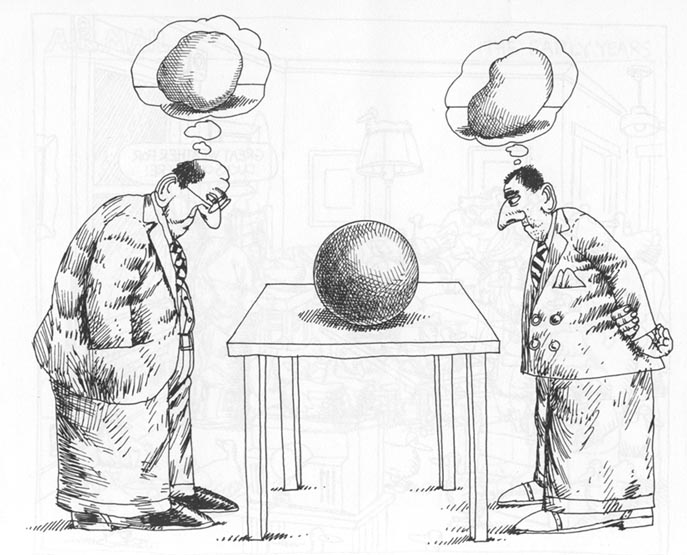
Breugel's Peasant Wedding Dance via.

"People in New York aren't that mean," my friend Chris told my friend Serge. "If you fell down on the street they wouldn't stomp on your balls or anything."

When Serge told me this I laughed so hard I couldn't think of anything else for four, maybe five minutes. If I would've been drinking milk, milk would've shot out my nose. My chest hurt. When the laughter would start to die down, I would remember that line again they wouldn't stomp on your balls or anything and the laughter would spark again, my chest heaving, leaving me gulping for air. But I can't expect you to understand why this was little story was, to me, the height of Western Humor - it was funny because Serge told it in a funny voice.

The voice was this sort of clipped, muffled version of a Hollywood imitation of a mid-century New York tough, if you can imagine that. As an accent, it was weak. As an impression, it was horrible. But as a funny voice - well, it was perfect. You just had to be there, I guess.

A lot of people say that friendship is about trust and intimacy, about confiding secret-most heartfelt feelings, about sharing passionate mutual interests, about companionship and company. For me, friendship is all about the funny voices.

-

Me and my friends have the New York Voice, the Robot Voice, the Seagull Voice, the Pretentious Artist Voice, the Pirate Rapper Voice (M.C. Pegleghook), the Werner Herzog Voice, the Australian Voice and a voice that’s just called the Voice. The Voice is deadly. A sort of mangled imitation of a British accent that, like an over-Xeroxed piece of paper, lost all of its form and definition from over-repetition until it didn't sound British at all - it just became the Voice. Two of my friends talked in the Voice for almost three weeks straight. It got so bad that they had trouble speaking normally. They didn't want to speak normally, they were content to just banter in the Voice.

-

The voices are more like games than like impressions.

Let me explain with an example: The Pretentious Artist voice goes like this. You speak in a fake German accent, elongating your vowels, accenting odd syllables your voice over-confident verbal strut. But the voice itself is only one half of the fun, it's what you say that really matters. The pretentious artist will describe a pretentious art work and then attach some hideous price-tag to it: "My new art installation, you must see it! First, I shave off all my body hair. Then I mold the hair into a giant mustache! Then - I set it on fire! It's genius! A representation of the modern soul in plaster and hair." Then, you wait a beat. "The price? ONE MILLION DOLLARS!"

It's hilarious. Believe me.

-

Because when you speak to someone in a silly voice - especially if it's a really stupid silly voice, you're trusting that they'll get it, that they're in on the joke, that they won't look at you with one cocked eyebrow and say, in an everyday voice free of willful mispronunciation or silly sentence constructions "What the hell are you talking about?" You're certain, when you're talking in a silly voice, that you are going to be allowed to goof off, to put on hold some of your seriousness. And it's damned funny. But the problem is that you have to be pretty good friends with someone to break out your Pirate Rapper Voice. You can't do it with just anyone. Because for the people who aren't in on the joke, who haven't been explained the rules of these games, some essential part of the joke is missing. All of my friends might be doubled over themselves in giggles, while people listening in - well, you just have to be there.

And because of that, there's a wonderful intimacy that comes with speaking in a silly voice. I was hanging out with a bunch of people a couple days ago, and we started speaking in funny voices. It was like a floodgate broke and I felt suddenly closer to these people, more accepted - because when you're with someone and you pinch up your vocal chords and pretend to sound like a chipmunk or something and your friend starts to laugh and then starts speaking like a chipmunk too, then you know that you are actually friends; a certain sort of friends, good enough friends to speak in a funny voice to.

-

Why don't you tell me about your silly voices?

Sunday, September 30, 2007

A Round-Up of Blogs I Like

The Daily Blog Blog
Watch as this young blogger creates a new blog a day for a year! At last count he's hit number 245 - the SausageAppreciator - and my personal favorites include the Edited Journal of Stuff I Lost In The Laundry and Guerrilla Lawn Decorator. I'm certain that you'll find your own favorites in a couple minutes. He updates each blog maybe once or twice a week, which is a pretty amazing feat, if you realize that this means he's making about 1,200 posts a month!

Supermarket Undercover
Susan N. is just one of thousands young graduates who leave college in May to become cub cashiers, working long hours for little pay in hopes of hitting it big in the highly competitive field of Supermarket Sales. Susan dishes all the dirt: how she gives out one customer a wrong amount of change and hides it; how she notices some famous cashiers showing up to work late; and of course there are the daily reports of office gossip from the break room. (Last Tuesday they had cake!) She even has some run-ins with cashier luminaries like Brad, Nancy and Faye! I'm usually not into celebrity gossip, but I've always found the high-wire world of the Supermarket really entrancing. And you will, too - when you read this blog.

I Didn't Know That You Could Eat That!
Well, now you do.

23 Squids Do!
This is one of my favorite squid websites ever! Updated by a zoologist at the Center for Cephelopod Studies in Snarksburg, Virginia, 23 Squids Do! is the official eye into the Center's famous Squid Pen. In an effort to map squid social life, researchers put 23 representatives of different squid species into a communal aquarium to figure out what happens when squid stop being polite... and start getting real. The daily updates about the squids' lives are incredibly illuminating. Everybody ends up having their favorite squid. A friend of mine likes Porky, the diminutive Piglet Squid, whose kind heart means he gets picked on by the other squids. My personal favorite is Lester, whose developing relationship with the trainer Valerie is heartwarming, to say the least. (Last week it was Valerie's birthday, and Lester remembered! He made her a hat out of kelp!) Check it out, and find more about our aquatic neighbors, the squid!

Monday, September 24, 2007

A Pick-Me-Up

A post about caffeine to read - over your morning coffee, preferably.

If you don't drink coffee, we probably don't have enough in common, me and you.

Friday, September 21, 2007

Oops... We Did It Again!


Now, I'm scared of Bush like the next liberal, but sometimes it all goes too far. Like a supervisor of mine who I overheard educating some hapless cashier - in the staccato squeal of the profoundly over-caffinated and under-informed - that she thought that September the 11th was an American version of the burning of the Reichstag. Say what you will about American education, but I don't think that a supermarket check-out line is the most appropriate place for a lecture on the history of the Second World War. And then, on Boing Boing today I saw a post about Naomi Wolf's The End of America: A Warning Letter to a Young Patriot, which has this list of ten 'warning signs' that shows oops! we're living in a fascist society. They are:

1. Invoke a terrifying internal and external enemy

2. Create a gulag

3. Develop a thug caste

4. Set up an internal surveillance system

5. Harass citizens' groups

6. Engage in arbitrary detention and release

7. Target key individuals

8. Control the press

9. Dissent equals treason

10. Suspend the rule of law


Now we, as blog-reading, well-informed, Bush-hating Americans are meant to look at this list and gasp and say to ourselves Oh no! Bush is in the middle of creating a fascist state. And then we get to sit back in our easy-chairs, feel doomed and indignant, and maybe make a tut-tut-tut sound before going back to whatever it was we were doing before we realized we were living under the iron fist of Darth Bush.

Now there are a couple things wrong with this checklist. The first is that it's pretty thin, information-wise. You could apply these ten points to the administration of that greatly beloved tyrant, Abraham Lincoln. Now, I think that the worst thing Lincoln did was to use hard Presidential power to secure his goals - it set a dangerous precedent for American dictatorship. Go through the list and ask yourself: did Lincoln do that? I think that the only thing he really didn't do was equate dissent with treason.

You've gotta remember, too that before Lincoln came around America was less a nation and more a loose confederation of states. Secession seemed a bit extreme, sure, but well within the logic of people's conception of American nationality. This was a time of unstable borders, where American expansionism drew up new territories by the decade, the term United States used to be plural (these United States), and regional and sectional differences were incredibly profound so that it might seem a different country in New York and South Carolina.

The second thing wrong is that I don't think that America could even host a fascist state. While Lincoln certainly forged a nation with a unified, if shaky national identity, I think that the monolith of our shared language, national politics, and national media hide a divided nation. The difference in culture and practice from Idaho to California to New York is so great that imposing the order and discipline of fascism over America's four (plus!) time zones would be a logistical nightmare about a billion times harder than, say, imposing universal healthcare on our unsuspecting nation. We've had a hard enough time imposing a working national education system on Americans. How the hell do we think we can impose a well-run fascist state? Try imagining the dystopic government Wolf intimates in her checklist actually being able to quash the deep stream of dissent of our American culture. The greatness of America is the same as our weakness: we're who we are, and not much can change us, and who were are is a group of contrarian, individualistic, materialistic assholes. And those don't mix well with genuine fascism.

The third thing is that the idea that the Bush administration is somehow on par with Hitler or Mussolini both diminishes the horror of true fascist regimes and elevates the efficacy of the Bush administration. The Nazis, the Soviets, the fascists - they were a organized wave of unspeakable horror and repression. The Bush administration is a bumbling enclave of kids who were bullied too much in high school and have some hard-on for hard-power. They're so incompetent that they'd be utterly laughable if, say, they were the leaders of a country the size of Turkmenistan or owned the coffee shop down the road. They might be messing a lot of things up, but the America that exists today, after six years of Bush, is not some predetermined step on the course to tyranny; it is, rather, the result of large-scale failures of leadership.

That's not to say that if the Bush administration had effectively pursued its policies, we'd be much better off. But I think that the real lesson we'll get from this administration is one of incompetence and arrogance, not malfeasance and Machiavellian politics. To paint Bush otherwise, as some sort of Darth Vader character, is to give him far too much credit.

If you like this, check out Damned Interesting's post on a failed coup set up by wealthy industrialists in the 1930s....

Paul Krugman on Healthcare

I've just finished reading Krugman's latest column and -

- HOLY SHIT! I CAN READ KRUGMAN ONLINE AGAIN! FOR FREE!

Celebration is at hand.

Sunday, September 16, 2007

A Fact About The Philosopher Ludwig Wittgenstein # 7


"No I won't! No I won't! I will never!" Wittgenstein screamed at a fashionable New Year's Eve party in Berlin, ushering in 1921. The next day found him on a train to Sweden, where he got himself a small room in a boardinghouse. For the next six months, Wittgenstein refused to speak a single word. He communicated in a series of grunts and gestures, spending his days hunched over a desk, writing furiously, tearing out his hair, ripping up pages and pages of manuscripts. Often at dinners, Wittgenstein would frustrate his fellow boarders by trying to participate in their lively conversations about Swedish politics and art - but without words. The great philosopher would get angery that nobody could understand him, often throwing plates against the wall and shaking intractable interlocutors. When summer came, he built a large bonfire in the countryside and burnt all of his past six months' of work. He wrote a postcard to his sister soon after that said, simply "Life is for reading great works. And writing them. There is nothing else."

Wittgenstein scholars have long fantasized about those lost pages. What new insights could they give to Wittgenstein's sometimes obscure oeuvre? In 1998 their questions were answered when the landlord of the Swedish boarding house was cleaning up the disused attic, and found a manila folder, with Ludwig Wittgenstein's signature on the cover, one edge half-burnt. He looked inside and found the only surviving pages of that 1921 manuscript. But Wittgenstein hadn't written a word. He'd filled the reams of paper with nothing more than thousands of drawings of differently sized squares.

Friday, September 14, 2007

Oh my love it's a funny little thing.


Photo by Flickr user Andrew Ciscel

Mornings like this one, I wake up with a sense of inevitable dread. I’m afraid that all of my hopes will float by me unfulfilled, and then, what will happen to me? Will I curl up into a little ball? Will I become one of those bitter old men who walk the streets with loneliness like lead weights? And I lay in the warmth of my sheets, and think of how my day’s going to go once I cast off the duvet and throw on clothes, and from there I think of the next day month and week, and there’s something meaningless to it all, something flat and without pay-off. I'd rather just lay in bed for another fifteen minutes and sink into the shallow-oblivion of half sleep.

And I’m not suffering from some universal existential angst here. I’m not doubting that there’s any meaning to be had from life. What I’m doubting is that there’s any meaning left for me.

At the same time as I worry this, I also think: I’m being so clichéd, every other twenty-three year old with a touch of ambition feels as hopeless as I do. It will pass, or I'll get used to it, or I'll wake up tomorrow and bam everything will be okay.

Maybe that's worse, though. That everyone feels this way.

*

I’m living in a strange city. I don’t know which bars to go to, I don't know which cafes to go to - and when I do go somewhere, I'm alone - and shy. So I read a lot. I've been watching far too much of the HBO Original Series The Wire. And don’t get me wrong – I’ve met a lot of very nice people here. But there’s something missing in the day-to-day concourse of my life. My great friends – those people who know me well enough for me to be wholly open with them, who probably like me enough to read this blog on a semi-regular basis – they’re all far away from me. I hear their voices on the phone, I send them e-mails. But after a while, those long-distance calls make my present loneliness just seem a bit starker. I can remember a time when I knew everyone, when I could feel popular and successful, where I was a senior in a small college and I knew what to do.

So I feel caught adrift on something. Placeless.

And where do I go from here? My ambition leads me somewhere. But where? I know I want to write. But there’s a whole underground economy of wannabe writers, garnishing their egos with short stories and blog posts, who have just as much ambition and just as much talent as I do. I'd like to be able to sell some Alternative Weekly my squid facts for one-hundred dollars a pop. But the things I find interesting seem to bore other people. I feel foreign to a big bulk ot people. And there are plenty of people who have found themselves friendless in a big city. There are plenty of people who wake up and get scared that the next warm summer day they step out into they'll be twenty-four and not be allowed to have fun.

You’d hope that your dread, your angst, your deepest fears, weren’t so goddamned normal that they were terribly clichéd. I wish I could be feeling something horribly shocking and new. I want groundbreaking angst.

But at the same time as I dismiss this, it's there, and it's real, and it's hard to shake it. I wake up and don't have joy, only hunger. I work and what I do is desperate - like a person at the beach trying to scratch their name in the sand quickly before the next wave comes to wash it all away.

I want to run away to a new life. One where I can go into a cafe and everyone says hi and wants to talk about books. One where I can go read my short stories out loud at open mic nights. One where I can call my friends - and see them, in flesh, in real life - and talk with them in silly voices. And the hard part is that the life I imagine seems about as possible as me making friends with Mark Twain; which I want to do, by the way.

Thursday, September 13, 2007

Dispossession - A Draft


I began this essay a week or two ago. As it grew longer, I found it harder and harder to strain sense out of my sentences. I would write in furious bursts, in great metaphors, and then look over what I wrote to edit, and while I'd cut some sentences and re-write others, I found myself unable to come closer to any sort of
point. My reasoning suddenly seemed cumbersome, my arguments stale when I thought them fresh, the ideas confused, when I thought them clear.

That being said, I think I'm onto something here. And while I'll be setting aside this topic for a while, I'm going to post this stump of an essay for you readers. Treat it as what it is: something raw, a bit of a beginning, a bit of a curiosity.

If you think I'm onto something, by all means - tell me. I'd like to know what it is.

*

This generation faces an uncharted wilderness of the mind. New technology has afforded us a terrible opportunity: the spoils may be rich, but the failures desperate. Will we be representatives of some new golden age? or citizens of a broken Diaspora?

All that’s certain is that we are a people without maps. We are lost. We have nowhere to go. We will find our way - but only in time.

*

It’s a tired fact, but true, that the same wealth of opportunity that makes our lives easier –cel phones, the internet, our relative ease – can make our lives feel impoverished. We have all wasted nights and days buffeted from website to website like a piece of trash caught in the wind until we notice that it’s three in the morning and our eyes hurt; we have all searched in the desert of cable TV for some El Dorado of satisfaction and in vain; we have all found our attention scattered between the conversation on the cel phone, the five open tabs on our internet browser, and the actual physical world that sits a couple feet in front of our computer screens. We have wealth, sure, and wealth which would have been unimaginable to our forbearers. But we find ourselves overwhelmed. We hide in our beds and never want to get up. We go to the gym. We feel stranded in a desert of the soul. We don’t know how to be the people we think we need to be.

Our wealth is hollow. It doesn’t give us happiness. That truth is an empty one, a sign that doesn’t point anywhere. But we don’t know what will make us happy. And so we continue deeper into the desert.

*

Our patience runs short. In a couple clicks we can land on another argument, another game, another song; so we have trouble devoting our attentions to any single thing. This is not a bad thing, within reason. In a way it makes us informational omnivores, with wide interests. Look at the epicurean vitality of websites like BoingBoing.net, modern day wonder-closets, collections of curiosities for the truly curious. But there is a point when this distraction, rather than feeding our creativity, shatters our attention, cracking the surface of our deeper thought. The people who do not learn to channel this distraction will find themselves living in an archipelago made up of tiny flat islands of understanding, surrounded by a dark unnavigable sea.

Plus it’s addicting. There is something immediately satisfying about the internet, but this makes it dangerous, because it’s so easy to access that satisfaction and much of it is hollow. We can foster the illusion that if we go to the next page of porn, something deeply rewarding will happen to us. That if we gain another level on WoW, we will possess some greater meaning to our lives. But when we are done, we find ourselves none the richer, just a little bit more tired, more distracted, sinking deeper into our computer screens.

*

In Japan there are young men called hikikomori . These young men hole themselves up in their rooms and don’t ever come out. The struggle of the outside world has become too much for them, perhaps, and so they creep back to the comfort of depression, of mediated experience. Filling their lives with comic books, computer games, and magazines, they are safe. And the are safe even if they cannot escape the familiar prison of their rooms nor their dramas the plotted fantasies of books and TVs. They can experience, but it will not hurt. They will feel, but they will not give up their control. They do not try – but neither do they fail. How do they get like this?

*

We spend our lives listening to songs other people sing, watching TV shows dealing with people we will have no commerce with, and reading stories that take place in far-away places we can neither effect nor change. We tend, as a generation, to critique more than we create, to watch more than we do. And this means that we suffer from an overactive critical sense, but an active life that is benumbed and abstract. What’s the big deal, though? The big deal is that we live a life surrounded by artificial lives, that no longer reflect the real struggles people tend to go through.

TV’s a great comfort. But while TV can comfort, more often than not it just numbs, putting our problems on hold by pausing our life. It makes our life a little bit more lonely. First, TV is too easy a comfort. We can press a single button, turn on the TV, and be safe. It’s far easier than, say, going to a café and trying to talk with someone you don’t know. But most friendships, most of the rewarding things in life, require us to put ourselves out there in some way, run a risk of looking stupid. We might be too shy, and stay at home watching TV.

The temptation to loose ourselves in this fantasy land are really great. Especially since, the more we slip into this comforting box of stories, the more impossible it seems to get back out. Because TV, in its non-stop interest, spins tales of people who are well-adjusted, active, funny, and engaging. If you’ve been sitting at home for the past month or two, ekeing out a life on the edges of society, then you can’t relate to the people you see on TV. You can’t relate to Ross and Monica, Rachel and Chandler. But the problem is – they’re become your good friends. That’s how you think people are meant to act like. And even though we all know that TV is fake, we lack the stories of people who are messed up, lazy, conflicted – television’s inability to communicate stories about loneliness and ennui trap some of us into a deeper cycle of loneliness and ennui, where we fail to recognize the sensibility of our problem.

*

OK – I’m going to outline this point:
Loneiness can be soothed with TV
But it makes you more lonely
- why? Because you don’t do anything with other people, it is easy to watch it (the initial costs are low)
the illusion of TV: it makes a world in which people do a lot
- but also, because of the temporal shortening (all the boring stuff is necessarily edited out to fit in the thirty to sixty minute window of time we have) we see no boredom
-- so we can escape into a world in which everything happens, but not to us. We think that we shouldn’t be bored.
The utter inability of TV to communicate a struggle against meaninglessness and eunnui in a meaningful way leads to us trapped in a cycle of meaninglessness and ennui because we fail to see that the problem actually exists.

The second problem is that TV spins an illusory world in which people are well-adjusted and active. Most of the human beings I meet are not like the people on TV. But the active, healthy people on TV are bad role models for the ranks of unhappy, broken people who find their solace and comfort of the television. A person might come home from a life alienated and unsatisfying, and watch an episode of the sit-com Friends. Let’s say they watch an hour of it a day. But that life on the screen is so very different . People on TV have friends, and they see their friends, and they work, and they are necessarily unbothered by the crippling existential angst that might lead a young person to withdraw from the world and watch the pleasant stories of people who do not withdraw from the world. We, who as a nation consume, consume stories about people who are far more active than anybody we ever see in our real flesh-and blood existences.

Where are the miscreants? The insomniacs? The alcoholics? The people in credit card debt? The idiots who hate their friends? Who have no friends? The compulsive masturbators? The guys who lie to get pretty girls in bed? The pretentious? The lonely? – we are all lonely. The people so bored they don’t know what to do? These marginal stories are now surrounded by a constant drone of normalcy. An exceptional normalcy – a life of event, carefully poltted and portioned in half an hour to hour dollops.

Sunday, September 9, 2007

A Fact About Our Nautical Friend, The Squid # 2


There arose a peculiar belief about squids among seafarers, that touching a squid would cause severe, almost instantaneous baldness. I've found evidence for this belief in English, Portuguese and Spanish writings (the French are curiously silent, but that might just be a shortcoming of my research). The belief even led to the popular (if mystifying) nautical exclamation: "He's so bald he must've shaken hands with a squid!"

Here's a section of the diary of Robert Snarksman, an officer of the Royal Navy who served from 1798-1820:

We were out afishing in the earlie day when we caught a monstre: a squid, aboute the size of a large dogge; we tried to fling it back overboard, but in the fighte a tentacle touched poore Pipkin, and he woke next morn his pate wholly bald.

This belief has also inspired the sea shanties, Squidtop, and She Served Him Squid For Dinner.

In the journals of Lorenzo Snarkaretti, an Italian explorer who visited China in the middle of the eighteenth century, we find evidence for how far this belief spread:

The Chinese, in their brothels, will have numerous squid living in their baths, as if the baths indeed were large aquariums. The women, when they bathe in these, will be approached and often fondled by the creatures and their many tentacles. This practice renders the women entirely hairless, which is the preference of the Chinese nobleman. The women wear the most elaborate wigs, which are sewn from the hair of peasant women by armies of slaves. The wigs can often be worth more than whole households, and tower over the diminutive women! Though we have never seen these baths, them being in the women's quarters and viewable only by concubines and eunuchs, they are so widely reported, they must not be doubted to exist.

My state of mind:

I've checked my mailbox three or four times today.

It's Sunday.

Friday, August 31, 2007

A Fact About Our Nautical Friend, The Squid


Squid are very good at smalltalk!

Researchers at the Society for Nautical Research in Kempsy, Ireland have taught a select group of squid to communicate using an innovative system of symbols. The squid are given a large waterproof boards with over 100 pictures on them, representing everything from simple nouns like 'fish' to a symbol that denotes that the squid is asking a question. The squid touch the various symbols with their tentacles to communicate, often forming complex sentences. After months of painstaking training, three special squid have become quite adept at the system, and repeatedly ask their trainers how their days have been going and whether they can have more fish. The squid have proved adept at smalltalk, engaging trainers on long, pointless conversations about the weather and what was on TV last night.

Wednesday, August 29, 2007

An Antaomy of a Crush


I remember giggling myself near half-to-death when I saw a singer at some 16th Century Italian choral concert whine in a perfect castrati squeal that when his Love looked at him sweet arrows pierced his bleeding heart. It was just so mawkish a sentiment, so utterly unapologetic about its creepiness, and so perfect in summing up what it feels like to have a crush that I couldn't help to blush. Because I had been there before - sugary arrows of love and everything.

For me having a crush is an exercise in various kinds of agony. When I like a girl I can't speak, look at her, walk near her, or exhibit any of the signs biologists use to determine life for fear of embarrassing myself whenever I'm around her. Then, after I bumble my way through a conversation or two with her about, say, cartoon characters or giant squid and the crush deepens, I will realize that I spend a sizable chunk of my day - from one to three hours, I'd guess - rehearsing what I will say to her and thinking about how cute her cheeks are. And then after I do talk to her all I can do is wonder whether she likes me or not, whether, when she laughs and touches my shoulder - does that mean that she likes me? that she, perhaps, might have a crush on me, too?

But the worst happens when the relationship moves - as it inevitably does - to its penultimate stage of casual e-mail flirting. This is the stage in courtship where you've been out on a date or two - you might have even kissed - and are slowly sorting out the second or third or fourth date through a salvo of e-mails. By this point I'm reduced to an awkward lump of nervousness, checking my e-mail once every five minutes or so to see whether she's responded. When she does respond it feels like I've just been given a bag full of candy and straightaway I will write and re-write my response until it's a little polished jewel of wonderfulness that, as I'm about to hit send, I know will charm her completely and then she'll call me instantly and we will rush into each others; arms and make out a lot. Then, after I hit send I realize I just sounded creepy or accidentally propositioned her. And I hope like hell she doesn't realize how nerdy I am.

Of course, there are rules to these e-mails. One must let a respectable amount of time pass between when you get a response and when you yourself respond. It must not be too much longer - or too much shorter - than your interlocutor's last e-mail. But above all these e-mails must spin the illusion that you do not, in fact, have a crush on this person; that your heart doesn't make 16th-century Italian noises whenever you get a new message from her; that you haven't imagined what it would be like if you kissed her right now.

I don't need to say that whatever initial charm I could throw out into the relationship is scuttled around this point in the process.


I tell my friends that I hate crushes. That I don't have time for them, that I'm not in a romantic mood right now, that I don't know anyone who I could have a crush on. But the truth is that I love crushes. It's like O become a secret agent: I have an agenda hidden to all but myself, except rather than kill someone I want to give them hugs and tell them how they're cuter than most common varieties of bunnies.

And I think maybe the deeper satisfaction of a crush is that it gives you something to do, a thing of beauty to mull over, and some hope to look forward to. Your days, while being as formless and generally pointless as ever, will sometimes surge with a sense of purpose and joy. However flimsy, however delusional that joy actually is. Because the girl sent you an e-mail or waved at you.

But there is a real beauty of a crush that I tend to overlook, in favor of the sheer craziness of it: you get to care for someone. And care, love, kindness - no matter what word you use - is one of the most beautiful things I can think. When I have a crush on someone, if they called me up at four in the morning waking me from beautiful dreams about hanging out with Mark Twain to ask me nonchalantly if I could make it over to their place to eat ice cream I would act like it was completely and utterly cool and not in the least bit inconvenient and I'll be over there as soon as I can. This is not the sort of care that I hold for most of the people in my life. If it were anyone else I would yell at them and tell them to call in the morning are they smoking crack or something. But with the crush, I have this almost unfathomable spring of care for them, and that care is fresh, and amazing for its even being there.

Even if it is about as creepy as saying that you have arrows of love stuck in your bleeding heart.

Sunday, August 26, 2007

Growing Up

Before I had my first kiss, before I got drunk at my first party, before I’d ever made a meal from scratch or paid a bill or got a haircut I liked; when I was an awkward young boy who mostly just thought about the eruptions of pimples on his face and fostered a guilty suspicion that somehow I was different from everyone else, that I was weird, and I believed that this unspeakable weirdness irrevocably quarantined me from peers – back when I was twelve or thirteen and was slowly becoming me: I listened to Leonard Cohen and read Milan Kundera, artists who I only realize now were my initiation into the mysteries of adult life. I would memorize their stories of doomed love affairs and baffle myself at their philosophies. In childhood I had been able to parcel out the world into neat packages. There were the good guys and the bad guys, and the stories were simple, whole, and sweet. It would be underestimating Cohen and Kundera’s influence on me to say that it was from them that I realized how compromised and complicated the world really was; they did so much more, they introduced me to the visceral sort of human struggle I would spend the next ten years or so trying to come to terms with. In their stories people hurt each other not because they were evil, but because that’s what people did. Life hurt. And I was stunned by that realization.

I had only started to get the first aches of crushes: daydreaming about taking girls I’d barely spoken with on dates and kissing them and having sex (this fantasy all the more passionate for how unclear sex actually was to me) and I could already see that something was growing in me that I couldn’t contain or satisfy. I couldn’t stop thinking about girls. And I could get any girls. That middle ground of sexual frustration was, to me, an uncharted span on the map of life. I had read nothing about it, seen no movies about it, everyone on TV looked so assured and witty when they talked about love. I must be different, broken, wrong.

And then I started listening to Leonard Cohen. Cohen knew where it was at. Just look at these two stanzas from the song Take This Longing:

Your body like a searchlight
my poverty revealed,
I would like to try your charity
until you cry, "Now you must try my greed."
And everything depends upon
how near you sleep to me

Just take this longing from my tongue
all the lonely things my hands have done.
Let me see your beauty broken down
like you would do for one your love.


These words meant nothing to me at the time, but I could intimate that they were important. There was a clue to my frustration in the puzzle of Cohen’s love affairs. I knew that when I could understand them and feel a connection to them, then I would have somehow broken out of my childhood, although I couldn’t express it like this at the time – I just, to be fair, pretended to know what Cohen was on about, and left it at that. So I listened to the album over and over until I had memorized every line, every image. I can sing along to the whole thing, even today.

And underneath all this emotional longing, there lurked beneath Cohen the figure of the messianic prophet. That there was, beneath the texture of loss and love, a deeper love, a religiosity that as a purely secular young whelp I could only indulge in by not admitting what I was doing, by singing along, but not listening to the words that I sang.

Milan Kundera brought me into the same world of sex and mysticism, but he spoke in a learned lilt that I recognized immediately as a style, as cool. His stories were chock full of that same heady and opaque burble of sex and infidelity; but he also built his stories around people philosophizing, trying to crack the veneer of life to find some meaningful core. His characters, for all their emotional backstabbing, were not just petty players in an afternoon soap opera. I mean, they were that – but they also moved around a world of ideas. And while I was shocked by the ideas themselves, I was more shocked by the idea that you could think vigorously about how to live your life. That you could have ideas. I knew then that I would unlock that door to adulthood and the frustration, the confusion, and the compromise would be illuminated by something richer, something I could not have before expected: art.

Maybe a year or two after I first discovered Cohen and Kundera, after buying more albums and more books, I started writing myself. And looking back at my early attempts at fiction and poetry, while of course I feel the requisite embarrassment at everything you’re meant to be embarrassed about: the clumsy technique, the self-importance, the mawkish melodrama; I am more struck by how back when I somehow decided that I wanted to writ, I was speaking with a voice that I had cadged from Kundera and Cohen. In some ways, those early attempts at stories outshine a lot of the work that I did when, dizzied by drugs and adolescence, I fell in love with my own sonorous voice; or even worse – the stuff that I wrote in College that tried to tackle the Big Ideas which turned out as bad as you could expect. Those attempts at fiction failed because their intentions were impure. I wanted to write them to show how good a writer I was, to show how much intelligence I could bash against my emotional problems. My early work – and the work of Cohen and Kundera who inspired it – seem to me something purer, inspired by the love of the story, by the love of art.

I’m thinking about this now because a couple of weeks ago I stumbled on The Unbearable Lightness of Being in the library and picked it up. A week after that I was trolling through a friend’s music and picked up the first Leonard Cohen album I ever had. So there I was, here I am, reunited with the works that started it all. And it feels odd to look over my shoulder and see me ten years ago listening to the same music, reading the same books, and to feel a continuity, and a growth.

I iz in ur newspapers of nashunal rekkord, harbriningin teh apockallps

Yes friends, we have yet another irrefutable sign that the rapture is at hand!

LOLcats in the WSJ.

Glory glory soon to be! I will be lifted on high to meet my maker! And the sinners, all of you horrible people who refuse to read my blog, you shall be cast down into Hades. The end times are most definitely these times.

Thursday, August 23, 2007

Sunday, August 19, 2007

Thoughts On Art And The Body


Another comic by Bill Kliban.

Here’s my question: do we forget ourselves when we’re moved by art?

A deeper question that motivates this is: what the hell is the nature of that artistic experience? Is there a single sort of ‘artistic experience’ that can cover the appreciation of all the arts, from dancing to poetry? Or are they all member of a broader class of experience? Or are they simply all called ‘art’ because of some linguistic misnomer, the same way whales were once thought of as fish? But we’re not going to get into that larger question right now.

I was thinking about this all last night at a mellow rock concert. All us kids were mustered around the stage, ignoring anything else that wasn’t held in the yellow and red gel-lights that flooded the small stage. Now, what I was thinking was that when we are moved by art, when we stare at the woman playing keyboard singing her heart out on the stage, we forget ourselves. We stop thinking of our own individual fabric of memory, thought, and body, and are somehow dissolved into something else – namely the artistic experience.


In Kant’s Third Critique I think we see a bit of this. Kant thought that all aesthetic judgments were universal, at least ideally; and that when we viewed art we did so disinterestedly – that is, ignoring the bias of personality. So when I look at a given work of art and call it trash, I don’t mean “Me, Brendan Mackie, who had a bad day today and is a white male in 2007 America, think that this work of art is a piece of trash” I mean “This piece of art is a piece of trash for everyone at any point in time” and implicitly “any dissenting opinion is a result of a failure of judgment or taste”. The disinterested viewer, the ideal viewer, will have the same reaction to a piece of art no matter who they are. It is up to the viewer of the art to get into the space in which they can filter out all the inessential quirks of their personal experience to experience something artistic that is somehow common to all people. (If anyone out there knows Kant better than me, and thinks that I’m butchering the Third Critique here, feel free to drop a comment about it – I haven’t read the damned thing in two years or so.)

But there’s something really unsatisfying about Kant’s view – especially my canned version of Kant’s viewed. Some of the pieces of art I love the most appeal to me not just because of their intrinsic universal value of the me as art objects but because of some personal value I can’t expect other people to share. I like Mirah, for instance, because I listened to her with a really good friend – and also, of course, because I think Mirah makes good music. Even if we partitioned off the personal pleasures of a given piece of art from the non-personal: thereby saying that the pleasure I get from my association of listening to Mirah is not an actual aesthetic pleasure, but more an aesthetic epiphenomena, limiting the aesthetic feeling to only those things that can be expected to be universal; that doesn’t solve the problem of cultural taste. We do not even need to look far beyond our own houses to see the tyranny of culture. My father, for instance, an open-minded and tasteful individual, cannot, for the life of him, understand much rap. But I can. Because I have been inculcated into how to listen to rap. Siilarly, I can’t understand modern dance to save my life and think that every piece of modern dance is a pile of pretentious poo. And while I might very well be right in thinking that, I’m open to the fact that I might not be able to appreciate good modern dance. To read a piece of art requires an understanding of a cultural grammar that we cannot expect to be universal. So we can’t expect our appreciation of art to be universal.

But we can ask a Kantian question and constrain it, and maybe then we come up with something worthwhile: if, without personal association and with the required cultural literacy, is there an essential universal quality to art?

Okay. So that’s just the set-up for my insight. I was wondering, as I watched all these people nodding along to the music last night, that we somehow forget our bodies when we are in the throes of the aesthetic experience. That we lose ourselves, our partictularness, in favor of a deeper, more universal connection to art.

Now I don’t know whether that’s an accurate description of what happens to us when we look at art, but I think that it points to the borders of the aesthetic experience. We have to be really careful when we’re talking about how people respond to art. There’s been an awful lot of ink and hot air thrown about what happens when a person looks at a painting or something and scratches their chin and calls it beautiful. I’d say that the only thing that the aestheticians can agree on is that the aesthetic experience is important. For some reason. Though I’ll be damned if anyone can agree why art is important.

So while I thought about this question, I kept on running into different questions that branched off that.

1) Can you experience art if you are a member of a marginalized minority group?

So much of English majordom is so obsessed by this question, and by the little questions that pop up around it – and I am frankly sick to death of it, and don’t think it leads us down any insightful avenues. So I will ignore it for now.

2) What about when you’re sick, or hungry, or tired – then can you have the aesthetic experience? And is it then diminished somehow?

3) And what about when you’re in a bad mood?

4) Is there are ‘right’ aesthetic experience to a given work? And a wrong one? If I say that Rhapsody in Blue makes we feel jaunty, and everyone else says it makes them feel profound – is my aesthetic experience wrong? Can you have a wrong aesthetic experience? What about an ignorant person who misread Huck Finn and thought that it was genuinely racist? What then?

5) Can we even adequately communicate the aesthetic experience? Or is it somehow beyond the grasp of our words? And if it is beyond the measurement of language – does it exist? I think of Wittgenstein, who argues that there can be no such thing as a private language, that there can be no such thind as words that refer only to individual things in our individual heads; and then I think of Einstein who said “Not everything that matters can be measured”.

6) Is the aesthetic experience even important at all?
Now, I have no answers to any of these questions. But if any of you out there have any – give them to me, I’d be interested to hear.

Monday, August 13, 2007

The Bus As Civic Space

I believe that Americans don't talk enough to one another. We don't discuss politics with people we disagree with, we don't mingle with people beyond our rather narrow habitual territories, we don't explore enough of the cities that we live in. We live in secluded villages of the mind, only rarely stumbling into the haunts of our neighbors. And this is okay. Faced with the overwhelming hubub of modern life, we can do no better than to fracture the civic mirror and pick and choose what picture we look at. But it would be nice to have a shared civic space in the American city - and I don't mean 'space' in the English major way here, no; I mean a real-life physical space. We have television, sure, but we only watch television - few of us actually contribute to it.

But wow, my belief in communicating with people who disagree with me sure got tested this morning. My seat-mate on the bus was reading a book, and I thought I would be nice and friendly and ask her what it was. She was a little hesitant, and actually turned the cover a bit away from me so I couldn't peer over and read the title. After a moment of two of squirming, she asked:

"Are you a liberal?"

Rather than saying yes, or that I was a progressive, or that I have a set of complicated political views that I don't feel can be summed up in a label like 'liberal' or 'conservative' I just said "I don't know." Which surprised my seat-mate, an overweight blond woman who was slurping gas-station coffee.

The book turned out to be Bill O'Reily's Culture Warrior. When she told me this I tensed for a fight, but told myself - well, okay, I should actually listen to her to see if I learn anything. She told me that O'Reily was the only person who really was brave enough to take on the real issues. And that Fox News was the only news station that had the courage enough to deal with unpopular subject. I was sitting there, thinking of all the funny things I could say to her, thinking of how sad it was that she had taken a drink of the Fox News Kool-Aid, and thinking that it is exactly this sort of ignorance that is the problem with America these days.

I told her that I thought O'Reily a great bully, and that he was leading to an era of divisiveness in America, which led to a lack of people who disagreed with one another - like me and her - from talking to each other. But I don't need to tell you what I said. You already know all the wonderful arguments I leveled against her.

But here's the thing: when I left the bus we both remained unconvinced. I had her promise that she would watch some Keith Olberman, and I promised I would track down a Bill O'Reily book and give it a chance. But the point of this - the insight I came away with - is that it's incredibly hard to talk with someone if they're working from a different set of assumptions farmed from a different universe of information. And that's the huge problem with Fox News in particular, that in its hectoring blaring echo-chamber of 9-11 doom, it distorts not only national discourse - but people's entire universe of understanding - so much that it becomes increasingly impossible to talk across that chasm.

But as soon as I write this, I think: so what? Is there really all that big a gap right now between Americans? Are we at a special juncture in our nation's history at which we are seeing a sundering of the national discourse, or did we ever have a monolithic discourse to begin with? Am I just teary-eyed and nostalgic for a myth, a myth of America where two people on the bus can talk to each other?

The trouble with Fox News isn't just that the most popular television news network in America spreads sensationalist propaganda when it doesn't make outright lies - but it's that by misinforming people to so great a degree, it makes it so that meaningful argument in which both sides can change their mind incredibly difficult, if not in some instances impossible. If, when she thinks of liberals, she thinks about latte-swilling Ragnorocks of bothersomeness, and I think of happy caring people, swilling lattes, there is little common ground for debate left. And that's a serious problem, a moral problem, one that will impress itself upon this country in the coming years.

Saturday, August 11, 2007

OMG You Have No Life

LolThompson by me.


PREMISES:

1) Politics is boring. Especially Presidential politics.

2) Iowa is boring. And there's nothing wrong in saying that: I lived there for four years and I can't remember doing anything at all. I'm serious.

3) I have as much chance to secure the Republican nomination as Fred Thompson does. I will hereafter refer to Thompson as Admiral Jowls. Because that name fits him far better than Fred Thompson.

THEREFOR,

Should someone go to the Iowa Straw Poll, in support of Admiral Jowls, and say:

“This is our Super Bowl,”


then that person is boring they have no life. I don't think that they should be talking with the media about their chosen candidate, because people will think that the candidate is as boring as they are. Especially if that candidate, like Admiral Jowls, is not even an actual candidate yet. And Mr. Garcia [who is the person quoted in the Times], you are so fucking boring that it actually hurts, and while I have never met you, I hereby issue a public apology to all of your friends, relatives, colleges and acquaintances who have had to sit through all your tectonic boredom all these years because they have suffered from a great national tragedy; namely, Mr. Garcia being a boring loser. Guys, seriously, start a support group. I know I'd join.

Friday, August 10, 2007

Following Your Dreams Through Editing

This afternoon I was working on a squib that I found especially cumbersome. Every sentence I wrote was wrong standing around in the wrong place, like a drunk frat boy trying to fraternize in a solemn church. The piece didn't have a thesis - but that hasn't really stopped me before, as kind readers of this blog will know. The problem was that I kept on rereading what I had written, rehashing it, refocusing it, twisting each paragraph into something new, something that would fit, and nothing seemed to fit; after a while, I couldn't even think of what I was trying to fit it into.

But after several hours of tweaking, I think I've gotten something that, while I can't be proud of it, I at least can show it to other human beings.

Later this afternoon, following the habit of Mr. Sam Clemens, I took a notebook into bed with me and, struggling against the heat, scribbled a couple pages of a short story I've been working on about a guy who finds a Diabolical Machine in his apartment building. Now, what struck me was that I just wrote, knowing that later I would come back and pare back what was extraneous, tighten the limp descriptions, polish the rough edges until they shone. But I was scared, actually - thinking this too languorous, too lazy.

Now, the difference between these two acts of writing is that for non-fiction writing, you have a thesis to argue, while with fiction, your point's more blunt. In writing non-fiction, I can edit while I'm writing because I know, before I'm finished, the general point I want to make, and I can tailor each sentence and each paragraph to lead up to that point. But in fiction, I can get no clear sense of what I'm trying to do until the entire sprawling mess is in front of me. And even then it's pretty hard.

But I felt a deeper fear. A fear of the edit. Imagine a lifetime of editing, a lifetime of work spent trying to get every word right, to sharpen my thoughts until they could cut. Now, this isn't too dire - if you understand from the outset that, given the sweat and the ink and the tweak you can come up with some sentences that have some bite to them; but if you're like me, a poor little slob with a couple blogs, some writerly airs, and an internship; you have no such guarantee. Think of how exciting, how wonderful, editing would be if you knew that the words you were editing would stand for a year or ten; and think of how disappointing, how dull, how self-conceited it would be to edit and think that those words would stand for no-one, no matter how sharp they were?

Wednesday, August 8, 2007

A Slacker Victory!


According to the New York Post, the Times has decided to say goodbye to its TimesSelect Service, which puts favorite columnists like Paul Krugman and Frank Rich behind a paywall. All I can say - and this certainly speaks to the sort of life I lead - is that this will actually raise my quality of life by a couple notches.

Tuesday, August 7, 2007

Teddy Roosevelt. He's awesome.

Image from LolPresidents.

Mental Floss has a run-down of the top ten reasons why Teddy Roosevelt is the most awesomest American President EVAR. And I agree. Roosevelt was brash, arrogant, and pretty politically incorrect - but he was also desperately charming. He basically invented the Teddy Bear. By which I mean it was named after him. Anyway.

Back when T.R. was campaigning for President as a member of the Bull Moose Party in 1912, he gave a speech in Milwaukee and a would-be assassin shot the former President square in his broad, moose-like chest. Roosevelt examined the wound and said to the crowd: "I don't know whether you fully understand that I have just been shot; but it takes more than that to kill a Bull Moose." and then spoke for ninety minutes more before going to see a doctor. Now if that isn't intestinal fortitude, I don't know what is. If I had been shot - if I had even heard a loud bang - if I, god forbid, ever mounted a stage to give a speech - I would wet my pants with nervousness. And T.R., well. He just kept on going. Which is just one of many reasons why T.R., I think, is the coolest President. Or the President I would most likely want as a friend.

Who's your dream-Pres-best-friend?

Monday, August 6, 2007

A New Job! A New You!

So I've started a new job, and it's so damned strange: I'm just terribly worried that I might somehow break some invisible taboo that will leave everybody angry with me. Like I will make a pot of coffee and it will overflow. Or I will say something terribly uncool and obvious in the middle of a staff meeting and everybody will recognize me as a huge faker.

Of course, I feel this pounding background urge to have everybody like me. And it's really not at all possible to be charming and entertaining when I'm about as helpless as a newborn kitten who doesn't know how to read the damned bus schedule yet.

Interruptions and Connections

I landed in the Twin Cities sometime yesterday morning. My memory of the whole day has not yet congealed into a narrative, and I'm left with what is more of a series of images, barely connected to one another. Here I am in the airport, gathering my heavy bags. And then I am taking a taxi, making awkward conversation with my friendly taxi driver. Then I am in my new and temporary home, getting settled as best I can. And then, in an odd, very nostalgic turn of events, I went down to a reunion for my recent Alma Mater. And now, today, I am at work. But these scenes do not yet fall into any sort of reasonable story for me. They are little more than tiny little vignettes of a life, that might add to a full story given enough time, but right now are surrounded by so much blank white space.

Of course, the vast bulk of my time has been spent trying to get over the technical hurdles of living here: finding myself stranded in some strange-looking part of the city, for instance, having to bushwhack my way across four-lane traffic to try to find my house; or, simply, sitting on the bus and getting the anxious suspicion that I'm actually on the wrong bus and thinking, for the entire ride, that I should get off and turn around - then realizing that I am actually on the right bus after all. I almost feel like I can't speak English.

Here are some quick things that I am surprised about:

1) How the hell did my room get this messy in little more than 24 hours?
2) How nervous I am that I will just get completely lost in some deserted suburb and I will have to walk twenty miles back home - or worse, call one of my roommates and try to get a ride back home.
3) I can get so damned tired.

I have this deep and very basic urge to be somewhere safe and familiar - but the joy and the crappiness of being an ambitious twenty-three year old is that there are few places left that are safe and familiar. The world, as they say, is my oyster, ripe for the picking, waiting for me with open arms and all that! But first thing's first: I need to figure out the damned bus schedule.

Saturday, August 4, 2007

In A Nutshell, The Modern World

So here it is, folks, the high point of our Western Civilization, the apex of human achievement, when we Americans walk up to the metaphysical bank teller to cash our collective check of freedom we get this, and nothing more and nothing less:

I am sitting in the Palm Beach Airport, listening to Feist on my lovely new computer, using the free wifi to check up on the Top Chef wikipedia website. I am chatting with my friends on GChat, about to haul my slightly tanned Brendan-body into an airplane. This, my loyal readers, this is true freedom. All that I need now is a hotdog with bacon bits sprinkled on it. And you know what, I could get one, if I wanted.

You see, I've been camping out in my grandmother's condo for the past couple days, getting fat on mediocre restaurant food, watching cable TV and failing to check my e-mail. A week without e-mail! It's like a week, I dunno, without breathing, or without carbonated beverages! And now that I'm again plunged into the sea of internet connectivity, I am amazed by how simple and yet how essential this confusion of information has become to my daily life.

But you know that already. What's really interesting is that dark province that I ventured into over the last week, the one where we can't find the latest YouTube video of, well, some high cultural achievement, nor can we send our friends messages about how awesome the new Bourne movie will be. In this far-away suburb of the American experience, there is no GMail, there are no blogs, there's just cable TV. So. Let's do a quick recap of what I learned on my weeklong break in Florida:

1) I like the show Top Chef far more than I really should. The basic premise is that it's a reality show, with chefs. And the last episode was so emotional, damn. This chef called Joey got eliminated and it wasn't really his fault, not exactly. But when he found out he started bawling, his face red, these big fat true tears streaming down his cheeks and I just choked up there with him, because he was talking about how everybody said that he could never do anything and here he was, on Top Chef - and of course, he didn't deserve to be eliminated! not at all! Sara so should have been tossed right out on here lazy-bad-cheffing tchuckus. But there is no justice, especially not on Basic Cable.

2) I also like cartoons. Still. Now and forever.

3) And naps.

But now I'm back! So keep on looking out for the posts.

Monday, July 23, 2007

The Course Of Empire

The scene bannered across the top of this blog is a cropped version of Destruction, the forth painting from Thomas Cole's Course Of Empire series. Cole's painting is given a nice shout-out in today's Times. Which is nice. The paintings trace the evolution of an empire from comfortable savage indolence to a pretentious Greek-columned apex which - of course - gets flooded by looting barbarians reducing the proud empire to attractive archaeological ruins.

It seems Americans don't really like to admit our empire exists, far from showing any sort of pride about it. Maybe it's because we're a lazy, freedom-loving people and empire, well, empire gets in the way of all of our nice things. But when the truth of our empire peeks its ugly little head up and we see it, we get really nervous. We know it will fall. So we are at once really nervous about it, and can't stop looking, can't stop wondering what will happen when the congress falls, when the states finally sunder.

Chocolate-Eating Surrender Monkeys!

According to Serious Eats, police in Fribourg, Switzerland, were doing a routine traffic stop and safe drivers, get this, were rewarded with bars of chocolate.

This makes me feel a little bit less proud to be an American. How many billions of dollars have we wasted on the Iraq War; subsidies to big-pharma, big-oil, and big-anything; and the NEA? And I haven't - never in my entire life of twenty-three years - been ever handed a chocolate bar from a policeman. We're missing out!

Friday, July 20, 2007

Word of the Moment?

Festoon.

As in: I got so festooned last night, when I woke up, my liver ached something righteous.

On The Decline Of Western Civilization And Why It's Not Actually All That Bad

I was in the kid’s section of the bookstore a couple days ago with a girl, and as she showed me her old favorite books – Bread and Jam For Frances being, I think, her most-super favorite, although by the time we left she’d pointed out a veritable stack of favorites – my mind kept on touching on the magic of reading. Now, before you get disgusted and go do more important things on the internet, I’d like to make it clear that I’m not going to be some namby-pamby pretentious defender of reading: one of my friends here in Boulder works at the local Borders, and told me that “One of my co-workers is really cool, forty, has read everything – and he compares working at Borders with the priesthood.” Yeah. That’s not going to be me. The only thing that the priesthood and Border’s books has in common is (insert funny joke here).

There is, despite all the pretensions, a definite magic to reading. And it starts when we’re young. There is something primal, basic, and invigorating about stories. We shape our lives through the stories we tell about ourselves, and I don’t think it would be overreaching to say that when we, as little snuggly balls of children, demand to be read a story for the umpteenth-billion time, we’re really in part learning how to tell stories about ourselves, make ourselves up.

But once we start to read for ourselves, the magic really fleshes itself out. In the intense privacy of reading – in which we are alone with only our book and our thoughts - we are able to try on new stories, stories that we’d never be able to try on with our parents around. When we read those first young adult books, the ones with impotent crushes and even more impotent writing, we’re also finding a place where we can start to be ourselves without parents, without friends, without anything else but ourselves.

Now that I’ve given – what? – two hurrahs for reading, I have to say this: artsy writers right now have, by and large, gotten it wrong. There is a sense, in such a nice capitalist utopia as ours, that for anything to be art it must be motivated by wholly non-commercial reasons; it must be born far away from the mercantile demands of the crude mob. And so art is rarefied, abstracted from people’s everyday experience, inaccessible, and just bad. Why? Because if it was entertaining – how could we know it was good?

Just look, take a nice long look, at Damien Hirst. His famous work, The Physical Impossibility of Death in the Mind of Someone Living is about the most pretentious, cynical piece of crap ever crapped since Piero Manzoni canned his crap and sold it for the current price of gold. It's also known as a female tiger shark preserved in a tank of formaldehyde. The idea is that it is daring, conceptual, et cetra. But the idea is actually this: It is not pleasing, and yet it is valuable, so it must have some other sort of value to it above and beyond those values we know it ourselves to have – a conceptual, if not aesthetic value. We get into a sort of Emperor’s New Clothes moment here. Because if everybody is chirping about how the L-A-N-G-U-A-G-E poets are so wonderful, or how Damien Hirst’s art is so fantastic, and you’re sitting there, a wide-eyed young undergrad, and you think: well, these people must know better than me – they being teachers and everybody else – and you’re likely to nod and say, yes, those rotting hunks of opaque jargon are, well, good artsy profound pieces of human creativity and wonderment. And then, because you need to write an essay about it, you’ll expound on your view until, forty years down the track, you’ll have been eating the offal of art and thinking it fine French dining - and writing even more convoluted apologies to get yourself tenure.

And this is even worse in literature. There is a lot of good stuff out there – David Foster Wallace and Marilynne Robinson, for instance, are gods on earth – but the whole act of writing and reading has this sense hanging over it that it shouldn’t be fun. Because it’s art.

Now look at all the wonderful stuff on TV: Deadwood, Firefly, Arrested Development, Seinfeld, The Sopranos – and the list goes on. Just because it’s entertaining, doesn’t mean it also doesn’t have to suck.

Not that there’s nothing more than entertainment. A really fantastic work of art can have an effect that goes beyond entertainment: Gilead, by Marilynne Robinson, does something more to you than Jonathan Lethem’s Gun With Occasional Music. Even though both are entertaining, Gilead leaves you feeling like you have had a deeper – for lack of a better word – experience. An experience that has somehow rung the bell of life more true, has sounded better its depths, has provided a sort of comfort against the strains of our daily energies. And not a lot of TV – even the best TV – can do that. And no TV show has yet done that task with any particular consistency.

But the distinction is not between high art which you need some special training to recognize and low art which is like Hostess Cupcakes, it tastes good but makes you fat and lazy; no, the distinction is between what you enjoy, what brings you understanding, what you find beautiful - and everything else. Not too complicated, eh?

Thursday, July 19, 2007

Will The Simpson's Movie Suck?


The new Simpsons movie comes out in less than a month - and already I'm getting so excited for it I nearly want to swallow the marketing campaign that's being force fed to us right now.

My generation, for everything we are, are really the Simpsons' generation. The show has been with me ever since there was a me for it to be with. It's shaped my humor, my intonation, my sense of self and has generally had the cultural impact of an earthquake. A well-plotted, yellow-skinned earthquake. Well. Maybe not. Maybe the cultural impact of... this.

And there have been so many good cartoons to come to the big screen in the past couple years. Ratatouille, of course, has to stand up there as probably the best film I've seen in a billion years. But don't you forget the hilarious Spongebob Squarepants Movie, The Incredibles, and Spirited Away.

But the Simpsons - the actual show - has sucked for a while. Or, at least, it hasn't been as good as it used to be. It's like the Applebee's of comedy now, and so very American for: it's consistent, there's a lot of it, and you can find it wherever the hell you go, whether it be Alaska, Spain or Korea.

The Simpsons used to be so much more. Why this happened - why it jumped the shark - was that it could no longer tackle the practical human issues that made it sparkle in its hey-day. It had simply tackled them all. Once you deal with crushes, bullying, obesity, nuclear power, hippydom, wanting to be cool and not being cool and then realizing that not being cool is actually cool (all things that various Simpsons episodes did wonderfully) - then you have to start having trips to Japan and Aerosmith coming to town and Homer becoming a stoner.

Moreover, the show is constrained because it needs to end on some sort of sit-com equilibrium. We need to return to the same Springfield at the start of every episode, so we have to close on the same Springfield at the close of every episode. This means that for the past ten years of so instead of growing the characters have only collapsed into broad caricatures of themselves. Bart is even more snarky. Marge more boring. Lisa more liberal. And Homer... , far, stupider. And there's not anything explicitly wrong with that. It just means that the show has lost some of it's luster.

So. Here's my prediction: if the Simpsons Movie deals with everyday human problems - it's going to be great. If it turns out to be an hour and a half of raising the ante of silliness and oddity, with Homer - I dunno - with Homer converting to Islam or something, it will be funny, but fail to be profound.

But I don't think it can return to the profundity of those early years. Great stories are about great change. And you can't represent this sort of great change when the characters need to again and again return to our TV screens for the next decade and a half. And so the characters are no longer us - no longer my generation that literally grew up with the Simpsons - but become totems, or idols - the mockery of life, but not its mimicry.

Wednesday, July 11, 2007

Concordances: Taoism, Pirates - and Deadwood.

This post, rather than advancing a particular, actual thesis is more an intellectual hike, a wander along a couple different trails of thought. I hope that some larger sense arises out of this rambling, even if that larger sense is obscured. That being said, what one person calls a hike another person calls being hopelessly lost why the hell don't you just ask for directions? So bear with me.

According to the New Yorker, the governments of pirate ships were surprisingly egalitarian. Now in the 19th Century, if you were in the normal, non-pirate Navy and you weren't the captain - your life sucked. The captain was the ultimate and final law at sea, able to rule anything and everything he wanted. He decided how much food you got to eat, who you would fight, and got to take in a whole lot more booty than anybody else on board.

But on pirate ships, captains were elected, only had absolute control during battle and got paid only twice as much as normal sailors. Pirate ships often would have simple constitutions, even. If you were an average sailor, your life would be far better on a pirate ship than on the ships of more civilized, law-abiding, non-peg-legged Navy. But why did pirate ships develop such liberal institutions outside of the law, while ships governed from within the law needed to rule so harshly? Wouldn't it be the other way around? That the law-abiding sailors would need less strict governance?

The problem is that on a pirate ship - adrift out in the ocean, with no nation, law, kinship, king or anything - nothing demands the obedience of the crew except for those bare expedient practicalities like money or work or survival. Let's it this way: you want everybody to follow the rules so everybody can get the benefit of cooperation. But if you (an individual pirate) don't follow the rules, you still get to partake of the booty. And there's nothing much to coerce you to obey. Except, you know, force. But that's not efficient. It's the classic prisoner's dilemma.

So even though pirate ships were adrift outside of the normal strictures of law, they had to subscribe to a jury-rigged, egalitarian law to make certain that there was enough incentive for everybody on ship to co-operate. Now, in our day-to-day unscripted affairs, we tend to do the same thing - we develop jury-rigged sets of laws to deal with recurrent situations in a way that ensures long-term cooperation. These are those little unwritten laws of conduct like, Don't make out with your best friend's ex-girlfriend; or, Don't swear in front of your grandma. We come to these laws almost unconsciously, so it's hard to articulate them. But we know them nonetheless - and when somebody breaks one, we get pissed off.

This situation - of order arising outside of law - is exactly what David Milch was thinking when he jumped into Deadwood - probably my favorite show on the face of the earth. He said in an interview with Salon that:

I had proposed to HBO a series about the city cops in Rome at the time of Nero. What had interested me was the idea of order without law. The Praetorian Guard, who were the emperor's guards, understood how they were to proceed. But for the city cops, who were called the Urban Cohorts, there was no law at all. So they were sort of making themselves up as they went along. I wanted to focus on that idea of how order is generated in the absence of law. They [HBO] were already doing a show about Rome in the time of Caesar, so they asked if I could engage the same themes in a different setting, and that was how I decided to do the western.


So when people get together, we kinda naturally clump together into some sort of order, if you wait long enough. From pirates to Roman policemen to Deadwood, we humans like to have sets of rules and laws that we live by so we can know what to expect. This, to me, looks like a nice bit of synchronicity, pointing to an underlying reason to human affairs. But turn the situation around, look at it from another angle, and what looks like a sort of triumph of human sympathy and understanding becomes farce. We think rules are so great. Well, they're just arbitrary, meaningless, and all the more meaningless for their universality. Just look at Chuang Tzu:

An apprentice to Robber Che asked him saying 'Is there then Tao in thieving?'

'Pray tell me of something in which there is not Tao', Che replied. 'There is the wisdom by which booty is located. The courage to go in first, and the heroism of coming out last. There is the shrewdness of calculating success, and justice in the equal division of the spoil. There has never yet been a great robber who has not possessed of these.'

Thus the doctrine of the Sages is equally indispensable to good men and to Che. But good men are scarce and bad men plentiful, so that the good the Sages do to the world is little and the evil great.

For Chaung Tzu, since the light of reason shines on both good and evil alike, then the light of reason isn't really all that good. We may think that our intelligence and understanding add to the beauty and joy of the world - but the universality of order means that order itself is not a good, but something neither good nor bad - something that actually exacerbates the badness of the world!

Indeed, Chaung Tzu sees the distinction between good an evil as one that wisdom imposes on us: just and unjust, worthy and worthless, the distinctions between colors and shapes - are all mere trappings that we hang on an otherwise beautiful natural order. The human order - the laws that we impinge on our conduct - is what corrupts life. It is only when the wisdom of the sages is forgotten, Chaung Tzu says, and even when we forget beauty and color and words, that we will live in true harmony. The harmony of nature, where nothing is divided.

But if order arises somewhat naturally in people - if it's used as readily by pirates as by politicians, by dole-bludgers as by CEOs - then how is it unnatural? People, it seems, live a life swimming in a sea of language, law and distinction. Chaung Tzu fails to see the naturalness of this, its inevitability. The insight, though, is that following the law is not the end-all and be-all of morality. Or even necessary for morality. Because everyone follows laws, and not everyone is moral, then being moral is something more than simple rule-following.

As I close this post, I want to come to some sort of concluding insight - but I can only motion vaguely to something I believe. That morality is not as simple as it seems. It is a natural human capacity, but one that must be cultivated - and that cannot be cultivated by law or stricture or coercion. I dunno. I hope I have given the pieces of something larger, and that you can fit them together as you will.

Tuesday, July 10, 2007

The Supreme Court: The DaVinci Code Theory Of Democracy

In the Discourses, Machiavelli says that a state is reliant on the wisdom of its founders to make good laws. That why this morning I woke up and just nearly jumped out of my skin I was so joyful I'm one of the few fortunates who can claim to live in this country of strong virtuous soul planted on an unshakable political bedrock. Yes, doesn't it just bring a tear in your eye to know that there are so many - maybe millions of unwashed, poor little people - who will never know the true joy of being an American? We should be happier, for their sorrow. Well, what made me particularly shocked at our founding institutions was that institution of institutions, the Supreme court.

So, in our ostensible democracy, we have a legislative body unelected by the people, who rule for life. And, as far as I can tell, there's no good reason for them to exist. If anybody out there has an excuse for why we should have a high court exist in the Land of Democracy and Freedom, tell me now, before I start to rant or something.

Now, what the Supreme Court is meant to do (I think) is judge whether any given law is Constitutional, as if the Constitution, in the founders' infinite wisdom, contained within it the secrets to best governance, and the only thing we mere mortals need to do to run our state properly is to study that ancient document as carefully as one would study the Bible, or Homer, or Seinfeld; so if a given law in twenty-first century America doesn't jibe with the imperatives set down by some white slave owners from the seventeenth century, then so be it - scratch the new wisdom, the old wisdom, while we do not understand it, has withstood the test of time - and so we get legislation that sells the Grand Olde Internete-Tubes piece by piece to the highest bidder, or some other bit of nonsense. It is okay (the argument would run) because there exists an ineffable and inarguable wisdom that our founding fathers mystically tapped into during their beer-fueled legislative orgy of which we and our Constitution, and our Democracy, are heirs. Call it the DaVinci Code theory of democracy.

What the Supreme Court actually is, when you get down to, is another legislative body. It makes laws. It does so by interpreting a vast canon of precedent and - who knows, maybe pig entrails. But it legislates nonetheless.

And having an unelected, unaccountable legislative body frustrates the very heart of our democracy. Just look at Roe vs. Wade. Now, I believe women should be able to have abortions because it allows them to have the freedom to decide whether or not to have a child: which is a pretty big decision, any of us would say. But I believe that Row vs. Wade, in basically imposing a law on the people- a good, just, moral law - pissed off a everyone who disagreed with it. Even though it does good it does so while side-stepping democracy. Part of the democratic franchise is that you fight for your cause and yet accept the outcome of the legislative process. Well, the anti-abortionists out there are pissed because they were never given a chance to actually get democratic about it.

And you know, the Court isn't some cabal of learned genius. They're humans, right? So they can be bought off. Just look at the Court's decision in the election of 2000. Or the Court's decision that somehow the right to free speech allowed companies to bribe our elected officials with campaign contributions.

The Court is just plain wrong for a democracy. Being moral isn't just about the morality of the outcome of our actions. It's about the underlying process and intention of the action itself. If being moral was all about doing things that had moral outcomes then nobody would be moral, or the wrong people would be moral, because we humans and our funny finite perceptions can't accurately track the long-term moral outcomes of what we do. We can only tell whether or not we do something with good in our hearts. And just because the Supreme Court sometimes does things that I agree with, it doesn't make those decisions just or right, because the process by which they were decided is fundamentally wrong - for a democracy. Whatever it rules carries the stench and taint of aristocracy and privilege that is so very antithetical to our basic political heritage.

This will be a bigger and bigger issue in the coming years. Bush got to put two judges on the Court. And with Bush, well, Bush just reeks of the brimstone, and while we'll probably as a nation be able to easily forget the War On Terror and No Child Left Behind and Plamegate and the lies and the fear and the steady inching towards the line that separates a fascist society from a free one - I mean, we'll forget it about as well as the Saturday night partier forgets the ugly girl he slept with - those Supreme Court justices are there until they die. And we're going to have to pay a heft alimony on them for at least half a generation. And that - it's scary.

Monday, July 9, 2007

So That's What It Is!

Ahh, Internet. I love how I can sit down on the computer with no particular objective at all and sit up four hours later, having done nothing more than check my e-mail eighty ba-gillion times and find out a bunch of trivia I didn't know I needed to know.. Let's call it the wikipedia effect.

Neatorama explains the origins of my favorite typographical symbol, the ampersand (&):

This symbol is stylized et, Latin for "and." Although it was invented by the Roman scribe Marcus Tullius Tiro in the first century B.C., it didn’t get its strange name until centuries later. In the early 1800s, schoolchildren learned this symbol as the 27th letter of the alphabet: X, Y, Z, &. But the symbol had no name. So, they ended their ABCs with "and, per se, and" meaning "&, which means ‘and.’" This phrase was slurred into one garbled word that eventually caught on with everyone: ampersand.


Wow. Never knew that.

What I love about this factoid is that the ampersand went through about seventeen centuries completely nameless, as just that squiggly thing that means and, a member of those common, nameless objects like that dangley thing at the back of your throat and the feeling you get when you sleep too much that feels kinda like tiredness, but must not be tiredness. And then it gets named - not by the dictate of some denoter from above - but from schoolkids. Being lazy.

Sunday, July 8, 2007

Brendan Mackie: Semi-Professional Writer

Guess what? I'm raising my profile on the blogosphere a little bit and going from an unpaid occasional writer of blog posts that only my close friends and family (and girls who are interested in me) read, to becoming the unpaid intern who writes blog-ish posts for a national independent magazine's web presence.

I will still keep up Raise High The Roofbeam, Carpenters and the Peach Blog. So don't worry. Just start looking for me on the Utne website come August.