Showing posts with label politics. Show all posts

Thursday, May 31, 2012

The Shifts

Harry Byrd Senior:  Racist, Democrat, Budget-Slasher
In 1963, the United States Congress was deadlocked.  A tax cut was being held up in the Senate Finance Committee.  Advocates of the bill insisted that it was essential for the nation's prosperity.  Opponents of the bill countered that it would lead to profligacy, bankruptcy, and ruin.  Budget hawks insisted on bloody cuts to government programs.  Young college educated know-it-alls dreamt of a vigorous government and the huge budgets that went with it.  There were calls to close military bases.  There were also calls for war.

These issues are familiar to news-reading Americans today.  Looking at them we automatically plop them in one of two camps--liberal or conservative, Democrat or Republican.  The strange thing is that in 1963 the ideological lines were drawn slightly differently than they are today, leading to a Twilight Zone politics, a politics in which the words liberal and conservative and Democrat and Republican do not mean what we assume them to mean.

The 1963 tax cut bill was the policy of liberal darling John Kennedy, thought up of by Kennedy's brain-trust of young intellectual firebrands.  The thinking behind the 1963 tax cut was that cutting taxes would lead to more economic growth, and so raise revenue.  This is the same argument used to defend tax cuts by conservatives today.  The only difference is that Kennedy's bill cut top tax rates from a little over 90% to 70%.  Today they stand around 30% (or 15% from capital gains.)

The opponent of the tax cut bill was the conservative Senator Harry Byrd Senior, the chairman of the Finance Committee.  Byrd was an arch Virginia conservative.  He wanted limited government, was wary of racial equality, and was one of the most powerful Democrats in the Senate.  He insisted that the government cut its budget below 100 billion dollars before he release his bill from committee.  Many of these cuts would come from slashing defense spending and closing military bases.

On one side, you have Eastern smarty-pants college-educated young men, who want tax cuts.  On the other side, you have a bigoted southern military base-closing deficit hawk, who fights these tax cuts.  Both sides are members of the Democratic party.

When we look at politics today, it seems that the policies associated with each ideology are necessary to it:  that conservatives have always and must be against wide-ranging social programs, raising taxes and protecting the environment; and liberals have always and must be against war, tax cuts and racial discrimination.  But in the massive tangle of politics and history, ideologies change.  They change slowly, usually so slowly no one can notice them, but if you look out from the broad view of decades and centuries, you see that many of the political positions that seem so entrenched and certain are merely contingent--they have changed and will change and must change.  Ever so slowly, history drags us on, and what it means to be who we are shifts--so slowly we only notice it after it's done.

Saturday, May 5, 2012

Lyndon Johnson And The Art Of The Impossible


Politics is the art of the possible.  No matter the justice of our causes--be they public healthcare or world domination--without enough votes, they remain only dreams, fit for little more than mid-level Political Science class discussion sections and Sunday newspaper magazine articles.

As a Senator Lyndon Johnson had learned the art of the possible better than anyone else.  He counted votes like a gambler counts cards.  No matter how glorious the cause, Johnson wouldn't step behind it unless he was sure that he could win.

This didn't mean Johnson wouldn't fight for things he believed in.  To pass the 1957 Civil Rights Bill, Johnson fought like an angry father in a revenge film.  Instead of giving speeches on the Senate floor, he pressed palms in the cloakroom, convincing people one-on-one, one-by-one, until he was sure that the vote would go his way.  But he fought because he looked at the votes and saw that he could win.  Though the law had been watered down when it passed, the 1957 bill was the first piece of civil rights legislation signed in 82 years.

At that point, Johnson had been sitting in public office for two whole decades, first as a Representative and then as a Senator, and he had done very little for the cause of civil rights.  For most of this time he had stood as an arch Southern conservative, batting down every mention of civil rights, squashing every attempt to promote equality between the races, filibustering every hope of reform.

Because the votes weren't there.  If he had promoted civil rights, he would have been abandoned by his southern allies--for what?  For a bill that would have never received enough votes to even win election for class president.  Lyndon Johnson would fight for causes he believed in--but only for causes that could win.

But Johnson teaches us that sometimes a politician must try the impossible.

After John F. Kennedy was assassinated, Lyndon Johnson was sworn in as America's 36th President and the nation mourned.  Four days later, on November 26th 1963, Johnson and his advisers tried to figure out what the new President would say to his first speech to the joint houses of Congress the next day.  The advisors told Johnson that he shouldn't talk at all about civil rights.  It would piss the Southerners off--and they were LBJ's base.  Why should LBJ piss the Southerners off just over a little thing like civil rights?  Civil rights was a lost cause.  The President shouldn't waste his time on lost causes.

"Well, what the hell's the Presidency for?"  Johnson asked.

The next day Johnson delivered a stirring speech that called for a landmark civil rights law in the memory of John Kennedy.  This would be the Civil Rights Act of 1964, the piece of paper that ended segregation in the South, and started to close the long chapter of legal racism in the US.


Johnson understood that the Presidency stands outside the normal political calculus.  The President is not bound by the normal strictures of political reality.  By the celebrity and respect of the President, he can rally support for those worthy but politically unpalatable causes that would otherwise languish in the Hall of Impossible Political Dreams.  If he fights for them.  And Johnson was a fighter.

Today America languishes, and every cure for our malaise seems to be outside the realm of the politically possible.  That's why today it is especially important to remember that what seems impossible can quickly become possible, as long as we're crazy enough to fight for it.

Monday, May 23, 2011

Learning Today: May 23rd, 2011. Bill O's Hates.

Turns out Bill O'Reilly likes Glenn Beck and hates Sean Hannity.

Ailes also faced internal resistance to Beck’s rise. Sean Hannity complained to Bill Shine about Beck. And it didn’t help matters that O’Reilly, who had become friends with Beck and can’t stand Hannity, scheduled Beck as a regular guest, a move that only annoyed Hannity further.

From this great piece on Roger Ailes, Fox News, and the Republican 2012 Nominee.

Sorry for the scant post today, I have a case of the Mondays.

Sunday, April 12, 2009

What's The Use In Talking?


So Thucydides is writing about the Spartans' debate about whether to go to war against the Athenians, treating us to pages and pages of arguments for and against, well-argued and cogent. Yet in the end the argument that wins the day is a quick paragraph so full of platitudinous cliches it makes a Hallmark Birthday card look like Winston Churchill. Thucydides says this:

The Spartans voted... that war should be declared, not so much because they were influenced by the speeches of their allies as because they were afraid of further growth of Athenian power....


This made me think of Lyndon Johnson, who in the position of Senate Majority Leader, saw the magnificence of public speaking much like the way you or I would look at a sledgehammer, that is, a blunt tool, to be used by someone else.

Eloquence on the floor of the Senate didn't matter because it was not eloquence that changed votes. It was Johnson with his promises, threats, and compromises. Even after hearing the most moving speech, a Johnson crony would still vote, not with his conscience, but with Johnson, for voting with Johnson was how people got things done. Johnson's early success as Majority Leader came by way of limiting debate on the floor: he made the entire Senate much more efficient by using a hitherto little-used parliamentary technology called a unanimous consent agreement, which forced the entire Senate to vote on particular bills at a particular time, clearing up the traditional speechifying logjam of Senates past. Indeed, the only real importance that speeches had on the floor of the Senate in those days was the threat of the filibuster, and comparing the filibuster to normal eloquence is like comparing a fancy dinner with a competitive eating championship.

This happens in the critical moment in the debate about the 1957 Civil Rights Bill:

Once, when Everett Dirkson of Illinois rose to support [House Minority Leader William] Knowland with his special brand of empty grandiloquence ('I have been thinking much of Runnymede'), Johnson half-yawned and lazily scratched his chest, in a magnificent gesture of casual confidence.


That was Stewart Alsop as quoted in Robert Caro's magnificent biography, Master of the Senate. Here's Caro's quick gloss on Alsop:

The speeches didn't matter; Johnson's every gesture made that clear. What mattered was the votes--and he had the votes.


And he had the votes not because of speeches, but because he appealed to practical things. Yet still I think rhetoric is important, speeches are important, eloquence is important. Why?

Monday, October 20, 2008

The problem with anecdote

Anecdote is one of those things that we use to understand the world. But there's a problem, because while anecdote can help us understand stuff on the minor scale of our personal lives (to prove that a particular person is flighty, for example, we don't expect any more than one story of that person canceling a date*) anecdotes suck about things any larger than our own small circle of friends and relatives. There's always going to be an anecdote to prove both sides of any issue. More than that, it's just kinda an inane way of understanding the world when you get down to it, telling illustrative stories. Check out the latest Brooks column to see anecdote at its worst. The anecdote doesn't add any insight into the situation, and is, well, just kinda weird.

*We can believe something, of course, almost in spite of all evidence if we'd want to. Though we might decide a person's flighty after hearing a single story about them, it might take us three or four or ten or twenty instances of flightiness (or a whole three months' worth of flightiness) in our own experience to come to the same conclusion, because we are wedded to the idea that this particular person is much less than flighty, indeed that they are especially kind, we think, and very concerned about our well-being.

Sunday, October 19, 2008

McCain Begins

After reading this New Yorker story about how Palin became McCain's VP pick, it struck me that Palin was kinda like Batman-Begins-era-Katie-Holmes. I mean you've got this product--McCain and the movie--and the product is trying its best to make its case for itself, but then on the sideline you've got someone charismatic, who the media loves, whojust keeps on sucking the juice from the main story. Coverage of Batman Begins was overshadowed by Holmes' 'association' with the sofa-jumping Tom Cruise. Coverage of McCain is similarly overshadowed by his bright-as-a-penny Tina Fey impersonator.

Friday, September 26, 2008

The Problem of Synecdoche

Poll question that popped up on my screen watching the MySpace coverage of the presidential debates (paraphrase):

Do you think that another 9/11 will happen on US soil?


I sure hope so. Every year, right after September 1oth.

Monday, September 15, 2008

COME ON MEDIA

Okay, reading the Times' comparison of the campaigns' stances on science issues presented a moment which illustrates the frustration of this presidential election cycle. They compare McCain and Obama's climate change policies thusly:

In terms of 1990 levels of carbon emissions, Mr. McCain would ultimately have the nation’s output drop by 60 percent and Mr. Obama by 80 percent.

BUT THEY NEVER MENTION THE MECHANISM FOR CONTROLLING THESE CARBON EMISSIONS. Which is, of course, you know, KINDA IMPORTANT. And the candidates have very different plans. McCain, for one, favors the public auction of carbon credits, which, as I understand it, is just a huge money giveaway which won't actually help reduce emissions at all, in comparison to an actual cap and trade scheme.

It's not like explaining anything like this would take more than ten words. It seems disingenuous at best to compare the two candidates and yet somehow escape any actual comparisons between the two. Perhaps, when you get a detailed enough comparison of policies so that people can actually judge the merits of them it violates journalistic objectivity or something. Because the facts would obviously favor one side. How else do we explain the continued belief that Alaskan oil drilling would have any effect at all on domestic gas prices?

UPDATE 10/6: Umm , it seems that I got confused about the differences between McCain and Obama's plan. Obama does favor the auctioning of carbon credits. I know that there are substantive differences between the two plans, only I am, unfortunatly, unclear as to what those differences are. Also, somewhat lazily, I will use this ignorance to further bolster my original point: we need more policy information in our news sources.

Monday, September 1, 2008

HOLY SHIT


What's Liz Lemon doing with Colonel Tigh?

... Oh wait.

UPDATE: Huh? (via waxy).

Thursday, August 7, 2008

Who is more dangerous? Bin Laden's driver? Or the guy on the corner smoking crack.

Today Osama bin Laden's driver was sentenced to spend the next five months in prison (he's already served about five years waiting for a trial.) Now this is big, front page news because it's a nice and tidy important judicial victory that comes tantalizingly close to global fear-or-ist number one himself. But one huge glooming thing stretches over this conviction for me. The man is being sentenced, really, for his proximity to bin Laden. The actual charge-this guy is now a war criminal for this-is "providing material support to a terrorist organization." This man was no terrorist mastermind, no idelogical firebrand. He was a driver.

But there's a double-take-worthy sort of twilight justice going on here. On the one hand, the courts declared this guy a war criminal. On the other hand, they don't see his war crimes as eliciting any more than five years in prison. Just to put that into perspective, that's the mandatory minimum sentence for the possession of 5 grams of crack cocaine. In fact, the average sentence for someone convicted of first-time trafficking of crack cocaine is ten years. So your local rock-slinger is TWICE as dangerous as Osama bin Laden's driver. Who is a war criminal. Isn't that a bit strange?

Sunday, June 22, 2008

NO DESPOT, PLZ


Like any sensible man, I've been thinking about Henry Timrod this morning, the poet laureate of the Confederacy--reading his poems shows just how batshit crazy the Civil War was. Here's a particular gem:

A CRY TO ARMS.


Ho! woodsmen of the mountain side!
Ho! dwellers in the vales!
Ho! ye who by the chafing tide
Have roughened in the gales!


Leave barn and byre, leave kin and cot,
Lay by the bloodless spade;
Let desk, and case, and counter rot,
And burn your books of trade.


The despot roves your fairest lands;
And till he flies or fears,
Your fields must grow but armed bands,
Your sheaves be sheaves of spears!
Give up to mildew and to rust
The useless tools of gain;
And feed your country's sacred dust
With floods of crimson rain!


Come, with the weapons at your call -
With musket, pike, or knife;
He wields the deadliest blade of all
Who lightest holds his life.
The arm that drives its unbought blows
With all a patriot's scorn,
Might brain a tyrant with a rose,
Or stab him with a thorn.


Does any falter? let him turn
To some brave maiden's eyes,
And catch the holy fires that burn
In those sublunar skies.
Oh! could you like your women feel
And in their spirit march,
A day might see your lines of steel
Beneath the victor's arch.


Friday, September 21, 2007

Oops... We Did It Again!


Now, I'm scared of Bush like the next liberal, but sometimes it all goes too far. Like a supervisor of mine who I overheard educating some hapless cashier - in the staccato squeal of the profoundly over-caffinated and under-informed - that she thought that September the 11th was an American version of the burning of the Reichstag. Say what you will about American education, but I don't think that a supermarket check-out line is the most appropriate place for a lecture on the history of the Second World War. And then, on Boing Boing today I saw a post about Naomi Wolf's The End of America: A Warning Letter to a Young Patriot, which has this list of ten 'warning signs' that shows oops! we're living in a fascist society. They are:

1. Invoke a terrifying internal and external enemy

2. Create a gulag

3. Develop a thug caste

4. Set up an internal surveillance system

5. Harass citizens' groups

6. Engage in arbitrary detention and release

7. Target key individuals

8. Control the press

9. Dissent equals treason

10. Suspend the rule of law


Now we, as blog-reading, well-informed, Bush-hating Americans are meant to look at this list and gasp and say to ourselves Oh no! Bush is in the middle of creating a fascist state. And then we get to sit back in our easy-chairs, feel doomed and indignant, and maybe make a tut-tut-tut sound before going back to whatever it was we were doing before we realized we were living under the iron fist of Darth Bush.

Now there are a couple things wrong with this checklist. The first is that it's pretty thin, information-wise. You could apply these ten points to the administration of that greatly beloved tyrant, Abraham Lincoln. Now, I think that the worst thing Lincoln did was to use hard Presidential power to secure his goals - it set a dangerous precedent for American dictatorship. Go through the list and ask yourself: did Lincoln do that? I think that the only thing he really didn't do was equate dissent with treason.

You've gotta remember, too that before Lincoln came around America was less a nation and more a loose confederation of states. Secession seemed a bit extreme, sure, but well within the logic of people's conception of American nationality. This was a time of unstable borders, where American expansionism drew up new territories by the decade, the term United States used to be plural (these United States), and regional and sectional differences were incredibly profound so that it might seem a different country in New York and South Carolina.

The second thing wrong is that I don't think that America could even host a fascist state. While Lincoln certainly forged a nation with a unified, if shaky national identity, I think that the monolith of our shared language, national politics, and national media hide a divided nation. The difference in culture and practice from Idaho to California to New York is so great that imposing the order and discipline of fascism over America's four (plus!) time zones would be a logistical nightmare about a billion times harder than, say, imposing universal healthcare on our unsuspecting nation. We've had a hard enough time imposing a working national education system on Americans. How the hell do we think we can impose a well-run fascist state? Try imagining the dystopic government Wolf intimates in her checklist actually being able to quash the deep stream of dissent of our American culture. The greatness of America is the same as our weakness: we're who we are, and not much can change us, and who were are is a group of contrarian, individualistic, materialistic assholes. And those don't mix well with genuine fascism.

The third thing is that the idea that the Bush administration is somehow on par with Hitler or Mussolini both diminishes the horror of true fascist regimes and elevates the efficacy of the Bush administration. The Nazis, the Soviets, the fascists - they were a organized wave of unspeakable horror and repression. The Bush administration is a bumbling enclave of kids who were bullied too much in high school and have some hard-on for hard-power. They're so incompetent that they'd be utterly laughable if, say, they were the leaders of a country the size of Turkmenistan or owned the coffee shop down the road. They might be messing a lot of things up, but the America that exists today, after six years of Bush, is not some predetermined step on the course to tyranny; it is, rather, the result of large-scale failures of leadership.

That's not to say that if the Bush administration had effectively pursued its policies, we'd be much better off. But I think that the real lesson we'll get from this administration is one of incompetence and arrogance, not malfeasance and Machiavellian politics. To paint Bush otherwise, as some sort of Darth Vader character, is to give him far too much credit.

If you like this, check out Damned Interesting's post on a failed coup set up by wealthy industrialists in the 1930s....

Monday, August 13, 2007

The Bus As Civic Space

I believe that Americans don't talk enough to one another. We don't discuss politics with people we disagree with, we don't mingle with people beyond our rather narrow habitual territories, we don't explore enough of the cities that we live in. We live in secluded villages of the mind, only rarely stumbling into the haunts of our neighbors. And this is okay. Faced with the overwhelming hubub of modern life, we can do no better than to fracture the civic mirror and pick and choose what picture we look at. But it would be nice to have a shared civic space in the American city - and I don't mean 'space' in the English major way here, no; I mean a real-life physical space. We have television, sure, but we only watch television - few of us actually contribute to it.

But wow, my belief in communicating with people who disagree with me sure got tested this morning. My seat-mate on the bus was reading a book, and I thought I would be nice and friendly and ask her what it was. She was a little hesitant, and actually turned the cover a bit away from me so I couldn't peer over and read the title. After a moment of two of squirming, she asked:

"Are you a liberal?"

Rather than saying yes, or that I was a progressive, or that I have a set of complicated political views that I don't feel can be summed up in a label like 'liberal' or 'conservative' I just said "I don't know." Which surprised my seat-mate, an overweight blond woman who was slurping gas-station coffee.

The book turned out to be Bill O'Reily's Culture Warrior. When she told me this I tensed for a fight, but told myself - well, okay, I should actually listen to her to see if I learn anything. She told me that O'Reily was the only person who really was brave enough to take on the real issues. And that Fox News was the only news station that had the courage enough to deal with unpopular subject. I was sitting there, thinking of all the funny things I could say to her, thinking of how sad it was that she had taken a drink of the Fox News Kool-Aid, and thinking that it is exactly this sort of ignorance that is the problem with America these days.

I told her that I thought O'Reily a great bully, and that he was leading to an era of divisiveness in America, which led to a lack of people who disagreed with one another - like me and her - from talking to each other. But I don't need to tell you what I said. You already know all the wonderful arguments I leveled against her.

But here's the thing: when I left the bus we both remained unconvinced. I had her promise that she would watch some Keith Olberman, and I promised I would track down a Bill O'Reily book and give it a chance. But the point of this - the insight I came away with - is that it's incredibly hard to talk with someone if they're working from a different set of assumptions farmed from a different universe of information. And that's the huge problem with Fox News in particular, that in its hectoring blaring echo-chamber of 9-11 doom, it distorts not only national discourse - but people's entire universe of understanding - so much that it becomes increasingly impossible to talk across that chasm.

But as soon as I write this, I think: so what? Is there really all that big a gap right now between Americans? Are we at a special juncture in our nation's history at which we are seeing a sundering of the national discourse, or did we ever have a monolithic discourse to begin with? Am I just teary-eyed and nostalgic for a myth, a myth of America where two people on the bus can talk to each other?

The trouble with Fox News isn't just that the most popular television news network in America spreads sensationalist propaganda when it doesn't make outright lies - but it's that by misinforming people to so great a degree, it makes it so that meaningful argument in which both sides can change their mind incredibly difficult, if not in some instances impossible. If, when she thinks of liberals, she thinks about latte-swilling Ragnorocks of bothersomeness, and I think of happy caring people, swilling lattes, there is little common ground for debate left. And that's a serious problem, a moral problem, one that will impress itself upon this country in the coming years.

Saturday, August 11, 2007

OMG You Have No Life

LolThompson by me.


PREMISES:

1) Politics is boring. Especially Presidential politics.

2) Iowa is boring. And there's nothing wrong in saying that: I lived there for four years and I can't remember doing anything at all. I'm serious.

3) I have as much chance to secure the Republican nomination as Fred Thompson does. I will hereafter refer to Thompson as Admiral Jowls. Because that name fits him far better than Fred Thompson.

THEREFOR,

Should someone go to the Iowa Straw Poll, in support of Admiral Jowls, and say:

“This is our Super Bowl,”


then that person is boring they have no life. I don't think that they should be talking with the media about their chosen candidate, because people will think that the candidate is as boring as they are. Especially if that candidate, like Admiral Jowls, is not even an actual candidate yet. And Mr. Garcia [who is the person quoted in the Times], you are so fucking boring that it actually hurts, and while I have never met you, I hereby issue a public apology to all of your friends, relatives, colleges and acquaintances who have had to sit through all your tectonic boredom all these years because they have suffered from a great national tragedy; namely, Mr. Garcia being a boring loser. Guys, seriously, start a support group. I know I'd join.

Tuesday, August 7, 2007

Teddy Roosevelt. He's awesome.

Image from LolPresidents.

Mental Floss has a run-down of the top ten reasons why Teddy Roosevelt is the most awesomest American President EVAR. And I agree. Roosevelt was brash, arrogant, and pretty politically incorrect - but he was also desperately charming. He basically invented the Teddy Bear. By which I mean it was named after him. Anyway.

Back when T.R. was campaigning for President as a member of the Bull Moose Party in 1912, he gave a speech in Milwaukee and a would-be assassin shot the former President square in his broad, moose-like chest. Roosevelt examined the wound and said to the crowd: "I don't know whether you fully understand that I have just been shot; but it takes more than that to kill a Bull Moose." and then spoke for ninety minutes more before going to see a doctor. Now if that isn't intestinal fortitude, I don't know what is. If I had been shot - if I had even heard a loud bang - if I, god forbid, ever mounted a stage to give a speech - I would wet my pants with nervousness. And T.R., well. He just kept on going. Which is just one of many reasons why T.R., I think, is the coolest President. Or the President I would most likely want as a friend.

Who's your dream-Pres-best-friend?

Tuesday, July 10, 2007

The Supreme Court: The DaVinci Code Theory Of Democracy

In the Discourses, Machiavelli says that a state is reliant on the wisdom of its founders to make good laws. That why this morning I woke up and just nearly jumped out of my skin I was so joyful I'm one of the few fortunates who can claim to live in this country of strong virtuous soul planted on an unshakable political bedrock. Yes, doesn't it just bring a tear in your eye to know that there are so many - maybe millions of unwashed, poor little people - who will never know the true joy of being an American? We should be happier, for their sorrow. Well, what made me particularly shocked at our founding institutions was that institution of institutions, the Supreme court.

So, in our ostensible democracy, we have a legislative body unelected by the people, who rule for life. And, as far as I can tell, there's no good reason for them to exist. If anybody out there has an excuse for why we should have a high court exist in the Land of Democracy and Freedom, tell me now, before I start to rant or something.

Now, what the Supreme Court is meant to do (I think) is judge whether any given law is Constitutional, as if the Constitution, in the founders' infinite wisdom, contained within it the secrets to best governance, and the only thing we mere mortals need to do to run our state properly is to study that ancient document as carefully as one would study the Bible, or Homer, or Seinfeld; so if a given law in twenty-first century America doesn't jibe with the imperatives set down by some white slave owners from the seventeenth century, then so be it - scratch the new wisdom, the old wisdom, while we do not understand it, has withstood the test of time - and so we get legislation that sells the Grand Olde Internete-Tubes piece by piece to the highest bidder, or some other bit of nonsense. It is okay (the argument would run) because there exists an ineffable and inarguable wisdom that our founding fathers mystically tapped into during their beer-fueled legislative orgy of which we and our Constitution, and our Democracy, are heirs. Call it the DaVinci Code theory of democracy.

What the Supreme Court actually is, when you get down to, is another legislative body. It makes laws. It does so by interpreting a vast canon of precedent and - who knows, maybe pig entrails. But it legislates nonetheless.

And having an unelected, unaccountable legislative body frustrates the very heart of our democracy. Just look at Roe vs. Wade. Now, I believe women should be able to have abortions because it allows them to have the freedom to decide whether or not to have a child: which is a pretty big decision, any of us would say. But I believe that Row vs. Wade, in basically imposing a law on the people- a good, just, moral law - pissed off a everyone who disagreed with it. Even though it does good it does so while side-stepping democracy. Part of the democratic franchise is that you fight for your cause and yet accept the outcome of the legislative process. Well, the anti-abortionists out there are pissed because they were never given a chance to actually get democratic about it.

And you know, the Court isn't some cabal of learned genius. They're humans, right? So they can be bought off. Just look at the Court's decision in the election of 2000. Or the Court's decision that somehow the right to free speech allowed companies to bribe our elected officials with campaign contributions.

The Court is just plain wrong for a democracy. Being moral isn't just about the morality of the outcome of our actions. It's about the underlying process and intention of the action itself. If being moral was all about doing things that had moral outcomes then nobody would be moral, or the wrong people would be moral, because we humans and our funny finite perceptions can't accurately track the long-term moral outcomes of what we do. We can only tell whether or not we do something with good in our hearts. And just because the Supreme Court sometimes does things that I agree with, it doesn't make those decisions just or right, because the process by which they were decided is fundamentally wrong - for a democracy. Whatever it rules carries the stench and taint of aristocracy and privilege that is so very antithetical to our basic political heritage.

This will be a bigger and bigger issue in the coming years. Bush got to put two judges on the Court. And with Bush, well, Bush just reeks of the brimstone, and while we'll probably as a nation be able to easily forget the War On Terror and No Child Left Behind and Plamegate and the lies and the fear and the steady inching towards the line that separates a fascist society from a free one - I mean, we'll forget it about as well as the Saturday night partier forgets the ugly girl he slept with - those Supreme Court justices are there until they die. And we're going to have to pay a heft alimony on them for at least half a generation. And that - it's scary.

Tuesday, June 12, 2007

Grinnell College, in the news!

Renowned internet blowhard, Marty Peretz takes a dig at my alma mater for having Angela Davis as our commencement speaker. Well, at least we're in good company.

If it makes any difference, she sucked. Really bad. But not enough for me to want to hang my head in shame. Not at all.

Thanks Andrew!

Monday, June 11, 2007

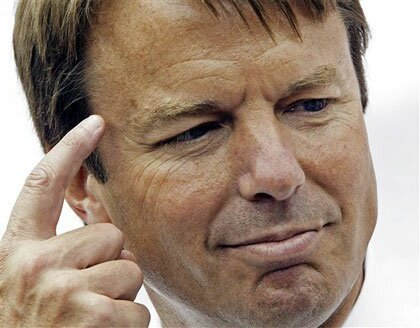
A view into the essential conflict of a political junkie, as seen through my belief that John Edwards really actually cares about me, personally


A political junkie is, in his heart, a conflicted beast. The conflict is this: he is interested in politics because in essence he is an idealist, and believes that his participation in politics can positively change the world; and yet, as his knowledge of politics deepens, he realizes that politics itself is a dirty, hypocritical business - he becomes the very opposite of an idealist, a cynic.

It is surprising that we continue to be surprised by the hypocrisy of elected office, even now that such hypocrisy has become a tired cliche. If we found an idealist's ideal politician, someone pure of heart, with his constituents' best interests in mind, articulate and intelligent, and everything else good and decent, we would disbelieve that he existed in the same way we'd disbelieve evidence of a unicorn or the Feejee Mermaid.

The political junkie - one who does not burn out - must feed on this conflict. They must, if they are to survive, find pleasure in dashing their newborn ideals against the cobblestones of reality. The same way it feels really good to gnaw on a canker-sore. Of course, when politics actually becomes a profession, ideals have nothing to do with it at all. It's all about power. But for the armchair political junkie, the most power we have is... well, it isn't much: we can vote. Maybe even in a primary; and if we're lucky - in a primary that matters. So we must feed off of this conflict between the idealism of what we think politics could be, and our cynicism at what it actually is. We may find a politician who our idealistic hearts can fall in love with, but then we find out more and more about him - and realize he's just like everybody else. And that realization is what keeps us going.

So I say what I say now with a sort of baited breath: I think John Edwards is on to something. Maybe.

The issue around which his entire campaign is mustered is poverty. Our country is one increasingly divided between rich and poor. One in which the basic opportunities of advancement are denied to a vast unwashed swath of people - not because they're especially stupid or lazy, but because they had the bad luck to get hurt and not have medical insurance, or they just fell out of work and couldn't fall back in. The problem is so deep, so old, that it seems incredibly boring, and I feel a flush of mawkishness writing it out like it was news.

The lack of a social safety net, a lack of some basic protection against the twists and turns of fortune, makes the American Life one of worry and fatigue for many. Look at me: a recent college grad, in so much debt it hurts like bad arthritis, having to pay health insurance out of my own pocket, working what would be affectionately called a 'dead-end job'. My perch on the great tree of the American Dream is very precarious, indeed. One bad wind will knock me off.

I'd have a much more interesting blog if that happened, that's for sure.

That Edwards dare take on poverty as his key issue is courageous, especially given how much cawing there is about crap like 'morality' and 'terrorism'. It's an issue - one of the rare issues - that actually matters.

Of all the candidates, Edwards the only one with a certain amount of sustainable vim and vigor. Hilary - I don't know about her. I can't understand her appeal at all, apart from being part of the Establishment (feel free, at this point in the blog post, to make doom noises). And I think that Obama, while he can be a wonderful speaker, will inevitably disappoint his supporters. We expect so much from him, that when he fails to deliver, we feel as if we've been cheated, that the Obama we thought we knew was just a fake, another poor political fake. Obama has all the personality of a Messiah. Messiahs, if you've ever noticed, aren't exactly the sort of people you want over your house for some steak and beer.

So Edwards. Sure. He has the Brylcreemey stench of politician around him. But watch. He might just get up there and blow us all away. He might be something more than a basic politician - he might be earnest. And if he's not earnest, he'll at least pretend to be earnest in a very well crafted way.

And in the end, that's all that matters to a political junkie.