Showing posts with label travel. Show all posts

Friday, July 13, 2012

Day Thirteen: All Inclusive, Wi-Fi Extra. The Amazing Awesome Anatolian Road Trip Diary

This is day thirteen of the Amazing Awesome Anatolian Road Trip Diary.

We checked into the hotel, and after collecting our money and passports and handing out keycards, the receptionist wrapped orange plastic bands around our wrists with small ceremony.  That was our initiation, even if we failed to realize it.  By virtue of those orange pieces of plastic, we has the right to all the pleasures and indulgences on offer.

The hundreds of people packed into the towering seven-story hotel buildings and the 354 hotel rooms, all were initiates like us, and all were devoted to the simple pleasures of open bars, buffet meals and swimming.  There were five restaurants, snacks in the afternoons from two cafe, a bar where drinks were free until midnight, and a nightclub which we never dared enter.

Our room looked out at the Aegean sea, which lapped hungrily at the 300 meter long strand of private beach bounded by the hotel.  The beds were large and comfy, and beside it next to the button for the beside reading light was a button which cycled through mood lighting:  red, blue, white, green.

Our first night there we spoke with a middle-aged British man at the bar.  It was obvious that he had spent the entire five days of his holiday trying to get the bartender’s attention, loading up on one free drink after another while his wife nervously laughed beside him.  We asked him if he had visited Ephesus, the ancient Greek city not more than ten minutes drive away.  He frowned and said no.  It turned out that he hadn’t left the hotel at all since he got there.  “I travel a lot for my job,” he explained.  “I’m just here to relax.”  I’ll admit it.  I scoffed at him.  Getting trapped here seemed like a moral failing, one that we would be immune to.

People asked us how many weeks we were staying and when we explained that we were only here for a day we got odd looks, like a day wasn’t even a unit of time—like we were mere fever dreams, to pass by harmlessly in the well-slept night.

The first thing we did was get massages.  At this point, it was already noon.  My masseuse covered me with a towel, folding it over piece by piece to lay bare whatever region of my body he was working on.  And it was work that the man was doing.  His forehead glistened with sweat.  He grunted softly with effort as his fingers pressed into the knotted meat of my back, and sighed as he rubbed oil into my sun-dried skin.

The most I moved was to flip over so he could get at my front.  I felt like a commodity, a lifeless, intentionless lump of relaxed material.  I had no will and no responsibilities.  It felt good.

After he finished, I was told to relax.  No problem.  I lay face down on the massage table, my breath slightly choked by the towel plugging up the face hole, but not choked enough to make me worry about it.  My thoughts stilled.  I stayed like that for an indefinite amount of time.

We ate at the buffet, loading our plates too high with salad greens, fried whiting, sardines, olives, curried turkey, pide, cheese, fruit, and cake.  We ate not because we were hungry, but because it was time to eat.  And eating wasn’t exactly a pleasure, it was an oblivion.  We shoveled food into our mouths, not talking, looking at nothing, pausing only to order another beer or refill our water glasses.

Then it was to the swimming pool.  We played in the water, diving down to the bottom of the pool where there were windows looking out on the cafe below and waving at the people.  Time passed in the water.  Then we laid in the shade, reading.  Time passed in the hot shade.

I drank.  It was free, so I drank.  I drank a lot.  I drank more than I had all year.  I drank so much that I couldn’t hope to count how much I drank.  I started at eleven with a beer, and by two I had reached a nervous tipsiness with helps of generous glasses of raki, gin and tonics, and something I ordered by just slurring ‘green drink’ at the bartender.  I managed to maintain this tipsiness until a little bit after dinner, ducking away from my friends to order whiskey and cokes and sucking them down to the ice by the poolside.

Everything was catered to us.  When you left the bar, two staff members stood politely at the door to pour the drink from your glass into a plastic cup so that if in your drunken stupor you dropped your drink, your glass wouldn’t break.  Nothing was denied you.  Extra food, more alcohol in your cocktails, a game of darts, a pillow for the sun-chair.  A tribe of orange-shirted staff called animators prowled the pools and the bar-area throughout the day, rounding people up for games of volleyball and bocce ball, always smiling, always leading people in chants, their eyes glinting with unnatural enthusiasm.

Two things were refused:  time, and the rest of the world.  And these were refused with an evangelical insistence.  There were no clocks anywhere, and the sun hung high and bright in the sky, giving the resort the look of an eternal afternoon.  We had no idea what time it was, how long we had been at the poolside for, how long it was until dinner and then sleep.  And since everything was provided for you at the hotel, why would you need to go anywhere else?  Why would you need to visit the supermarket?  There was a convenience store in the shopping arcade strung between the reception and the main dining room.  Why would you need to see the ruins of the great city of Ephesus down the road?  They were just stones, and here there was life and young women in bikinis.  Why would you need to talk to your friends?  Fun was here, joy was here, contentment was here.

The only thing that you needed to pay for was wifi, and that was only available on the first floor lobby with a pitifully weak signal.  A few men opened black IBM laptops at the circular tables, struggling for a connection.  We told ourselves we would get the internet, check our e-mails, ponder the next leg of our journey.

But we never got around to it.  Wifi would connect us to the outside world, where we could read e-mails from work and talk to our families.  As we settled into our sleepy acceptance of food and drinks and sunlight, the desire we had to talk to anyone else dwindled, flickered, and died.

Like that, we were overcome with the time-blind hedonism of the resort.  It felt like we had been there a week and that we would be there forever—or at least until the end of summer—but we had only been there for eighteen hours, and we would leave the next morning.

-&-

At night, my friend was chosen for a competition.  Boys against girls.  Five a side.  They sat on the stage of the theater, young men and women from all different countries.  The men were drink-worn, wearing sporty clothes and competitive faces.  The girls were in high heels and dresses.  They played a series of games.  A drinking race.  A paper airplane competition.  A game where they raced to blow up balloons and then sit on the balloons to pop them.  A game where they tried to get as many people as possible to stand in a small space.  The games were impossible and absurd, but as soon as the competition started, I was fired up.  I wanted my friend to win.  I cheered.  I sipped from my drink.  The Fabio-haired Animator clapped his hands and chanted “Tempo!  Tempo!” as if it was a magic word, and it felt like a magic word.

The staff would ask me how I was doing and all I could do was shrug.  Of course I was doing good.  I wasn’t working.  I had all my needs catered for me.  How could I suffer from anything?

And when I said this, they would nod like they understood.

But they were at work.  And their work was to cater to the grotesqueries of my pleasure.

There were swarms of waiters in white and black button-up shirts and bow-ties manning the buffets, refilling drinks, cleaning the filthy tablecloths, trying to keep proud expressions on their faces.  There were bartenders forever rushing from one drunk man to another, getting them slowly and profoundly drunk.  There were the Animators, organizing their seven hundredth game of bocce ball, calling out to everyone to have a good time.  This was their work, and I felt like it was awful.  But then my sleepy hunger would lap ay my mind, and I would just lift myself up, hulk myself over to the bar, and order another free drink.  Like that I achieved freedom from worry.


The Amazing Awesome Anatolian Road Trip Diary continues...

You can also get the whole series as an e-book.

Day Twelve: Sunburned Myth: Pamukkale and Aphrodisias. The Amazing Awesome Anatolian Road Trip Diary

This is day tweleve of the Amazing Awesome Anatolian Road Trip Diary.

The olive-planted hills rolled on, behind them the far-away jagged mountains.  The landscape looked mythical—the kind that Heracles and Odysseus might have romped around in before there were cars, and roads, and helpful signs to guide the wayward tourist to photo-worthy sites.  Against a hill in the distance we could see our destination:  a huge slope of white, as white as snow, seemingly cut into the rock.  This was Pamukkale—Cotton Castle in Turkish.  Behind the white, crowning the top of the hill were the ruins of a Roman city.

We parked the car and walked towards the entrance.  We could hear people, but the cicadas and the crickets susurrating in the summer heat were louder.  Ducks led ducklings padding across a pond in a park at the bottom of the hill.  And above us was that startling band of pure white.

We slipped off our shoes before walking up Pamukkale—you have to go barefoot.  The sun was hotter than it should have been, reflecting off the white cliffs.  The limestone was wet with cool water, which eased the heat a little.

I took off my sunglasses just to see how things looked.  The white was too white.  A thousand times whiter than the whiteness of a blank sheet of paper.  A whiteness so pure it made me squint and pull away.

Man-made pools staggered up the hill in ascending plateaus, the water the majestic blue usually only seen in advertisements for beach hotels.  In the folds of the rock, the white was sometimes tinted a subtle pink.  On the higher ridges, stalactites and stalagmites of limestone met to make hungrily grinning mouths.

“Seeing natural phenomena like this, it’s not surprising why people need to invent gods,” my friend said.

And seeing it, so strange, so different, so unexpected, you need to think of an explanation for it.  Eternal curses against the landscape itself, the anger of Zeus, ancient aliens.  The accepted explanation is that the springwater is supersaturated with carbon dioxide and limestone, and as the water bubbles over the mountains, it forms dribbles of stone called travertines.  It’s true enough.  But it doesn’t explain the wonder.

-&-

A head-scarfed mother led a half-naked toddler by the hand while he splashed in the pool, her other hand holding her skirt up, the hem brushing the surface of the water.  Next to her, a pair of Russians, bejeweled and bikinied, poured water over their big breasts, and then indolently laid face down in healing clay.  A large-bellied Italian stood in front of his wife’s camcorder and lustily narrated the scene behind him.  A line of Chinese made their way up the hill like ants, in street clothes, holding their shoes at their sides, a tour guide barking liked a provincial official.  We played around in one of the lower pools, slapping the jelly-like white sediment over our bodies and observing the other tourists.

But I was impatient where I should have relaxed.  While my friends enjoying the feeling of the warm water and the majesty of the scenery, laying on their backs, staring at the sky, I was hunched forward with my hands around my knees, wondering whether the higher pools were any better.  Were we just wasting our time?  Was the really amazing stuff just a little ahead?

I  left my friends and climbed alone to the higher pool.  It was the same as the lower pool where my friends were.  I looked over at them below me.  And then I looked above me as the parade of tourists continued, a tutti-frutti splatter of swimsuits and skin.

The heat was incredible. The light was magnified by the limestone and the sun glinting off the waters.  I could feel my skin burn and crack.

At the top, a waterfall pushed over the edge of the hill, and person after person lined up next to it to snap photos.  No one stood under it, though.  I cut in line and made funny faces while reveling in the warm water.

After climbing Pamukkale, we made it to the ruins if the Ancient Roman city of Hierapolis.  A tourist trap has been planted here.  A broad pavilion, called Antique Pools, welcomes the sunburned tourists to buy overpriced ice creams and coffees.  There was a booth where for 30 lira you could get a video of you and a friend flying on a magic carpet through the tourists sites of Turkey.  In the pool itself—which you have to pay to enter—people lounge on the Roman columns, fallen, broken, and submerged in the water.

-&-

On the way from Pamukkale to Kusadasi, we took a small detour to visit Aphrodisias, one of the best preserved Roman cities on earth.  The place was completely silent.  Besides the attendant who sold us our tickets, we could see nobody.  For a moment, it was easy to believe that there was no noise at all, and that the place had been untouched for thousands of years.  But after a moment, I realized that I simply couldn’t hear the noise of people.  The cicadas were wild.  The birds sang.  The grass sashayed in the hot wind.

The entrance was lined with the detritus of archeology:  emptied sarcophagi decorated with funereal scenes, mantles from the tops of walls, grave stele.  Iconoclasts and demon-wary Christians have defaced most of them, snapping off the noses of the carved figures, rubbing away the faces, scrawling protective crosses in the rock.

A stack of marble mantles stood in the shade of the building with as much ceremony of out-of-use deck chairs.  They are decorated with faces, still expressive, their eyes still happy and lecherous, their cheeks still full or hollowed, their expressions knowing and arch, gluttonous, pedantic.  Between them run garlands of stone fruits.  These mantles are stacked three high and four deep.  A lazy brown cat wandered in between them, looked up at us, and gave a lazy meow.

We descended some steps to the Sebasteion, the temple to the cult of the Divine Emperors.  High friezes, triple porticos, a courtyard, all stood reconstructed in the empty summer heat.  Only a tenth of the building stands.  Looking at it, I tried to imagine what it was like when it once was real.

We moved on to the Temple of Aphrodite, the city’s patron god.  A gate remained, towering as high as a small hotel, proud and marble and white in the sun.  In another stretch of the Temple, tumbled marble columns scarred by fire lay in the vine-choked ground.  In 500 AD the temple was converted into a church, and people prayed here until the Seljuk Turks came around 1200 AD and emptied the city.

The city is vast.  It is amazing.  It is stunning to think of the labor which once raised these stones, and the lives which once pulsed through these streets.

The tops of my feet had been so sunburned that they looked like plums.  My arms felt like they’d been turned into Brendan Jerky.  My girlfriend forgot to put on sunscreen at all and so she teeters on uncertain legs, her whole bare back red, sweaty, asking for water.  We are dusty and travel worn.

But the city is also boring and hot.  The ruins are just ruins, and it takes a bit of mental effort for me to see the wonder in the bricks and the marble porticos, effort that I don’t have after twelve days of travel, and after the sun reflected off the limestone, and after the driving, and after the beauty I have already seen.

We hurried through the ruins, past the theater and the agora, past the Hadrianic Baths where archeologists labored in the heat.  Then we circled around to the entrance and retired to the museum which—pleasure of all pleasures!—was air conditioned.  It was only there, once we were comfortable, that we could appreciate how sun-baked, dehydrated, over-traveled, and tired we had become.

The museum was filled with the artifacts of Aphrodisias that were too fine to leave out in the open air and the unshaded sun.  There were statues, friezes, monuments, and coins, the broken pieces fit together, the scenes explained with helpful informational plaques.  Where the items have been badly damaged, they provide small helpful drawings that show how the site would have looked like when it was whole.

Most of these fine antiquities blur together, passing by, undistinguished even by their age.  We have seen so much already.  But some touch me.  I wonder why.  It is not by virtue of their superior craftsmanship.  I can hardly tell what separates a good statue from a great statue.  Some works of art just touch me, and make me curious again when for whole museums I have been bored.

Here it is two statues of boxers that excite my attention.  Their strong arms and chests rippled with tough-toned muscles.  They hold themselves with the proud and beaten posture of someone who has fought with their whole heart against defeat.  But time has defeated them, when no opponent could.  One is missing its forearm, his shin is broken, his face has been cracked in three pieces, and is only half-recovered.  His bald head and empty eyes make him look like a man losing his power, surprised at how quickly he became so old.  The other boxer suffered from a shattered leg, a lost neck, and a head cleaved in two.  They stare across each other, silent.

In a hot side-room of the museum, the friezes of the Sebasteion have been restored and put up on pedestals.  There are dozens of them, showing emperors and gods.  One frieze depicts Day, Hemena, a cloak rising behind her head, lifted by a gust of wind symbolizing the epiphany of the gods.  Her face has been gouged away and her hand snapped off her body.  Beside her stands the god of the Waters, Oceanus, also throwing a cloak to the wind behind his head.  His features have been dulled by rain.  But these two friezes are lonely.  When they stood up on the porticos of the Sebasteion, Day would have been paired with Night, together representing the eternity of the Roman Order.  Oceanus would have been paired with the earth, and show how the Roman Empire commanded the lands and the seas.  But now these two great symbols stand lonely and broken, symbolizing only the eventual victory of time.

-&-

We felt broken.  We felt tired.  We limped out of Aphrodisias to our car.  Then we drove up winding mountain roads, feeling more broken and more tired as the sun sets over the mountains, as we pass through more kilometers of mythological landscape.  We passed over the top of a mountain road to find the Agean Sea spread out before us.
There we improbably checked into an all-inclusive beachside resort to wash the salt off our bodies and sleep the sun out of our minds with an all-you-can drink bar and an army of holiday makers.  Tomorrow it’s going to get weird.

Tuesday, July 10, 2012

Day Ten: Beneath Cappadocia. The Amazing Awesome Anatolian Road Trip Diary

This is day ten of the Amazing Awesome Anatolian Road Trip Diary.


In the shallow part of the late morning we pulled out of our hotel, setting out for the deeper parts of Cappadocia.  The cities fell away, and the English road signs, the tour groups, the restaurants, the ATV rentals were all replaced by irrigated farmland.

Time passed like it does on long drives.

“Slow down,” the guy in the passenger seat said all of a sudden.

“What is it?” the driver asked.  There were no other cars on the road.

“Slow down!” again, with more insistence, pointing ahead of us.

And then we saw it.  A huge flock of sheep taking up both lanes of the otherwise empty road.  We pulled over.  Bringing up the front of the flock was a sheep dog, its tongue happily lolling out of its mouth.  The sheep followed, their bells ringing with every trot, the full udders of the momma sheep swaying back and forth.  Th shepherd brought up the rear, with his crook hitting the asphalt step by step.  Following him was a second sheep dog, more dutifully drooping its muzzle to the ground, ready to urge on stragglers.

-&-

We descended into the underground city of Kaymakli, a complex cut eight floors deep into the soft volcanic rock.  Once it could have been home to over three thousand people.  Now the upper levels of this subterranean metropolis are used by locals for storage—a honeycombed ancient attic.  A portion of the city has been made safe for tourists.  The walls have been strung with lights, the sloping steps have been reinforced with concrete and steel, and almost every turn has been marked with helpful signs.

As soon as we went inside the heat of the day lifted, and we could smell damp stone.  The hand-carved walls were uneven, branching off to various rooms like the arms of a tree.  The corridors narrowed as they went deeper, until in some places you had to bend over to pass through them, or fall onto your hands and knees.  Hollowed out into the soft rock were storage rooms, wine presses, a church, living rooms, graves, and a metallurgist.

Deeper into the city, we marveled at a huge ventilation shaft.  It was about the size of a comfortable chair, and the left side of it was dotted with hand-and-footholds climbing all the way down.  We turned the flashlight into to the darkness, but the light got lost in the depths.  We had no idea how deep the shaft went, or how high.

And it stunned us to think that all of these sloping passageways and huge stone caverns were carved by people.  That someone had not only climbed this vertiginous ventilation shaft but excavated it from the living stone.  Ancient Christians had done the majority of the work here, retreating to the caves as a defense against persecution.  But the Christians had only expanded and improved on cave structures which had existed long before them, going as far back as the Hittites.  The caves were safe.  They were a good place to hide from the shifting tides of empire.

-&-

Our next stop was the gorge of Ihlara, a broad tree-filled gash in the rock whose sides were speckled with windows and rooms that once were the seclusion of early Christians.  Around eighty thousand people once lived here in lonesome safety, in four thousand houses carved into the sides of the rock, praying at over a hundred churches.

As we walked to the ticket office a large crowd of high-school girls burst through of the turnstiles.  The first group was dressed modestly in headscarfs, clucking softly to themselves.  One girl stopped at the gift shop and put on a cowboy hat over her hijab, laughing to her friends.  The next wave of young women were dressed in western fashion—in camisoles, skinny jeans and shorts.  I think they were from the same school, but they looked like they came from two different worlds.

We paid for our tickets and made our way down the three hundred steps to the bottom of the gorge.  The whole sky was cloudy.  The wind tasted of cloud, the far-off mountains behind us were capped by clouds, and the clear sunny heat we were used to was dulled by clouds.

We visited the Agacalti Church, which was caved into the cliff wall in the eleventh century, propped up with four arches, and decorated with a small dome.  The walls were frescoed in white and orange paint, with the robes of the prophets drawn out in turquoise.  Jesus loomed above us in the main dome, holding a blessing with one hand and a book in the other, surrounded by winged spirits who were perpetually dragging the resurrected messiah up to heaven.  None of the figures had pupils in their eyes, and so they stare, empty, forlorn down onto us.  The church showed its age.  The paint was chipped in places, a passageway had fallen, the lower parts of the wall had been scratched with crude graffiti.

We followed the steps further down to the bottom, a long line of tourists ahead of us and behind.  But when we reached the gorge the other tourists turned left to a nearby church, and we continued forwards, crossing the fast-flowing river.  After a few minutes we could no longer hear the noise of the tour groups.  Around us was the solitude of rocks and trees, of dust and bugs, the burble of water and the empty noise of wilderness.

We climbed up to another church carved into the farther cliff-face.  This one was less well-preserved, more isolated, less protected.  Three entrances with finely carved archways led into a darkened interior, the ceiling drooping with cobwebs.  Passing the weak flashlight against the walls we could make out the remains of the white and orange paint that had once brightened the walls.  A greek cross on a pillar.  Geometric patterns crawling along a ceiling.  As we went deeper into the ruin, the daylight was swallowed by the shadows, and we found the side-rooms and the small passageways completely dark.  The flashlight tried in vain to illuminate these big empty rooms, and we stopped on the threshold, peering inside, wondering what had once been there, trying to imagine what the church might have looked like back when it was filled with the noise of living.

-&-

On our way out of Cappadocia we passed by another fairy chimney site.  We stopped the car at an overlook and took pictures of the rock which fell like folds of fabric in an art-student’s texture study, honeycombed with floors, walls, windows, and doors.

It was amazing, but we had been looking at amazing things now for ten straight days, and in the late afternoon with four hours of driving ahead of us, we only enjoyed the scene briefly.  We quickly folded ourselves back into the car, passed by a parking lot full of tourist buses, empty besides their drivers, who lay idle in their driver’s seats, either napping the afternoon away or texting, ignoring the ponderous photo-worthy spires rising into the air above them.  They, too, were tired of beauty.  We drove onwards to Konya, where we would spend the night.


View Larger Map


The Amazing Awesome Anatolian Road Trip Diary continues...

You can also get the whole series as an e-book.

Sunday, July 8, 2012

Days Seven And Eight: Roads. The Decapitated Gods Of Mount Nemrut. More Roads. The Amazing Awesome Anatolian Road Trip Diary

These are days seven and eight of the Amazing Awesome Anatolian Road Trip Diary.

The narrow road cut through the crests and troughs of the rising shadow-filled mountains, and our car bravely made its way forward.  A half-moon hung in the sky, softening the sky's broad darkness.  We were tired, and quiet mostly.  It was three in the morning, and we had been traveling together for exactly a week.

We didn’t know whether we were going the right way or not.  We hadn’t seen a sign for a dozen kilometers or so, and the road looked too obscure, too uncertain.  A white panel van passed us, speeding up the winding road.  “That’s a tour bus,” I said, straightening up in my seat with rising hope.  “We’re going the right way.”

“It’s not a tour,” our navigator snapped.  “Tours couldn’t have vans that small.  It wouldn’t be efficient.”

Maybe we were getting a little grumpy.  We had woken up too early.  We had been in the compact car for too long.  The silence came over us, and kilometers sped beneath us.

And then in the East the darkness changed.  A thin band of orange broke against the horizon, dropping off into blue, which smeared into the nighttime black.  It was the first touches of morning light.  We were racing against it.

By four thirty in the morning we parked on a steep parking lot filled with tourist vans.  The night was cold and windy.  My only pair of trousers had ripped back in Mardin, so I was wearing nothing more than salmon-colored shorts and a thin T-shirt.  I had failed to have the foresight to wear shoes instead of sandals.

In front of us was a mountain peak, a darker imposition against the moony night.  This was Mount Nemrut, one of the most famous sights in Turkey.

Hints of sunrise.  Photo by Jenna Staff.
We walked up.  It felt good to walk.  Walking kept us warm.  The path was steep and pebbly, and we could see almost nothing in the morning darkness besides the growing band of light to the East, and the dim outlines of the rolling hills beneath us, and the dark shape of the peak to the left of us.  It was beautiful, but we were tired, and maybe too tired and too cold to appreciate the beauty.  We said little to each other.  We passed by other tourists who were puffing their way up the mountain, pausing for breath against a pile of stones.  One group, bundled warm in blankets and coats, looked at my T-shirt and short and could do nothing but laug.

By five we made it to the Eastern Platform of Mount Nemrut, and the first light of the day was spilling out against the stone peak.  The heads of decapitated gods stood before us, each as tall as a man.  The heads of five men—gods and kings—were flanked by an eagle and a lion.  They all looked out towards the morning empty eyes.  On the rise of the hill behind them stood the five bodies of these heads, indistinct blurs in the morning darkness.

Heads, before the dawn.  Photo by Jenna Staff.

Mount Nemrut is the mausoleum of Antiochus the first of Commagene who lived in the first century BC.  Antiochus’ small kingdom was a mixture of Persian, Greek and Armenian cultures that had torn its independence after the Roman Empire defeated the Seleucids.  Antiochus, whose full name was Antiochos, a just, eminent god, friend of Romans and friend of Greeks, declared himself a god, and planned that after his death his body should be moved away from the people and closer to the gods.  He chose Mount Nemrut.  Here he established a group of priests who would celebrate his birthday and his coronation once a month, for all eternity.

The heads depict Greek-looking kings with Persian hats.  There is Apollo-Mithras-Helios-Hermes; Zeus-Oromasdes; the king Antiochus himself, god-like a pround; Heracles-Artagnes-Ares, a queen, and Tyche-Fortuna herself.  Sometime after Commagene’s inevitable fall, once the birthdays and coronations were forgotten, these heads were broken off and tumbled down to the terrace below.  They were only rediscovered in the 1880s, when a German Engineer found them while looking for transport routes for the Ottoman Empire.

The heads slowly became illuminated by the rising morning light.  The shadows deepened their features.  The stones became more alive.  You could now see the curls of their beard, the arrogance in their eyebrows, the peak of the eagle’s beak, the fierceness of the lion’s eyes.

On the terrace a motley of people jabbered at each other.  Everyone snapped pictures, and posed for pictures, and clucked at each other about how funny the pictures looked, and crowded around the good vantages for photos.

We moved onto the Eastern pedestal to look out across the mountains, still dark with nioght.  There we had a moment of repose, and pulled the blanket up around us against the cold.  The light on the horizon became thicker, and now you could just make out the swell of red that would become the sun.

As the light grew, slate-colored lakes started to shimmer in the valleys below us.  Then all at once it was bright enough that I could actually see the pages of my notebook.  Seven vans pulled up to a special access parking lot below us, and they disgorged a pilgrimage of tourists who climb up the steep path, just in time for the sunrise.

Then the salmon-colored light swelled over the mountain.  Sunrise was coming.  The crowd silenced.

Like that—in a moment—it was day.  The sun peeked over the ridge of the mountain before it resolutely lifted itself up out of its mountain bed.  More photos were snapped.  A man posed for a novelty shot where it looked like he was holding the sun between two pinched fingers.  But despite all that, it was beautiful, and for a moment I felt a sympathy with the other tourists.  We were all feeling this beauty.

Sunrise.  Photo by Jenna Staff.

And then the tourists evaporated, like morning dew.  We walked around the peak of the mountain, suddenly alone again, admiring the stone heads in the cool morning light.  Then we walked around the peak to look at the Western Platform where another set of decapitated heads faced the setting sun.

-&-

This, for eight hours.  Photo by Jenna Staff.


Then it was days of driving.  We drove from Gaziantep to Adiyaman, and then to Mount Nemrut.  Then we wound our way back, retracing our steps, heading West to the dream-like province of Cappadocia.


Again, it was a day of Turkish road travel.  We passed a car with its passenger seat packed full of sheep.  A minaret sprouted from a boxy factory.  Road workers hid from the heat in the small shade of tree planted on the median strip of the road.

As we moved west, the earth rose to become a rolling Medeterranian farmland of olives and grapes, before peaking to become a series of craggy, pine-lush peaks.  The setting sun hit a splatter of clouds, marking the edges of the clouds white.

Then all at once the hills fall away into a stone-littered scraggly mud-splattered expanse rising with rocks and dust.  Ahead of us lay mountains, dark and broad.  We were leaving the East, with its rough brilliance, into the more popular tourist-areas of central Turkey.

-&-

In the style of Maximum Fun’s Jordan Ranks America, we ranked Eastern Turkey.

Standing tall at number five is “Hello, money!” the two words known to every single barefoot child you may happen to run across.

Making a strong debut at number four, it’s goats.  They’re cute, their shaggy, they seem to be content where they go, they make great cheese.  The consensus is:  goats are great.  Why don’t we have more goats?  Can we get some pet goats or what?

An old favorite retains spot number three.  You guessed it, it’s the shalwar, the Turkish farmer’s M.C. Hammer pants.  Baggy, with a crotch that dips past the ankle, nothing says “fashion” like these centuries-old trousers.

A surprise at number two!  It’s horrible drivers!  Passing you at a hundred and thirty kilometers an hour as you make a blind turn down a mountain road!  Demonstrating fantastic feats of steering-wheel acrobatics on roundabouts!  Honking while you’re stopped at a red light!  The drivers of Eastern Turkey will give you the ride of your life!

Taking the top spot at number one it’s Kebabs.  Lunch and dinner, why would you want to eat anything else?  These flame roasted skewers of meat can be angelically good or give you food poisoning.  But one things’ for sure:  it’s the only thing on the menu!


The Amazing Awesome Anatolian Road Trip Diary continues...

You can also get the whole series as an e-book.

Wednesday, July 4, 2012

Day Four: Mardin, Too Marvelous. The Amazing Awesome Anatolian Road Trip Diary

This is day four of the Amazing Awesome Anatolian Road Trip Diary.


Mardin clings to the side of a mountain, looking out over the Mesopotamian plains and the meander of the Tigris below.  But Yenishehir—the New City where our hotel was—hides behind the old city on the easy flatland, a wealthy spread of new apartment buildings and restaurants.


A five minute drive brought us to the base of the old city, and we stepped out of the car to admire a view of the bread crust-colored buildings and the crowning mass of the citadel that stood at Mardin's peak.

Local legend has it that Mardin was founded before the Great Flood.  The earliest archeological excavations date the settlement at least back to 6,000 years ago.  And it’s easy to see why people wanted to live here.  The plains keep you fed.  The mountain keeps you safe.  It is a wonderful place to build a city.

But the mountain could not keep Mardin safe forever.  And over the long history of war and empire, generations of generals have stood on the Syrian plain below Mardin and looked up, lustily envying the strategic brilliance of this mountain town.  Here are the names of the civilizations which have conquered Mardin, one after the other: the Subarians, the Hurrians, the Elamites, the Babylonians, the Hitties, the Assyrians, the Romans, the Byzantines, the Arabs, the Seljuk Turks, the Artukids, the Mongols, and then finally—in the 16th Century—the Ottoman Turks who themselves were replaced by the Turkish Republic in the beginning of the 20th Century.


We turned from the city to the Mesopotamian Plain behind it.  After driving through the hilly plateau for so long, the flatness of everything was stunning.  The plain stretched to the horizon utterly untroubled by hill or rise or roll, completely flat, squares of wheat-colored farmland broken by squares of dark irrigated land, dark cloud shadows moving slowly from one end of the plain to the other.  The dusty horizon joined with the sky in an indistinct haze, like the world couldn’t exactly decide what should be land and what should be sky.

-&-

We climbed up alleyways of stone steps, the roofs of the city rising above us at various angles, two or three nipple-tipped minarets piercing the skyline in the distance.  These streets were not made—they grew up over the slow course of decades and centuries, going where they would—not necessarily going straight to anywhere in particular—but just going.  And so we walked without any other direction but up, marveling at the ancient-looking character of the buildings around us.

Mardin looked exactly how I imagined an ancient Near Eastern city should look.  The houses were old, with finely-made arched Ottoman windows, clustered together like mushrooms.  Many were in various stages of disrepair:  cracked walls, gaping windows.  We passed under a drooping stone balcony supported dubiously by a nest of wooden planks and plastic pipes.  “Careful of the scorpions,” our Turkish friend told us as we stumbled up through a pebbly patch of waste land.  It was easy to imagine that we were back in the Twelfth Century.


But then small details would force the modern world back:  spent Cheetos bags fluttering in the street, the sound of a Turkish soap opera blaring through an open window of an ancient-looking house.

An exceptionally happy young man on a donkey strolled by us.  Polite girls in loose headscarfs said hello to us.  We said hello back and followed them to the nearby mosque,—the Abdullatif Camii.  There were a gaggle of girls in the mosque’s front courtyard lingering under the shadow of a vine trellis, asking us questions and giggling.  After a few minutes a young woman peeks her head out of an open door and announced “Girls!  It’s time!”  The girls are enrolled in a summer Koran course at the mosque.  But the girls dawdled as much as they could, asking us foreigners our names, laughing, posing for pictures and then running away from pictures and hiding their smiles behind their hands.

The mosque was old, the outside decorated with beautiful clay work in the Artukids style.  We ventured inside the mosque, and look around for a moment before heading out again into the dry desert heat.


We came to a main street, hung with plastic awnings, blaring with staticy radios barely picking up ancient music, vegetable sellers sitting at their shop doing their accounts by hand, and somewhere in the distance the anxious braying of a donkey.  The feeling washed over me again:  this could be a hundred years ago, or a thousand.  Or it could be today.

And then I realized I had been wrong about Mardin.  Being in Mardin was not like being transported back in time.  Instead it was like being smeared through time, at once living in the present and the past—as if time which normally is so punctilious and fussy had gone sloppy and forgetful.

-&-

There are things to do in Mardin, important cultural landmarks that the guidebooks insisted we check off our lists—but it was more rewarding to simply fall through the alleyways and let ourselves get lost in the remarkable feeling of the city.  Nevertheless, we were tourists, and so we had to do touristy things.

First we went to the Mardin Museum, which boasted artifacts from the area’s six thousand years of human settlement.  Looking into the glass cases showing paleolithic tools, I felt a sense of sadness.  Because what survives from the ancient world?  Clay and metal and nothing more.  Stone axes, broken shards of curde jugs, small statues, thin metal needles, a stone toy cart, obsidian cutting tools still sharp after six millennia, baked clay writing tablets and seals—and nothing much more from the clamor of human life.  A few small cuneiform inscriptions show the grubbily commercial origins of writing.  They are nothing more than contracts, announcements, statues, and deeds.—They come from before the time that writing had become art.  I wondered what would survive of our life, after the centuries pulled their forgetfulness over our civilization?

After the museum, we tried to find Ulu Camii—the Great Mosque.  We were directed down a merchant-clogged alleyway selling an oriental range of sundries:  sheep and calf heads in plastic bowls, black with rot, flies buzzing around the eye sockets; repair shops and metal workers, a ten-year old fixing a saw blade onto a machine tool; a metal worker stamping patterns onto a plate by hand; cages full of ducks and baby chickens, squawking; cookware, plastic pipes, woodworking tools; kebab restauranteurs carving off slices of meat; tea shops; clothes shops; anything a person might need.

We got to the mosque a few moments before the call to prayer, and the broad courtyard was filled with locals washing their feet in the fountain.  We decided to wait in a nearby cafe until the prayers were over.  There we looked out over the Mesopotamian Plain again and drank Mirra Coffee—the most bitter sip of coffee that I have ever had in my life.  A serving is little over two or three teaspoons, and the taste stayed in our pallets for at least half an hour.

Our refreshment done, we visited Ulu Camii, remarked about in guidebook after guidebook.  But after having enjoyed the city for the majority of the afternoon, I was disappointed by how boring the great mosque was.  It was a large mosque made of white stone, decorated in high Artukid style, the walls crawling with amazing calligraphy.  But the inside of the mosque was bare and cool, and I couldn’t feel excited for it.  We splashed water over our faces at the fountain, and then left to again plunge into the city.

Our final act of tourism was to climb to the top of the city where the Mardin citadel perches, looking over the Syrian farmland.  We rested there, snapping photos of ourselves against the grand backdrop of the valley where civilization began.


-&-

We had planned to do more around Mardin:  we would find a city where an ancient bridge crossed the Tigris river; we could tour a working Syriac Christian monastery; we could admire an ancient mosque.  But once we got back into the car, we shrugged off all our remaining touristic plans.  We didn’t want any more cultural heritage:  we had had enough.  We were full of beauty already, and full of wonder, and our camera full of pictures.  Insisting on seeing more striking sites would be too gluttonous.  Instead we followed the wide new road west, to the city of Urfa, some three hours away.


View Larger Map


The Amazing Awesome Anatolian Road Trip Diary continues...

You can also get the whole series as an e-book.

Monday, July 2, 2012

Day Two: A Lesson In Turkish Automotive Adventure. Afterwards, Erzurum. The Amazing Awesome Anatolian Road Trip Diary

This is day two of the Amazing Awesome Anatolian Road Trip Diary.

The road south from Trabzon climbed slowly onto Anatolian plateau, and as the day wore on we drove up loftier and loftier mountains, plunging further and further east.

We discovered that the number one Turkish road-trip pass-time is overtaking other cars.  Two lanes?  One lane?  Dirt road dusty with construction?  Turkish drivers think all these places are great for passing by motorists languishing at the speed limit.  Inevitably every few minutes we would suddenly be passed by a clutch of cars which would veer into the oncoming traffic.  This happened everywhere we drove:  in cities, on long straight highways, on blind curves hugging the sides of mountains.

At first, these incidents were scary.  Our driver would brace herself and grip the wheel testily.  Us passengers would hurl opprobrium at the passing car.  “Why is he passing us?”  “Turkish death wish.”

But after three straight hours of driving an absurd humor crept into the incautious bravery of the Turkish driver.  Once while driving down a wide mountain highway we were passed by an impatient driver who himself was passed while passing us by an even more impatient driver.  This was a thing of beauty.  A rare "Double Pass."  Of course, a few bends in the mountain later we saw both cars stuck in a clog of traffic, only ten meters ahead of us for all their automotive bravery.

The art of Turkish overtaking reached its most fantastic hight when we saw a motorbike puttering its way up the side of the mountain, its left turn signal on, meandering suddenly into the left-hand lane even though there were no other cars on the road.  “Look guys,” our resident snark pointed out, “this guy’s passing himself.  It's a Self Pass.”


-&-

Then the beauty of the changing scenery quieted us.  We had mounted the Anatolian Plateau, an otherworldly dry scrubland stretching restlessly in every direction.  Slabs of rock jutted out of the pasture at odd angles, as if there had been some great ancient war that had torn up the earth.  The sky was bigger, prouder, full of huge castle-like clouds.  The light looked different.  It was clear, and sharpened things.

For long stretches of the well-paved highway we saw no other cars, and for a while we could be imagine that civilization was very far away from us.  But Turkey is one of the oldest civilized landscapes on earth, and the road threaded its way through numerous small villages, like beads strung on a bracelet.  A little before noon we stopped in one to pick up nuts and cherries for our lunch, and outside a local bakery we gawked at a wheelbarrow stacked with burning logs for charcoal.

Later we passed through a dust-grey town, the perfect setting for an Anatolian wild west film.  In the other lane we saw a thin horse pulling a beaten-up cart  On our right a seven-year old boy diligently changed the tyre of an eight wheeler, while his father gummed at the filter of a cigarette and admired his work.

But too quickly, the loneliness of the vast landscape returned, and it was back to the rolling hills and the scrubland and the feeling that we were far away from everything.  The only hint that we were nearing something big were the handful of billboards chucked along the roadside.  One was for a bank.  “ATM!—30km!”

-&-

Erzurum is an ancient town perched more a mile above sea level like an eagle on a high rock.  As we pushed our way into the crazy traffic trying to find a hotel, we became worried.  The streets seemed a little too pot-holed, a little too crammed with cars, the driving a little too intemperate, the people a little too interested in us and our small car.  We drove the wrong way up a one-way street, argued about directions, finally found our hotel, and parked, struggling out of our seats with half-shaking legs and testy humor.  We heard a passing child remark in wonder.  “Tourists!”

The history of Erzurum is one of conquest.  First settled by the Armenians, it fell under the sway of the Roman Empire in the late fourth century and was quickly renamed after the Emperor Theodosius.  The city was reinforced, and strengthened to become one of the bastions that Rome held against the Persian Empire.  And for the next two thousand years, the tides of history have pushed ambitious empires over Erzurum.  The Persians, the Byzantines, the Arabs, the Turks, the Russians.  Each has come, only to leave again while Erzurum remains in its lofty rock, proud and slow.

We found our hotel.  The proprietor was kneeling on a prayer mat in the lobby, and slowly straightened himself up to meet us.  He was very old, with white stubble on his face, no teeth, and the striking intelligent eyes of a much younger man.  Our Turkish friend negotiated with him, and the old man refused to lower the price of our rooms by a single lira.  Weary with travel, we checked in, dropped off our bags, and made a hurried search for toilet paper before gathering ourselves for one last jot of tourism.

Somewhat refreshed, we drove into the nearby city center to look at the historical sites before the light died.  Our first stop was the Çifte Minareli Medrese, the Twin Minaret Madrasa, a strikingly strong red-brick building raised in 1271.  We found the Madrasa—so emblematic of Erzurum that it’s on the Wikipedia page—closed for renovation, covered in scaffolding and sheets of green mesh tarp that fluttered in the cool mountain wind.

Rebuffed, we crossed the street to the Three Kumbats—medieval octagonal tombs topped with steep conical roofs that look a little bit like hats.  One of the roofs had grass sprouting in the grout between the bricks, looking like a bad hair transplant.  The Kumbats were built sometime between the 13th and 14th Centuries, but who built them and why is unknown.

We discovered a young man sprawled napping on the curb of the leftmost Kumbat, in bright red shoes, jeans and a red shirt, his arm thrown up over his eyes to block out the high afternoon sun.  He stirred as we gawked at him, shifted his arm a little to give us a surly look, and then returned to sleep.

The doors of the Kumbats were all locked, but we could look inside through the barred windows.  Nothing.  Any sarcophagi that had once rested here had been removed sometime in the past eight hundred years, leaving nothing but bare stone and shade.

But they were still remarkable, because they were so solid, and so old.  As we made our way around the Kubats and settled into an appreciative silence, I imagined the workers who placed the stones there a thousand years before us, and I wondered what they were thinking of as they worked, and of how when they stretched themselves up and wiped the sweat off their foreheads, they looked to the same background of high rain-washed mountains as we looked.

The third and final cultural event of the day was the nearby citadel, a vast building of heavy stone overlooking the city and the plain below it from where the passing generations of Empire had looked out onto world.  We circled it, looking for an entrance.  It was shut.  The citadel had closed a quarter of an hour before.

-&-

Our humor had thinned.  At the citadel a group of dirty-faced children had swaggered up to us, cornering a straggling member of our group shouting “Money!  Money!  Money!” with threat and anger.  Our jokes had lost their laughter.  We checked out a mosque built in 1179 and tried to appreciate the ancient domed roofs and the quadruple arches, but we were just playing the role of tourists without actually enjoying what we saw.  We all sat sat on the rug at the front of the mosque and waited.  We were hungry, but we hadn’t exactly realized that we were hungry, so we lingered in a half-exhausted pile before coming to the inevitable conclusion that it was time to eat.

Erzurum is famous for Cag Kebab, a spit-roast lamb dish that might very well be the ancestor of the ubiquitous doner.  Two restaurants claim to have invented the kebab.  We went to one, Gel-Gor Kebab, a bright clean building near the city center.

Once we were seated we craned our heads around us, looking for a waiter to present us with a menu.  No menus came, but soon a waiter efficiently whisked plates of salad and thin bread onto the table.  A moment later another waiter offered us skewers of slow-roasted lamb.  We ate one skewer, two, and then three, gorging ourselves on the grease and hot pepper paste, eventually falling into contended food comas where time seemed to have no meaning, and our tiredness seemed to have no meaning, and the hassle of the traffic had no meaning, and all there was that mattered was the pleasant bluges in our bellies.  We had passed through the mild discomforts of travel into a painless nirvana of gluttony, our pain gone.


Soon our dirty plates were removed and we were asked if we wanted dessert.  Yes please. Dessert was Kadayıf Dolması, another local delicacy that is nest of deep-fried pasta soaked in syrup, stuffed with chopped walnuts.  The texture, the taste, the sublimity of Kadayıf Dolması is impossible to describe.  Maybe it's like the Turkish dessert version of a perfect sushi roll:  an infinitely subtle combination of simple falvors.  After polishing off two of these each, we gazed at each other in a contended stupor.

Now that the dusk was coming, the city seemed easier than it had when we had first struggled in.  The roads had cleared themselves of cars, and silence had fallen on the terraced streets and the quiet houses.  We pulled open the curtains of our hotel room and looked out on the skyline, and below us the ancient plains, and we know that we had accomplished something that day.  We had struggled, and we had enjoyed it.


The Amazing Awesome Anatolian Road Trip Diary continues...

You can also get the whole series as an e-book.

Sunday, July 1, 2012

Day One: Trabzon and Sümela Monastery The Amazing Awesome Anatolian Road Trip Diary

This is day one of the Amazing Awesome Anatolian Road Trip Diary.


A year ago me and my girlfriend moved to Istanbul to plunge into what we imagined would be lives of oriental adventure.  But during the school year we plodded through our jobs as elementary school teachers at a plodding nine-to-five pace.  On the weekends we would sometimes muster up the energy to explore the ponderous great city of Istanbul.  But after twelve months, we had become jaded with the mosaics and the palaces.  We had seen it all before, and taken pictures before, and read the information plaques before.  The smog-filled sticky heat of summer laid over the city, and we were listless.  Last Friday finally, school ended.

We rented a car and gathered a trio of friends recruited from Wisconsin, Istanbul, and Arkansas.  We will see the country—all of it—or as much of it as we can manage.  We met in a hotel in Trabzon late Saturday morning, excited and hopeful.

-&-

Trabzon is an ancient port on the Black Sea, founded in the 8th Century BC.  Once known as Trebizond and a key part of the Roman Empire, the city has stood while Empires have surged and crashed around it.  From Alexander to Augustus, from Justinian to Mehmet the conqueror to Ataturk, each has laid his own claim to the city.  And when he left, the city remained behind, facing the blue sea as always.  The streets follow a tangled course, jumbling around squares and apartment buildings, rising and falling and overlapping.  Through these arteries cars weave around each other brazenly, avoiding accident again and again at the very last minute.

Beyond the jigsawed skyline of the city center, we could see the broad blue stretch of the Black Sea.  Above the city stood bulging piney mountains.

We drove south.  Soon the city was done.  The landscape rolled on, wave after wave of increasingly prouder hills.  The road-side offered intermittent and mysterious industrial scenes:  concrete factories, car door factories, and half-finished skeletons of buildings crouching in the hill-folds.  After forty minutes we made it to the foot of the mountain.

-&-

The air was misty and cool, a light drizzle making the air feel wet and fresh.  Families were barbecuing overlooking the quick flow of the river, and I could taste the delicious taste of cooked meat just by breathing.

We walked up the road, the other cars racing beside us at irresponsible speeds.  But in those moments when we could see no cars, the mountain let us forget ourselves in its trees and the surge of river.  A slither of rainwater ran down the shoulder, grey with dirt.

Sumela Monastery and its mountain.  Photo by Jenna Staff.

And then there was a gap in the trees, and we got a view of the monastery we were climbing towards.  It was improbably flattened onto the mountainside high above us.  This was Sümela Monastery, ancient, built in the forth century to commemorate a miraculous icon of the Virgin Mary discovered in a high mountain cave, as if made by Anatolian angels helpful enough to make a nice icon, but tricksy enough to hide it in the highest cave they could find.

A little further up the road, a bridge crossed the river over cascading waterfall  The sluice of water rumbled fell over the dark wet rocks, throwing up spray that tickled our skin.  It looked like a picture.  So posed for pictures.

The scenery inspired many observations.

“Looks like Wisconsin.”

“Looks like Korea.”

“Looks like Lord of the Rings.”

Then a steep mountain trail broke off from the road and we left the asphalt and the other cars behind us to plunge into the trees.  After five minutes we could barely hear the cars anymore, and we were panting as we hiked.  The whole world seemed only to be trees, and the dripping wet, and us.

After ten minutes of climbing path became steep, and we clambered up the muddy ground.  Then the forest opened into a clearing of white queen anne’s lace and morning glory.  The sounds of cars was gone.  We can hear the strains of a Turkish violin, and clapping.

We climbed the trail to a small pavilion.  An old man sat under it, safe from the rain, sawing at his Turkish violin with earnest, businesslike concentration.  Arranged around him was a Turkish tour group, laughingly beginning a half-remembered folk dance, linking arms, kicking up their feet, smiling.  And like that we were back on the main road, entered again into the artery of tourism.  The path curved around the mountainside, and we followed it to the monastary.

-&-

Rooms carved into the rock.  Photo by Jenna Staff.
The rooms were bare.  The windows were empty.  There were no beds, no bibles, no monks.  The complex stood as a symbol of something that had once lived, but was by now dead enough to be merely history.  The monastery had been abandoned in the bloody chaos of the First World War, after the area had been conquered by the Russians, and then the Russians had revolted and become Communists, and then the Communists pulled out and were replaced by the new Republican government of the great general Ataturk.

A set of steep stairs led finally to the Rock Church, the center of Sümela.  A facade of frescos stood in the open air, half-faded after the century and a half of rain and wind.

Historical desecration of history.  Photo by Jenna Staff.
As I made it closer, I saw that the fresco had seen better days.  The faces of the prophets and Jesus were scored away.  The paint had faded.  The whole bottom half of the frescos was scratched with thousands of words of graffiti.  In places the plaster had fallen off in chunks, revealing hints of paint—earlier frescos, now forgotten.

The painting itself was crude.  The figures were stylized and grave.  The buildings were lopsided, colorful, impossible—a Jerusalem of the mind, painted by monks who had never seen Jerusalem, and who had climbed the mountain to get away from buildings, whose faces were all stern and holy, whose colors were bright and unreal.

But then, after a closer look, I saw something.  Some of the graffiti was dated.  1876.  1891.  It was written in cursive Greek and Armenian and Roman letters.  This desecration was itself historical, I realized.  My disgust faded to confusion.

The facade led into a large cave, the whole face of it plastered and painted with huge images of Jesus, the Virgin Mary, and robe-clad saints with helpful Greek inscriptions next to their faces so you could tell which saint exactly they were.  The figures here were more confident than those outside, and better preserved.

Ceiling Jesus.  Photo by Jenna Staff.

We stood together, me and the other tourists and my friends, wondering at the monks who had long ago made their way up to this holy mountain, and had managed to hold on for a millennium and a half, looking with awe over the same valley as we were, climbing the same rocks, breathing the same air.  I thought of them turning their backs on the diseased cities below them, losing themselves in the forest and the rocks, imagining sometimes that there never had been such things as Emperors or roads or chariots, or their old banal lives.

The Amazing Awesome Anatolian Road Trip Diary continues...

You can also get the whole series as an e-book.

Monday, June 6, 2011

Learning Today: Paris Syndrome

Paris. If all you ever knew about Paris came from watching Hollywood films, you'd assume that as soon as you alighted from your plane at Charles De Gaulle your journey would consist of nothing but falling in love, eating scrumptious food, and marveling at the wealth of beauty and culture that Paris affords.

People who've been to the City of Love can tell you that despite the city's charms, the streets smell like piss. It's a great city--but it's still a city, inhabited by humans in all their sweaty variety.

Travelers need to inure themselves against disappointment. Those who don't might have some problems.

One of those problems is Paris Syndrome. Sometimes, when Japanese tourists visit Paris, they are so disappointed by the tawdry reality of the city that they can suffer from a mental breakdown. The problems with the language barrier, the informality of the French, and the horror of international travel all compound to make the victim of Paris Syndrome so disappointed that they crack. The Japanese Embassy in Paris reportedly sends home about 20 people suffering from Paris Syndrome each year.

Tuesday, June 10, 2008

Signs That You've Been Bit By The Travel Bug

If you read this list of tourist spots Americans can't visit (via Kottke) and you begin to plan how, indeed, you could visit them all.

I think that Kumgangsan is a bit within my reach, right?

Thursday, February 21, 2008

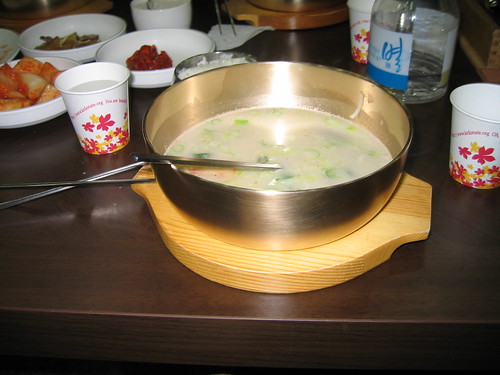
First Meal In Korea!


I'm typing this through a cloud of jetlag and confusion. It's so very strange to be a foreigner, but the strangeness eases me. I feel at home in airports, food courts, empty malls; there I have no responsibility other than to wait, to walk to the right gate, to board the right plane and sit in place, to eat. The ubiquitous novelty of foreignness feels easy. I have no responsibility but to look, to take in, to move.

More later. In the meantime, check out the photos.

Saturday, August 4, 2007

In A Nutshell, The Modern World

So here it is, folks, the high point of our Western Civilization, the apex of human achievement, when we Americans walk up to the metaphysical bank teller to cash our collective check of freedom we get this, and nothing more and nothing less:

I am sitting in the Palm Beach Airport, listening to Feist on my lovely new computer, using the free wifi to check up on the Top Chef wikipedia website. I am chatting with my friends on GChat, about to haul my slightly tanned Brendan-body into an airplane. This, my loyal readers, this is true freedom. All that I need now is a hotdog with bacon bits sprinkled on it. And you know what, I could get one, if I wanted.

You see, I've been camping out in my grandmother's condo for the past couple days, getting fat on mediocre restaurant food, watching cable TV and failing to check my e-mail. A week without e-mail! It's like a week, I dunno, without breathing, or without carbonated beverages! And now that I'm again plunged into the sea of internet connectivity, I am amazed by how simple and yet how essential this confusion of information has become to my daily life.

But you know that already. What's really interesting is that dark province that I ventured into over the last week, the one where we can't find the latest YouTube video of, well, some high cultural achievement, nor can we send our friends messages about how awesome the new Bourne movie will be. In this far-away suburb of the American experience, there is no GMail, there are no blogs, there's just cable TV. So. Let's do a quick recap of what I learned on my weeklong break in Florida:

1) I like the show Top Chef far more than I really should. The basic premise is that it's a reality show, with chefs. And the last episode was so emotional, damn. This chef called Joey got eliminated and it wasn't really his fault, not exactly. But when he found out he started bawling, his face red, these big fat true tears streaming down his cheeks and I just choked up there with him, because he was talking about how everybody said that he could never do anything and here he was, on Top Chef - and of course, he didn't deserve to be eliminated! not at all! Sara so should have been tossed right out on here lazy-bad-cheffing tchuckus. But there is no justice, especially not on Basic Cable.

2) I also like cartoons. Still. Now and forever.

3) And naps.

But now I'm back! So keep on looking out for the posts.