Question asked to me today at lunch:
"At what age do American students start to use mechanical pencils?"

Showing posts with label korea. Show all posts
Showing posts with label korea. Show all posts
Thursday, September 25, 2008

Thursday, August 28, 2008
How Training A Dog Is Like Teaching A Korean Schoolgirl
Check out this cool video from the perma-cool TED talks about... dog training. Not the most interesting subject ever, I know, but this must be the most genius dog trainer you'll see. Ian Dunbar, the dog trainer in question, has a really neat perspective on canine discipline. It's pretty simple, like all great things are. You have to make the dog's desires line up with yours.
This is great because I think we can take everything he says about dog training and apply it to the rest of our lives, translating the advice about teaching "sit puppy" to "now learn some English." So many times in the classroom do I find myself making the mistakes Dunbar ascribes to bad dog owners. I punish the kids by yelling at them. I fail to understand why the kids want to talk with each other instead of listening to me patter on in a foreign tongue. Dunbar's strategy is all about empathy--about seeing 'bad' behaviour as something logical and understandable, not as evidence of metaphysical malfeasance. This requires making a greater-than-usual effort to understand another being's perspective, but the pay-off is huge: instead of seeing my students as THE ENEMY who I must forge into a disciplined English-learning machine, I can see them as creatures with their own desires and needs--I just have to somehow shoehorn English learning in there. If he can understand why a puppy acts up, then I can understand why my students want to talk with each other instead of studying English.
Now, what's the practical upswing of all this rarefied theoretical bullshit? My biggest discipline problem teaching is that my (all-girl) students often want to gossip to each other in Korean. So if I can take their relentless social urge and somehow filter it into English learning, then my classes will be significantly easier, and more fun. The great thing about teaching a language which you won't get from teaching math or literature, is that language-learning is hard-wired in our brains. It is as natural as eating. The pay-off is instantly satisfying: communication. Now how to harness that communication, that's the hard part, but I suppose I will spend the better part of my weekend thinking this through.
Saturday, June 7, 2008
In South Korea, Students Study So Hard They Have To Leave South Korea
The New York Times reports on the curious phenomenon of South Koreans sending their kids to English-speaking countries to study English. Don't think for a second when you're reading this that this is at all rare. In every single class I teach there is at least one student who has lived in Australia or Canada or New Zealand (usually Canada). Sometimes there are two or three. And these students have a definite edge over the other kids, at least when it comes to English.
The demand for English education in Korea is huge. There are about 300,000 of us native English teachers here (keep that number in mind when you read that Lee Myun Bak wants to add an additional 10,000). And part of the reason why the demand is so great is that there exists a sort of low-level desperation about English. Everybody knows that it's important, and everybody studies very very hard, but learning good English, the sort of English expressed on test scores, seems almost Sisyphean.
And the problem I see is that the high cost of education is driving a wedge between rich and poor. After-school kids are expected to go to private academies (which cost a lot of money) and these kids will do better in class. And so in the public school classroom, the bar is raised a little higher--perhaps so high that the kids whose families cannot afford academies or private tutors or trips to Australia will fall behind. I know in my classroom sometimes the only kids who can understand me are those who have been to America, go to two English academies a day.
And it's not like the kids who can do well are enjoying themselves. My students--middle school students--study so much that when I ask them questions like "What are your hobbies?" they tell me "Sleep." "Video games." Indeed, after the last vacation I asked my students: "What did you do?" and many told me "I went to Bangkok."---This is Korean slang for staying in the house all day. (Bang means room, and I think Ko means corner [I'm not sure.]) Anyway. The kids are being educated ragged. Without the freedom to let their minds play, get creative, rebel, create themselves.... Just so they can speak good English. Damn.
The demand for English education in Korea is huge. There are about 300,000 of us native English teachers here (keep that number in mind when you read that Lee Myun Bak wants to add an additional 10,000). And part of the reason why the demand is so great is that there exists a sort of low-level desperation about English. Everybody knows that it's important, and everybody studies very very hard, but learning good English, the sort of English expressed on test scores, seems almost Sisyphean.
And the problem I see is that the high cost of education is driving a wedge between rich and poor. After-school kids are expected to go to private academies (which cost a lot of money) and these kids will do better in class. And so in the public school classroom, the bar is raised a little higher--perhaps so high that the kids whose families cannot afford academies or private tutors or trips to Australia will fall behind. I know in my classroom sometimes the only kids who can understand me are those who have been to America, go to two English academies a day.
And it's not like the kids who can do well are enjoying themselves. My students--middle school students--study so much that when I ask them questions like "What are your hobbies?" they tell me "Sleep." "Video games." Indeed, after the last vacation I asked my students: "What did you do?" and many told me "I went to Bangkok."---This is Korean slang for staying in the house all day. (Bang means room, and I think Ko means corner [I'm not sure.]) Anyway. The kids are being educated ragged. Without the freedom to let their minds play, get creative, rebel, create themselves.... Just so they can speak good English. Damn.
Thursday, June 5, 2008
Korean Food: A Crash Course
Today at an impromptu teacher's lunch/dinner (the proceedings stretched continuously from about eleven thirty in the morning until five in the evening) I ate the following, in order.
FIRST SNACK
Kimbap.
Coffee.
SECOND SNACK
Korean lunch-box (including pork cutlet, rice, soup, and a variety of other things whose name I do not know.)
Coffee
Coffee-flavored cookies.
THIRD SNACK (speared by the P.E. teacher as he waded into the ocean in a SCUBA suit--literally killed by the P.E. teacher not more than three minutes prior to the food sliding into our mouths--did I mention that we were eating this all right on the beach?)
Fresh sea cucumber.
Assorted fish.
APPETIZER
Mussel soup.
SECOND APPETIZER
Live! Sea! Cucumber!
Live penis fish. (I do not know what this is in English, but it looks like a penis, and it's most certainly an invertebrate, because even after you kill it and chop it up it continues to writhe in agony suggesting it has no central nervous system. It looks pretty much exactly like a penis.)
Live octopus.
Some sort of crustacean that tastes like sea water that we certainly do not eat in America.
MAIN DISH
Fresh scallops (still moving) cooked on a table-mounted barbecue. (The first cooked thing we ate all day!)
Some other sort of fresh shell-fish.
Kim-chee.
AFTER-MAIN DISH SNACK
Eel. (Now, there were many things I ate which the Korean teachers suggested would give me 'stamina', basically all the phallic fish which you ate still alive fall into this category, for obvious reason, but the very most potent stamina-boosting food was the spine of the eel, served separately from the rest of the eel, and I ate about ten of them, these spines, and though you might think that the whole stamina thing is bullshit, I'm having heart palpitations right now, and I blame it squarely on my eel-induced male power.
I managed to get home somehow but some of the P.E. teachers want me to come out and drink with them. But I can barely move.
FIRST SNACK
Kimbap.
Coffee.
SECOND SNACK
Korean lunch-box (including pork cutlet, rice, soup, and a variety of other things whose name I do not know.)
Coffee
Coffee-flavored cookies.
THIRD SNACK (speared by the P.E. teacher as he waded into the ocean in a SCUBA suit--literally killed by the P.E. teacher not more than three minutes prior to the food sliding into our mouths--did I mention that we were eating this all right on the beach?)
Fresh sea cucumber.
Assorted fish.
APPETIZER
Mussel soup.
SECOND APPETIZER
Live! Sea! Cucumber!
Live penis fish. (I do not know what this is in English, but it looks like a penis, and it's most certainly an invertebrate, because even after you kill it and chop it up it continues to writhe in agony suggesting it has no central nervous system. It looks pretty much exactly like a penis.)
Live octopus.
Some sort of crustacean that tastes like sea water that we certainly do not eat in America.
MAIN DISH
Fresh scallops (still moving) cooked on a table-mounted barbecue. (The first cooked thing we ate all day!)
Some other sort of fresh shell-fish.
Kim-chee.
AFTER-MAIN DISH SNACK
Eel. (Now, there were many things I ate which the Korean teachers suggested would give me 'stamina', basically all the phallic fish which you ate still alive fall into this category, for obvious reason, but the very most potent stamina-boosting food was the spine of the eel, served separately from the rest of the eel, and I ate about ten of them, these spines, and though you might think that the whole stamina thing is bullshit, I'm having heart palpitations right now, and I blame it squarely on my eel-induced male power.
I managed to get home somehow but some of the P.E. teachers want me to come out and drink with them. But I can barely move.
Monday, June 2, 2008
In South Korea, It Never Ends
The it meaning work. My humble host nation topped the list of the hardest working countries. The average South Korean works six and a half hours a day EVERY DAY OF THEIR LIVES.
Thankfully, this workaholism does not transfer to the large English-teaching population. Although if you counted my literary pursuits as 'work' I am probably pretty high up there, as far as total hours spent in work each day.
Just to emphasize something that they mentioned in the article, here you are often given a title depending on your job. Instead of Mr. Mackie I am Mackie-Teacher, or, in proper South Korean, Mackie San Sang Nim.
Thankfully, this workaholism does not transfer to the large English-teaching population. Although if you counted my literary pursuits as 'work' I am probably pretty high up there, as far as total hours spent in work each day.
Just to emphasize something that they mentioned in the article, here you are often given a title depending on your job. Instead of Mr. Mackie I am Mackie-Teacher, or, in proper South Korean, Mackie San Sang Nim.
Monday, May 12, 2008
Blog-Hiatus
As is probably painfully obvious to my readers, I haven't really been posting for the last month or so. My writing energies have been focused elsewhere: I'm cranking out a novel, so all the words stored up in my head are going towards that novel for the moment. But let's see if I can't post a little more regularly from here on out.
For your pleasure, here's a quick game. We'll play: Guess which thing about Korea is a blatant lie. Put your answers in the comments.
1) While Western cultures have Valentines day, Korea goes one step better-it has a Valentines day on the 14th of every single month. The 14th of February is Red Valentine's day, where women give candy to the men they like. The 14th of March is White Valentine's Day, where it's the guy's turn to stimulate the greeting card industry. The 14th of April is called Black Valentine's Day, where singles eat a black Chinese noodle called Jaja Myun which mirrors the blackness of their hearts. There are other color-coded Valentines for the other months, but nobody really remembers what the rest of them are.
2) In Korean restaurants you will often be served a dish of hot peppers. You are meant to take these hot peppers and then dip them into hot pepper sauce.
3) There are no less than two Korean TV channels devoted to the 1998 video-game Starcraft.
4) A popular after-work activity is going to a Noraebang, or singing room, where you and your workmates can go get drunk and sing karaoke. Often, these singing rooms will come with an added feature: you can rent companion women! Whether these women are actively prostitutes or not is an open question, but men will pay them to sit with them and drown them in compliments.
5) Around half of South Korean women get plastic surgery, usually to make their appearance more 'western'. The subways are festooned with signs reading "Big eyes, lovely breasts" which pretty much sums up the South Korean aesthetic ideal.
I'll post the answer in a week.
For your pleasure, here's a quick game. We'll play: Guess which thing about Korea is a blatant lie. Put your answers in the comments.
1) While Western cultures have Valentines day, Korea goes one step better-it has a Valentines day on the 14th of every single month. The 14th of February is Red Valentine's day, where women give candy to the men they like. The 14th of March is White Valentine's Day, where it's the guy's turn to stimulate the greeting card industry. The 14th of April is called Black Valentine's Day, where singles eat a black Chinese noodle called Jaja Myun which mirrors the blackness of their hearts. There are other color-coded Valentines for the other months, but nobody really remembers what the rest of them are.
2) In Korean restaurants you will often be served a dish of hot peppers. You are meant to take these hot peppers and then dip them into hot pepper sauce.
3) There are no less than two Korean TV channels devoted to the 1998 video-game Starcraft.
4) A popular after-work activity is going to a Noraebang, or singing room, where you and your workmates can go get drunk and sing karaoke. Often, these singing rooms will come with an added feature: you can rent companion women! Whether these women are actively prostitutes or not is an open question, but men will pay them to sit with them and drown them in compliments.
5) Around half of South Korean women get plastic surgery, usually to make their appearance more 'western'. The subways are festooned with signs reading "Big eyes, lovely breasts" which pretty much sums up the South Korean aesthetic ideal.
I'll post the answer in a week.
Saturday, April 19, 2008
Check out the swag!
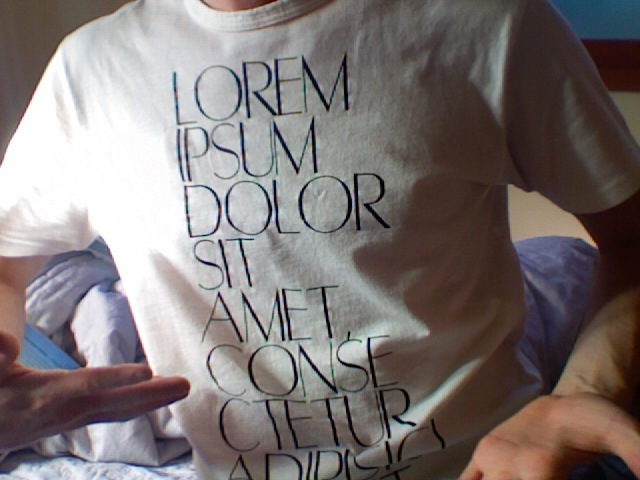
I got this T-shirt. The tag says you can find more at hellogas.com/worldtypographers. I couldn't find the shirt there, though. Curious?
Friday, March 28, 2008
What Do 400 Sleep-Deprived School Girls Look Like?

Check out the new photos if you're curious. And be sure to read the descriptions, I've told a lot of the story there.
Thursday, March 13, 2008
Photos are up!

See a pictorial representation of my first week or so in Korea. Need to pick up one of those adapter-things to begin to chronicle the next leg of my journey, but at least for now there are a handful of piccies for you all to gander at!
Monday, March 3, 2008
First day at school!
A morning mist settled over Busan, grey and crisp, but as the day wore on the mist refused to lift, cuddling its langorous tails around mountains and buildings until late in the evening, leaving a dusty, acrid stink. What had looked like a pleasant meterological phenomena was nothing of the sort. The mist was almost as much of politics as of percipitation: a wholly un-benign Chinese import: smog. When the wind blows right, Busan fills its lungs full of Chinese air. Elementary school children are given the day off school. It's too dangerous for them to go outside.
It was my first day at school - and I could think of it as one of the more awkward moments of my life, if I wanted to. Everything I do here, I do for the first time. Everything I do, I'm baffled. One of the only ways I have of drawing a line of sense through all the sensations that come my way is through complaining. Because when I complain--that the food is strange, that I cannot get anywhere by myself, that I feel overwhelmed--my life becomes arranged around the concept of some idealized life in which all the food was familiar, in which I could communicate easily with everyone around me, and in which I lived a life of ease. Instead, letting go of complaints, I have to admit my life for what it is: essentially meaningless; or rather, a life whose meaning has been closed off for me, obscured, rubbed out, confused. I get to school, I stand in the right places, I smile and I nod and I try to be helpful, but at this point I think I am more a symbol. I am a symbol that has not yet been reckoned, added, subtracted, divided, multiplied, or plumbed.
The taxi driver who took me to the school this morning didn't know where the school actually was so we drove around aimlessly for a little while before, a couple cel phone calls later, after asking random school-girls on the street, we made it to the big red-brick building that is the reason why I flew across an ocean to teach. The big bulk of my day was spent overcomign odd technical difficulties that I would at this point rather forget. But in the remainder of my day I was intorduced to the whole school through the school's CCTV, Iand to the other teachers, and I had a bunch of students come up to me to pracise their english and tell me I looked handsome. Aw shucks! If only the actual teaching part was that easy. But even though I didn't do too much, there was so much newness that I made it back to my apartment exausted, and, after a bit of a dining adventure I'll write about once I can get my photos up on Flickr, I settled into a thick, dreamless, half-day sleep.
It was my first day at school - and I could think of it as one of the more awkward moments of my life, if I wanted to. Everything I do here, I do for the first time. Everything I do, I'm baffled. One of the only ways I have of drawing a line of sense through all the sensations that come my way is through complaining. Because when I complain--that the food is strange, that I cannot get anywhere by myself, that I feel overwhelmed--my life becomes arranged around the concept of some idealized life in which all the food was familiar, in which I could communicate easily with everyone around me, and in which I lived a life of ease. Instead, letting go of complaints, I have to admit my life for what it is: essentially meaningless; or rather, a life whose meaning has been closed off for me, obscured, rubbed out, confused. I get to school, I stand in the right places, I smile and I nod and I try to be helpful, but at this point I think I am more a symbol. I am a symbol that has not yet been reckoned, added, subtracted, divided, multiplied, or plumbed.
The taxi driver who took me to the school this morning didn't know where the school actually was so we drove around aimlessly for a little while before, a couple cel phone calls later, after asking random school-girls on the street, we made it to the big red-brick building that is the reason why I flew across an ocean to teach. The big bulk of my day was spent overcomign odd technical difficulties that I would at this point rather forget. But in the remainder of my day I was intorduced to the whole school through the school's CCTV, Iand to the other teachers, and I had a bunch of students come up to me to pracise their english and tell me I looked handsome. Aw shucks! If only the actual teaching part was that easy. But even though I didn't do too much, there was so much newness that I made it back to my apartment exausted, and, after a bit of a dining adventure I'll write about once I can get my photos up on Flickr, I settled into a thick, dreamless, half-day sleep.
Thursday, February 21, 2008
First Meal In Korea!
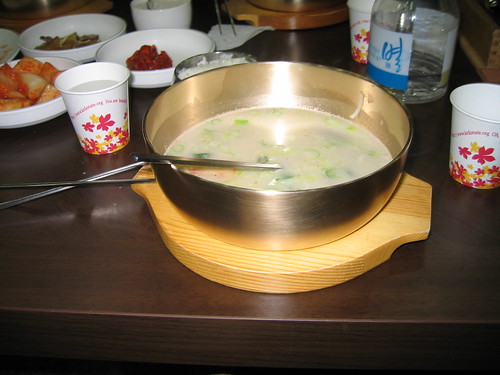
I'm typing this through a cloud of jetlag and confusion. It's so very strange to be a foreigner, but the strangeness eases me. I feel at home in airports, food courts, empty malls; there I have no responsibility other than to wait, to walk to the right gate, to board the right plane and sit in place, to eat. The ubiquitous novelty of foreignness feels easy. I have no responsibility but to look, to take in, to move.
More later. In the meantime, check out the photos.
Subscribe to:
Posts (Atom)