Check out the new photos if you're curious. And be sure to read the descriptions, I've told a lot of the story there.
Friday, March 28, 2008
What Do 400 Sleep-Deprived School Girls Look Like?
Check out the new photos if you're curious. And be sure to read the descriptions, I've told a lot of the story there.
Sunday, March 16, 2008
Things Taste Strange, Things Are Strange
You would easily expect food to be different in Korea. And you're right. You will notice of course the very obvious differences--but those differences you expect, you expect the Koreans to eat live octopus and kim chee But it are those more subtle, less superficial differences in taste that end up shocking you. I have two examples of this. Both of them come from the workplace casual of the staff-room.
A couple hours ago I was offered what the Koreans call a japjari tomato. This is a green tomato that you eat raw and whole, like an apple. Now, we're all used to tomatoes in our sauces and on our salads and on our sandwiches or over our pasta or on our pizza, but I think this was one of the first times when I just had a tomato--just a lone tomato. And the taste was a tart explosion of a vinegary pulp with a ringing bite of brine, with a slight fog of unami hanging as an aftertaste, with a mouthfeel like a squishy apple. Sure, it tasted like a tomato. But here, out of context, even the taste of a tomato can taste utterly foreign, a revelation.
And then I was just chatting to a fellow teacher when she handed me a stub of a microwaved sweet potato. "Here," she said. And I ate it. Just like you'd eat some chips.
Sweet potatoes as a snack? Tomatoes eaten like an apple? Strange food isn't just a matter of mixing strange ingredients, but a matter of thinking about ingredients differently. Indeed, so much of our cooking--like so much of our culture--is simply contingent, arbitrary, and meaningless, the epiphenomena of history, and yet we tie food so tightly around our sense of self, it sometimes still baffles me how meaningful it all seems.
Thursday, March 13, 2008
Photos are up!
See a pictorial representation of my first week or so in Korea. Need to pick up one of those adapter-things to begin to chronicle the next leg of my journey, but at least for now there are a handful of piccies for you all to gander at!
Tuesday, March 11, 2008
I'm Looking Over A Four-Leafed Clover
From Slate, via Bookforum - a story about the Clover. The best coffee machine in the universe. Or at least the most expensive.
The Problem With Political Blogs
Now I'm a blog junkie, a blog convert, a blog evangelizer, a blog fanatic, I've joined the club, drunk the kool-aid and jumped the shark. I especially like political blogs. I reckon I get a livelier and more honestly informed take on politics from blogs than from newspapers. (I nearly wrote "better informed" but I think the crucial difference between a blogger and a reporter is that a blogger is allowed to write to a better informed audience, the reporter himself may actually be better informed but just can't get that information on the page.) But I thought of a problem with political blogs that hadn't touched my mind before.
There's a certain balkanization of subject matter on blogs. You come to trust particular bloggers, some of whom you return to day after day, but those particular bloggers are only good at a handful of subjects. But let's say something incredibly important happens in the world--say, some obscure crisis in the financial markets, or a some small state that nobody's ever heard of causing a large-scale diplomatic blow-up. Well then the bloggers that I rely on might not be able to deliver the goods on those weird weird subjects. So what am I to do.\?
Now, what I think happens in those situations is this: bloggers read more blogs than anybody else. If they don't know what's up, they're likely to know somebody who knows something, and thus will put up a nice snip and a nice link. But as a reader, this is the moment when I turn my eyes back to the newspapers and news magazines. They're more likely to have a broader range of good material than blogs. Sorry, bloggers!
There's a certain balkanization of subject matter on blogs. You come to trust particular bloggers, some of whom you return to day after day, but those particular bloggers are only good at a handful of subjects. But let's say something incredibly important happens in the world--say, some obscure crisis in the financial markets, or a some small state that nobody's ever heard of causing a large-scale diplomatic blow-up. Well then the bloggers that I rely on might not be able to deliver the goods on those weird weird subjects. So what am I to do.\?
Now, what I think happens in those situations is this: bloggers read more blogs than anybody else. If they don't know what's up, they're likely to know somebody who knows something, and thus will put up a nice snip and a nice link. But as a reader, this is the moment when I turn my eyes back to the newspapers and news magazines. They're more likely to have a broader range of good material than blogs. Sorry, bloggers!
Friday, March 7, 2008
Coffees I Have Known And Loved
I have had a half a dozen utterly unimpeachable, perfect cups of coffee--maybe fewer. These cups have become my measure of coffee, the ideals that all other coffees are held to. The best cup of my recent memory I had at Kopplin's Coffee in the Twin Cities. Kopplins, using some ridiculously expensive coffee machine called a Clover and employing baristas with upper-level research degrees in coffee preparation, makes a perfectly smooth and welcome cup of coffee that presents the taste of coffee beans with the same deceptively easy grace with which a great chef presents the taste of a cut of steak: the art is not in disguising, mixing, or melding the taste of the thing at hand, but in drawing the taste out, forcing you to taste the essential flavors. The next best cup of coffee I remember came from a neighborhood cafe in Seinna. The cafe was a loud, sweaty, congenial place, and I was a bit of a regular. I remember one lunch rush I tried to pay with a large bill and the barista yelled at me and waved me away, giving me the coffee on the house because he had no time to make me change. It was a cappuccino. I must've been about fifteen. And I remember that first sip as the taste that I am always looking for when I get coffee, the perfect coffee moment, tinged with equal parts embarrassment and joy.
What I have realized over the past week or so, though, is that even the mediocre, daily coffee that I have been used to is really actually very good, on the grand world-wide continuum of good and bad coffee. For all America's venality and shittiness, it sure can make a good cup of coffee. Here in Korea, when you ask for coffee you get, not some concoction brewed from ground coffee beans, but instant coffee, with lots of sugar and fake cream. This is everywhere you go, from fancy restaurants to places that are presumably cafes to the local gas station. And it is not some nation-wide monoculture of bad coffee, either: there is a lot of variation into the kind of bad coffee, I imagine whole industries devoted to the perversion and desecration of my favorite drink. The most common offense comes in the form of little plastic sachets, individually portioned with a mixture of sugar instant coffee and fake cream, that you empty into a cup of hot water, leading to a thin, joyless caffeine and fat delivery system. But I have also, in this brief week, sampled coffee partitioned out into tea bags and left to steep for five minutes, making a bitter, joyless coffee tea, and I have encountered brewed coffee left to heat for half an hour or more, resulting in a thick, joyless, coffee-like sludge, which is the closest to real coffee I have come; I have also swallowed my pride and bought--from the local supermarket--a joyless and unholy cup of Starbucks-branded 'espresso' that tastes closer to a cocktails of bitterness and capitalism than it tastes to the fare of my local and beloved cafes back in America.
But addiction is addiction, and still I buy coffee. And still, that inaugural sip first thing in the morning, that sip that coalesces reality around me, that ushers in every subsequent productive and un-productive moment, the sip that tells me that I am indeed alive--even when it's bad coffee, it's still the single most lovely part of my day.
Tuesday, March 4, 2008

Jason Kotke is the quintessential web denizen - the unimpeachable everyman of the web and his blog, more than any other site, sums up the learned culture of the internet. Why do I lavish this praise on the already much-read, much-beloved, and much-written-about Mr. Kottke? Because, in addition to the posts he did on birds eating toxic waste to get dates, in addition to competitive crossword puzzle mavens, he turned me on to Kitty Wigs. Which has to be the most internetty thing in the whole universe. (All in the past 24 hours!)
Monday, March 3, 2008
First day at school!
A morning mist settled over Busan, grey and crisp, but as the day wore on the mist refused to lift, cuddling its langorous tails around mountains and buildings until late in the evening, leaving a dusty, acrid stink. What had looked like a pleasant meterological phenomena was nothing of the sort. The mist was almost as much of politics as of percipitation: a wholly un-benign Chinese import: smog. When the wind blows right, Busan fills its lungs full of Chinese air. Elementary school children are given the day off school. It's too dangerous for them to go outside.
It was my first day at school - and I could think of it as one of the more awkward moments of my life, if I wanted to. Everything I do here, I do for the first time. Everything I do, I'm baffled. One of the only ways I have of drawing a line of sense through all the sensations that come my way is through complaining. Because when I complain--that the food is strange, that I cannot get anywhere by myself, that I feel overwhelmed--my life becomes arranged around the concept of some idealized life in which all the food was familiar, in which I could communicate easily with everyone around me, and in which I lived a life of ease. Instead, letting go of complaints, I have to admit my life for what it is: essentially meaningless; or rather, a life whose meaning has been closed off for me, obscured, rubbed out, confused. I get to school, I stand in the right places, I smile and I nod and I try to be helpful, but at this point I think I am more a symbol. I am a symbol that has not yet been reckoned, added, subtracted, divided, multiplied, or plumbed.
The taxi driver who took me to the school this morning didn't know where the school actually was so we drove around aimlessly for a little while before, a couple cel phone calls later, after asking random school-girls on the street, we made it to the big red-brick building that is the reason why I flew across an ocean to teach. The big bulk of my day was spent overcomign odd technical difficulties that I would at this point rather forget. But in the remainder of my day I was intorduced to the whole school through the school's CCTV, Iand to the other teachers, and I had a bunch of students come up to me to pracise their english and tell me I looked handsome. Aw shucks! If only the actual teaching part was that easy. But even though I didn't do too much, there was so much newness that I made it back to my apartment exausted, and, after a bit of a dining adventure I'll write about once I can get my photos up on Flickr, I settled into a thick, dreamless, half-day sleep.
It was my first day at school - and I could think of it as one of the more awkward moments of my life, if I wanted to. Everything I do here, I do for the first time. Everything I do, I'm baffled. One of the only ways I have of drawing a line of sense through all the sensations that come my way is through complaining. Because when I complain--that the food is strange, that I cannot get anywhere by myself, that I feel overwhelmed--my life becomes arranged around the concept of some idealized life in which all the food was familiar, in which I could communicate easily with everyone around me, and in which I lived a life of ease. Instead, letting go of complaints, I have to admit my life for what it is: essentially meaningless; or rather, a life whose meaning has been closed off for me, obscured, rubbed out, confused. I get to school, I stand in the right places, I smile and I nod and I try to be helpful, but at this point I think I am more a symbol. I am a symbol that has not yet been reckoned, added, subtracted, divided, multiplied, or plumbed.
The taxi driver who took me to the school this morning didn't know where the school actually was so we drove around aimlessly for a little while before, a couple cel phone calls later, after asking random school-girls on the street, we made it to the big red-brick building that is the reason why I flew across an ocean to teach. The big bulk of my day was spent overcomign odd technical difficulties that I would at this point rather forget. But in the remainder of my day I was intorduced to the whole school through the school's CCTV, Iand to the other teachers, and I had a bunch of students come up to me to pracise their english and tell me I looked handsome. Aw shucks! If only the actual teaching part was that easy. But even though I didn't do too much, there was so much newness that I made it back to my apartment exausted, and, after a bit of a dining adventure I'll write about once I can get my photos up on Flickr, I settled into a thick, dreamless, half-day sleep.
Thursday, February 21, 2008
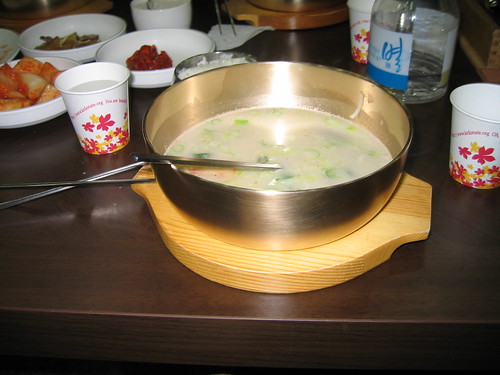
First Meal In Korea!
I'm typing this through a cloud of jetlag and confusion. It's so very strange to be a foreigner, but the strangeness eases me. I feel at home in airports, food courts, empty malls; there I have no responsibility other than to wait, to walk to the right gate, to board the right plane and sit in place, to eat. The ubiquitous novelty of foreignness feels easy. I have no responsibility but to look, to take in, to move.
More later. In the meantime, check out the photos.
Tuesday, February 19, 2008
New York Times + Cephalopods = Global Media Conspiracy?
New York Times video on a scientist researching cephalopod camouflage.
Same guy who did the legendary octopus video, embedded below.
Monday, February 18, 2008
A Fact About Chicago
It seems that the adoption of the bowl would be a fairly straightforward process, but not in Chicago. Most of urban Chicago didn’t use bowls until the early 1930s. The social reformer Jane Addams called Chicago’s lack of adequate bowls “a disgrace of governance and civic will,” but it took a riot—the famed soup riots of 1933—to make the bowl a common addition to Chicago dinner tables.
The problem was simple: the various department stores in Chicago all got their flatware from a single supplier, S. N. Arch and sons and Silas N. Arch didn’t think there was much demand for bowls because of Chicago’s famed distaste for soup. “Steak, potatoes, that’s all a man needs,” the secretive Arch is reported to have said whenever the subject of bowls came up. “Bowls are for sniveling weaklings and the lesser races.”
Some families would have heirloom bowls, or bowls sent over from relatives, but surprisingly the majority of Chicagoans survived without the bowl for generations. Some were even proud of Chicago’s lack of bowls. “No soup here!” was the sign in the window of a prominent downtown café: soup, Chicagoans thought, was the food of the poor.
But during the Great Depression, charities set up to distribute food—mostly in the form of thin soups or gruel—found that they lacked the necessary bowls to get food to the stomachs of the hungry masses. On a dismal January night in 1933 after being denied food because of a lack of bowls, a horde of dispossessed young men stormed to the front of prominent department stores, demanding the missing piece of flatware. Police were called in, and twelve lives ended that cold night.
Silently, bowls entered the department stores—and kitchens— of Chicago and have stayed there ever since!
Sunday, February 17, 2008
Saturday, February 9, 2008
Wednesday, February 6, 2008
Random Facts, Anyone?
Mental Floss has just made a Random Fact Generator. People can make their own facts and send them in! Unfortunately, the facts have to be true. For a second there I thought I had a new career.
The last post was my 100th post on Raise High The Roofbeam, Carpenters, by the way!
Help me celebrate?
The last post was my 100th post on Raise High The Roofbeam, Carpenters, by the way!
Help me celebrate?
Sunday, February 3, 2008
Quotes From The Times
No longer the bloody avatar of wounded American pride, he seems more inclined toward humanitarian intervention — a one-man N.G.O. with a machete. Will he show up in Darfur next?
“In the past, Britain was something that just happened,” he said. “You didn’t have to think about it."
Each slice was perched on a round of Italian bread, but most of the men ate only the meat and stacked the bread slices in front of them, tallying their gluttony like poker players amassing chips.
A single woman, courted by two eligible men, will be drawn toward the man who is superficially right but ontologically wrong for her before choosing, in the final 20 minutes, the man with the opposite qualities.
Hoax Time, Please!
Mental_Floss runs down four of history's best hoaxes. They're a bit predictable, though, so here are a couple of my favorites to supplement:
The Trojan Horse has to be the boldest hoax in history. The premise--that the Greeks would offer the Trojans a gift of a huge wooden horse--is just weird.. What sort of gift is a huge wooden horse, anyway? Scholars will tell you this is because the Trojans really liked horses. This explanation explains nothing. But it makes for a great hoax, mixing equal amounts audacity, cleverness, and misdirection.
The Count Saint German made his way through 18th Century Europe scamming courtiers, spreading rumors of his mystic prowess (including his miraculous ability to never die), and issuing a stream of prattle so wondrous it lightens the heart. Here's Cassanova on Saint Germain (who knows about the accuracy - it's from Wikipedia):
The greatest part of the story of Saint Germain is that even now--hundreds of years later--impressionable young occultists will swallow the Count's stories like they were peer-reviewed scientific truth. Poor creatures.
In the annals of hoaxing, chapters and chapters--whole volumes!--should be devoted to the Australians. Something about the climate makes tall tales a near Olympic sport. Maybe it's the climate of free-flowing beer. If you're ever out camping with a group of Australians, inevitably one will tell you about the deadly Dropbear, a carnivorous version of the cuddlesome Koala. The Dropbear's most favorite snack is a tourist. It drops on them. And eats them up. And it doesn't exist. It's just a story to scare poor confused Americans.
Even the cream of Australian culture can't help but engage in a little lying now and then. Pissed off about the utter nonsense of modernist poetry, two conservative poets sent in a series of meaningless poems to Australia's premier modernist poetry rag and signed them by the name Ern Malley. The hoax ended with the magazine's young editor Max Harris getting charged with obscenity for some reason. The funny thing about Ern Malley is that, well, even though his poems are meaningless twaddle, everybody likes them. I like them. Here's the first in the Ern Malley cycle:
The Japanese have really been very innovative about hoaxing, exaggerating, contorting, and refining the technique the with the same aplomb that turned robots into GIANT ROBOTS. Now, to set the scene: poodles are all the rage in Japan, costing upwards of a thousand dollars. A Japanese celebrity is on a talk show, chatting about her poodle when she complained that her poodle didn't bark and refused to eat dog food. Turns out the poodle was a lamb and some scam artist was selling lambs as poodles. And it also turned out that the whole widely-reported story was a hoax. How's that for innovation, kids?
The Count Saint German made his way through 18th Century Europe scamming courtiers, spreading rumors of his mystic prowess (including his miraculous ability to never die), and issuing a stream of prattle so wondrous it lightens the heart. Here's Cassanova on Saint Germain (who knows about the accuracy - it's from Wikipedia):
The most enjoyable dinner I had was with Madame de Gergi, who came with the famous adventurer, known by the name of the Count de St. Germain. This individual, instead of eating, talked from the beginning of the meal to the end, and I followed his example in one respect as I did not eat, but listened to him with the greatest attention. It may safely be said that as a conversationalist he was unequalled.
The greatest part of the story of Saint Germain is that even now--hundreds of years later--impressionable young occultists will swallow the Count's stories like they were peer-reviewed scientific truth. Poor creatures.
In the annals of hoaxing, chapters and chapters--whole volumes!--should be devoted to the Australians. Something about the climate makes tall tales a near Olympic sport. Maybe it's the climate of free-flowing beer. If you're ever out camping with a group of Australians, inevitably one will tell you about the deadly Dropbear, a carnivorous version of the cuddlesome Koala. The Dropbear's most favorite snack is a tourist. It drops on them. And eats them up. And it doesn't exist. It's just a story to scare poor confused Americans.
Even the cream of Australian culture can't help but engage in a little lying now and then. Pissed off about the utter nonsense of modernist poetry, two conservative poets sent in a series of meaningless poems to Australia's premier modernist poetry rag and signed them by the name Ern Malley. The hoax ended with the magazine's young editor Max Harris getting charged with obscenity for some reason. The funny thing about Ern Malley is that, well, even though his poems are meaningless twaddle, everybody likes them. I like them. Here's the first in the Ern Malley cycle:
I love those last four lines. Bonus points for this story is that back in my career as an up-and-coming young Australian writer I swept the youth section of the Max Harris literary awards. Hurrah.Dürer: Innsbruck, 1495
I had often, cowled in the slumberous heavy air,
Closed my inanimate lids to find it real,
As I knew it would be, the colourful spires
And painted roofs, the high snows glimpsed at the back,
All reversed in the quiet reflecting waters
Not knowing then that Dürer perceived it too.
Now I find that once more I have shrunk
To an interloper, robber of dead men’s dream,
I had read in books that art is not easy
But no one warned that the mind repeats
In its ignorance the vision of others. I am still
the black swan of trespass on alien waters.
The Japanese have really been very innovative about hoaxing, exaggerating, contorting, and refining the technique the with the same aplomb that turned robots into GIANT ROBOTS. Now, to set the scene: poodles are all the rage in Japan, costing upwards of a thousand dollars. A Japanese celebrity is on a talk show, chatting about her poodle when she complained that her poodle didn't bark and refused to eat dog food. Turns out the poodle was a lamb and some scam artist was selling lambs as poodles. And it also turned out that the whole widely-reported story was a hoax. How's that for innovation, kids?
Saturday, February 2, 2008
What Do You Think Of The New Color Scheme?
I was thinking that the whole white-text-on-blue-background might be hard to read. So I changed it. What do you think?
1 2 3 4 5 6 7 Days In Brendan Mackie!
This is it, folks! The last full week of Brendan at Utne! There will still be some Utne blogging, although it's unclear how much there will be.... But that means this here blog will be a little bit better maintained. Which means you (and by you I mean the internet) should start reading it. Come on! I'm a semi-professional writer now!
Media Lies Both Political And Scientific
From The Stacks: King-Cat Comix
The Not-So-Great Race
Fiction 2.0
London Times Caught Cheating Social Networking Sites
This New House
Drop a comment in this comment thread for fun! I would like to have contests up here, but I don't know if I have the critical mass to have contests. I probably don't. But as a game - a fun little game - if you read this, drop a comment in the comment box: and maybe I can write you your own personal squid fact. For free! Yeah, howabout that. If you drop me a comment in the comment box I will write you your very own personalized squid fact. So do it. So I know that you're out there.
Media Lies Both Political And Scientific
From The Stacks: King-Cat Comix
The Not-So-Great Race
Fiction 2.0
London Times Caught Cheating Social Networking Sites
This New House
Drop a comment in this comment thread for fun! I would like to have contests up here, but I don't know if I have the critical mass to have contests. I probably don't. But as a game - a fun little game - if you read this, drop a comment in the comment box: and maybe I can write you your own personal squid fact. For free! Yeah, howabout that. If you drop me a comment in the comment box I will write you your very own personalized squid fact. So do it. So I know that you're out there.
Subscribe to:
Posts (Atom)