Are you a wonk or a snark?
Consider this an open thread.

Thursday, August 23, 2007

Sunday, August 19, 2007
Thoughts On Art And The Body
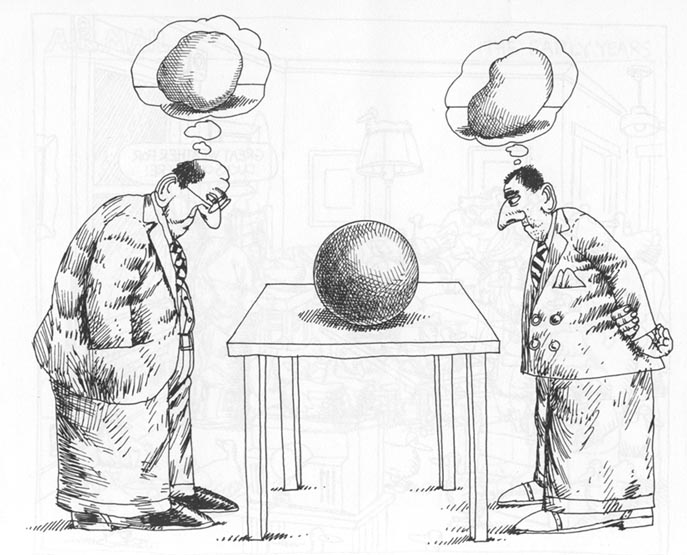
Here’s my question: do we forget ourselves when we’re moved by art?
A deeper question that motivates this is: what the hell is the nature of that artistic experience? Is there a single sort of ‘artistic experience’ that can cover the appreciation of all the arts, from dancing to poetry? Or are they all member of a broader class of experience? Or are they simply all called ‘art’ because of some linguistic misnomer, the same way whales were once thought of as fish? But we’re not going to get into that larger question right now.
I was thinking about this all last night at a mellow rock concert. All us kids were mustered around the stage, ignoring anything else that wasn’t held in the yellow and red gel-lights that flooded the small stage. Now, what I was thinking was that when we are moved by art, when we stare at the woman playing keyboard singing her heart out on the stage, we forget ourselves. We stop thinking of our own individual fabric of memory, thought, and body, and are somehow dissolved into something else – namely the artistic experience.
In Kant’s Third Critique I think we see a bit of this. Kant thought that all aesthetic judgments were universal, at least ideally; and that when we viewed art we did so disinterestedly – that is, ignoring the bias of personality. So when I look at a given work of art and call it trash, I don’t mean “Me, Brendan Mackie, who had a bad day today and is a white male in 2007 America, think that this work of art is a piece of trash” I mean “This piece of art is a piece of trash for everyone at any point in time” and implicitly “any dissenting opinion is a result of a failure of judgment or taste”. The disinterested viewer, the ideal viewer, will have the same reaction to a piece of art no matter who they are. It is up to the viewer of the art to get into the space in which they can filter out all the inessential quirks of their personal experience to experience something artistic that is somehow common to all people. (If anyone out there knows Kant better than me, and thinks that I’m butchering the Third Critique here, feel free to drop a comment about it – I haven’t read the damned thing in two years or so.)
But there’s something really unsatisfying about Kant’s view – especially my canned version of Kant’s viewed. Some of the pieces of art I love the most appeal to me not just because of their intrinsic universal value of the me as art objects but because of some personal value I can’t expect other people to share. I like Mirah, for instance, because I listened to her with a really good friend – and also, of course, because I think Mirah makes good music. Even if we partitioned off the personal pleasures of a given piece of art from the non-personal: thereby saying that the pleasure I get from my association of listening to Mirah is not an actual aesthetic pleasure, but more an aesthetic epiphenomena, limiting the aesthetic feeling to only those things that can be expected to be universal; that doesn’t solve the problem of cultural taste. We do not even need to look far beyond our own houses to see the tyranny of culture. My father, for instance, an open-minded and tasteful individual, cannot, for the life of him, understand much rap. But I can. Because I have been inculcated into how to listen to rap. Siilarly, I can’t understand modern dance to save my life and think that every piece of modern dance is a pile of pretentious poo. And while I might very well be right in thinking that, I’m open to the fact that I might not be able to appreciate good modern dance. To read a piece of art requires an understanding of a cultural grammar that we cannot expect to be universal. So we can’t expect our appreciation of art to be universal.
But we can ask a Kantian question and constrain it, and maybe then we come up with something worthwhile: if, without personal association and with the required cultural literacy, is there an essential universal quality to art?
Okay. So that’s just the set-up for my insight. I was wondering, as I watched all these people nodding along to the music last night, that we somehow forget our bodies when we are in the throes of the aesthetic experience. That we lose ourselves, our partictularness, in favor of a deeper, more universal connection to art.
Now I don’t know whether that’s an accurate description of what happens to us when we look at art, but I think that it points to the borders of the aesthetic experience. We have to be really careful when we’re talking about how people respond to art. There’s been an awful lot of ink and hot air thrown about what happens when a person looks at a painting or something and scratches their chin and calls it beautiful. I’d say that the only thing that the aestheticians can agree on is that the aesthetic experience is important. For some reason. Though I’ll be damned if anyone can agree why art is important.
So while I thought about this question, I kept on running into different questions that branched off that.
1) Can you experience art if you are a member of a marginalized minority group?
So much of English majordom is so obsessed by this question, and by the little questions that pop up around it – and I am frankly sick to death of it, and don’t think it leads us down any insightful avenues. So I will ignore it for now.
2) What about when you’re sick, or hungry, or tired – then can you have the aesthetic experience? And is it then diminished somehow?
3) And what about when you’re in a bad mood?
4) Is there are ‘right’ aesthetic experience to a given work? And a wrong one? If I say that Rhapsody in Blue makes we feel jaunty, and everyone else says it makes them feel profound – is my aesthetic experience wrong? Can you have a wrong aesthetic experience? What about an ignorant person who misread Huck Finn and thought that it was genuinely racist? What then?
5) Can we even adequately communicate the aesthetic experience? Or is it somehow beyond the grasp of our words? And if it is beyond the measurement of language – does it exist? I think of Wittgenstein, who argues that there can be no such thing as a private language, that there can be no such thind as words that refer only to individual things in our individual heads; and then I think of Einstein who said “Not everything that matters can be measured”.
6) Is the aesthetic experience even important at all?
Now, I have no answers to any of these questions. But if any of you out there have any – give them to me, I’d be interested to hear.
Monday, August 13, 2007
The Bus As Civic Space
I believe that Americans don't talk enough to one another. We don't discuss politics with people we disagree with, we don't mingle with people beyond our rather narrow habitual territories, we don't explore enough of the cities that we live in. We live in secluded villages of the mind, only rarely stumbling into the haunts of our neighbors. And this is okay. Faced with the overwhelming hubub of modern life, we can do no better than to fracture the civic mirror and pick and choose what picture we look at. But it would be nice to have a shared civic space in the American city - and I don't mean 'space' in the English major way here, no; I mean a real-life physical space. We have television, sure, but we only watch television - few of us actually contribute to it.
But wow, my belief in communicating with people who disagree with me sure got tested this morning. My seat-mate on the bus was reading a book, and I thought I would be nice and friendly and ask her what it was. She was a little hesitant, and actually turned the cover a bit away from me so I couldn't peer over and read the title. After a moment of two of squirming, she asked:
"Are you a liberal?"
Rather than saying yes, or that I was a progressive, or that I have a set of complicated political views that I don't feel can be summed up in a label like 'liberal' or 'conservative' I just said "I don't know." Which surprised my seat-mate, an overweight blond woman who was slurping gas-station coffee.
The book turned out to be Bill O'Reily's Culture Warrior. When she told me this I tensed for a fight, but told myself - well, okay, I should actually listen to her to see if I learn anything. She told me that O'Reily was the only person who really was brave enough to take on the real issues. And that Fox News was the only news station that had the courage enough to deal with unpopular subject. I was sitting there, thinking of all the funny things I could say to her, thinking of how sad it was that she had taken a drink of the Fox News Kool-Aid, and thinking that it is exactly this sort of ignorance that is the problem with America these days.
I told her that I thought O'Reily a great bully, and that he was leading to an era of divisiveness in America, which led to a lack of people who disagreed with one another - like me and her - from talking to each other. But I don't need to tell you what I said. You already know all the wonderful arguments I leveled against her.
But here's the thing: when I left the bus we both remained unconvinced. I had her promise that she would watch some Keith Olberman, and I promised I would track down a Bill O'Reily book and give it a chance. But the point of this - the insight I came away with - is that it's incredibly hard to talk with someone if they're working from a different set of assumptions farmed from a different universe of information. And that's the huge problem with Fox News in particular, that in its hectoring blaring echo-chamber of 9-11 doom, it distorts not only national discourse - but people's entire universe of understanding - so much that it becomes increasingly impossible to talk across that chasm.
But as soon as I write this, I think: so what? Is there really all that big a gap right now between Americans? Are we at a special juncture in our nation's history at which we are seeing a sundering of the national discourse, or did we ever have a monolithic discourse to begin with? Am I just teary-eyed and nostalgic for a myth, a myth of America where two people on the bus can talk to each other?
The trouble with Fox News isn't just that the most popular television news network in America spreads sensationalist propaganda when it doesn't make outright lies - but it's that by misinforming people to so great a degree, it makes it so that meaningful argument in which both sides can change their mind incredibly difficult, if not in some instances impossible. If, when she thinks of liberals, she thinks about latte-swilling Ragnorocks of bothersomeness, and I think of happy caring people, swilling lattes, there is little common ground for debate left. And that's a serious problem, a moral problem, one that will impress itself upon this country in the coming years.
But wow, my belief in communicating with people who disagree with me sure got tested this morning. My seat-mate on the bus was reading a book, and I thought I would be nice and friendly and ask her what it was. She was a little hesitant, and actually turned the cover a bit away from me so I couldn't peer over and read the title. After a moment of two of squirming, she asked:
"Are you a liberal?"
Rather than saying yes, or that I was a progressive, or that I have a set of complicated political views that I don't feel can be summed up in a label like 'liberal' or 'conservative' I just said "I don't know." Which surprised my seat-mate, an overweight blond woman who was slurping gas-station coffee.
The book turned out to be Bill O'Reily's Culture Warrior. When she told me this I tensed for a fight, but told myself - well, okay, I should actually listen to her to see if I learn anything. She told me that O'Reily was the only person who really was brave enough to take on the real issues. And that Fox News was the only news station that had the courage enough to deal with unpopular subject. I was sitting there, thinking of all the funny things I could say to her, thinking of how sad it was that she had taken a drink of the Fox News Kool-Aid, and thinking that it is exactly this sort of ignorance that is the problem with America these days.
I told her that I thought O'Reily a great bully, and that he was leading to an era of divisiveness in America, which led to a lack of people who disagreed with one another - like me and her - from talking to each other. But I don't need to tell you what I said. You already know all the wonderful arguments I leveled against her.
But here's the thing: when I left the bus we both remained unconvinced. I had her promise that she would watch some Keith Olberman, and I promised I would track down a Bill O'Reily book and give it a chance. But the point of this - the insight I came away with - is that it's incredibly hard to talk with someone if they're working from a different set of assumptions farmed from a different universe of information. And that's the huge problem with Fox News in particular, that in its hectoring blaring echo-chamber of 9-11 doom, it distorts not only national discourse - but people's entire universe of understanding - so much that it becomes increasingly impossible to talk across that chasm.
But as soon as I write this, I think: so what? Is there really all that big a gap right now between Americans? Are we at a special juncture in our nation's history at which we are seeing a sundering of the national discourse, or did we ever have a monolithic discourse to begin with? Am I just teary-eyed and nostalgic for a myth, a myth of America where two people on the bus can talk to each other?
The trouble with Fox News isn't just that the most popular television news network in America spreads sensationalist propaganda when it doesn't make outright lies - but it's that by misinforming people to so great a degree, it makes it so that meaningful argument in which both sides can change their mind incredibly difficult, if not in some instances impossible. If, when she thinks of liberals, she thinks about latte-swilling Ragnorocks of bothersomeness, and I think of happy caring people, swilling lattes, there is little common ground for debate left. And that's a serious problem, a moral problem, one that will impress itself upon this country in the coming years.
Saturday, August 11, 2007
OMG You Have No Life
 LolThompson by me.
PREMISES:
1) Politics is boring. Especially Presidential politics.
2) Iowa is boring. And there's nothing wrong in saying that: I lived there for four years and I can't remember doing anything at all. I'm serious.
3) I have as much chance to secure the Republican nomination as Fred Thompson does. I will hereafter refer to Thompson as Admiral Jowls. Because that name fits him far better than Fred Thompson.
THEREFOR,
Should someone go to the Iowa Straw Poll, in support of Admiral Jowls, and say:
“This is our Super Bowl,”
then that person is boring they have no life. I don't think that they should be talking with the media about their chosen candidate, because people will think that the candidate is as boring as they are. Especially if that candidate, like Admiral Jowls, is not even an actual candidate yet. And Mr. Garcia [who is the person quoted in the Times], you are so fucking boring that it actually hurts, and while I have never met you, I hereby issue a public apology to all of your friends, relatives, colleges and acquaintances who have had to sit through all your tectonic boredom all these years because they have suffered from a great national tragedy; namely, Mr. Garcia being a boring loser. Guys, seriously, start a support group. I know I'd join.
Friday, August 10, 2007
Following Your Dreams Through Editing
This afternoon I was working on a squib that I found especially cumbersome. Every sentence I wrote was wrong standing around in the wrong place, like a drunk frat boy trying to fraternize in a solemn church. The piece didn't have a thesis - but that hasn't really stopped me before, as kind readers of this blog will know. The problem was that I kept on rereading what I had written, rehashing it, refocusing it, twisting each paragraph into something new, something that would fit, and nothing seemed to fit; after a while, I couldn't even think of what I was trying to fit it into.
But after several hours of tweaking, I think I've gotten something that, while I can't be proud of it, I at least can show it to other human beings.
Later this afternoon, following the habit of Mr. Sam Clemens, I took a notebook into bed with me and, struggling against the heat, scribbled a couple pages of a short story I've been working on about a guy who finds a Diabolical Machine in his apartment building. Now, what struck me was that I just wrote, knowing that later I would come back and pare back what was extraneous, tighten the limp descriptions, polish the rough edges until they shone. But I was scared, actually - thinking this too languorous, too lazy.
Now, the difference between these two acts of writing is that for non-fiction writing, you have a thesis to argue, while with fiction, your point's more blunt. In writing non-fiction, I can edit while I'm writing because I know, before I'm finished, the general point I want to make, and I can tailor each sentence and each paragraph to lead up to that point. But in fiction, I can get no clear sense of what I'm trying to do until the entire sprawling mess is in front of me. And even then it's pretty hard.
But I felt a deeper fear. A fear of the edit. Imagine a lifetime of editing, a lifetime of work spent trying to get every word right, to sharpen my thoughts until they could cut. Now, this isn't too dire - if you understand from the outset that, given the sweat and the ink and the tweak you can come up with some sentences that have some bite to them; but if you're like me, a poor little slob with a couple blogs, some writerly airs, and an internship; you have no such guarantee. Think of how exciting, how wonderful, editing would be if you knew that the words you were editing would stand for a year or ten; and think of how disappointing, how dull, how self-conceited it would be to edit and think that those words would stand for no-one, no matter how sharp they were?
But after several hours of tweaking, I think I've gotten something that, while I can't be proud of it, I at least can show it to other human beings.
Later this afternoon, following the habit of Mr. Sam Clemens, I took a notebook into bed with me and, struggling against the heat, scribbled a couple pages of a short story I've been working on about a guy who finds a Diabolical Machine in his apartment building. Now, what struck me was that I just wrote, knowing that later I would come back and pare back what was extraneous, tighten the limp descriptions, polish the rough edges until they shone. But I was scared, actually - thinking this too languorous, too lazy.
Now, the difference between these two acts of writing is that for non-fiction writing, you have a thesis to argue, while with fiction, your point's more blunt. In writing non-fiction, I can edit while I'm writing because I know, before I'm finished, the general point I want to make, and I can tailor each sentence and each paragraph to lead up to that point. But in fiction, I can get no clear sense of what I'm trying to do until the entire sprawling mess is in front of me. And even then it's pretty hard.
But I felt a deeper fear. A fear of the edit. Imagine a lifetime of editing, a lifetime of work spent trying to get every word right, to sharpen my thoughts until they could cut. Now, this isn't too dire - if you understand from the outset that, given the sweat and the ink and the tweak you can come up with some sentences that have some bite to them; but if you're like me, a poor little slob with a couple blogs, some writerly airs, and an internship; you have no such guarantee. Think of how exciting, how wonderful, editing would be if you knew that the words you were editing would stand for a year or ten; and think of how disappointing, how dull, how self-conceited it would be to edit and think that those words would stand for no-one, no matter how sharp they were?
Wednesday, August 8, 2007
A Slacker Victory!

Image from Animation Archive
According to the New York Post, the Times has decided to say goodbye to its TimesSelect Service, which puts favorite columnists like Paul Krugman and Frank Rich behind a paywall. All I can say - and this certainly speaks to the sort of life I lead - is that this will actually raise my quality of life by a couple notches.
Tuesday, August 7, 2007
Teddy Roosevelt. He's awesome.

Back when T.R. was campaigning for President as a member of the Bull Moose Party in 1912, he gave a speech in Milwaukee and a would-be assassin shot the former President square in his broad, moose-like chest. Roosevelt examined the wound and said to the crowd: "I don't know whether you fully understand that I have just been shot; but it takes more than that to kill a Bull Moose." and then spoke for ninety minutes more before going to see a doctor. Now if that isn't intestinal fortitude, I don't know what is. If I had been shot - if I had even heard a loud bang - if I, god forbid, ever mounted a stage to give a speech - I would wet my pants with nervousness. And T.R., well. He just kept on going. Which is just one of many reasons why T.R., I think, is the coolest President. Or the President I would most likely want as a friend.
Who's your dream-Pres-best-friend?
Monday, August 6, 2007
A New Job! A New You!
So I've started a new job, and it's so damned strange: I'm just terribly worried that I might somehow break some invisible taboo that will leave everybody angry with me. Like I will make a pot of coffee and it will overflow. Or I will say something terribly uncool and obvious in the middle of a staff meeting and everybody will recognize me as a huge faker.
Of course, I feel this pounding background urge to have everybody like me. And it's really not at all possible to be charming and entertaining when I'm about as helpless as a newborn kitten who doesn't know how to read the damned bus schedule yet.
Of course, I feel this pounding background urge to have everybody like me. And it's really not at all possible to be charming and entertaining when I'm about as helpless as a newborn kitten who doesn't know how to read the damned bus schedule yet.
Interruptions and Connections
I landed in the Twin Cities sometime yesterday morning. My memory of the whole day has not yet congealed into a narrative, and I'm left with what is more of a series of images, barely connected to one another. Here I am in the airport, gathering my heavy bags. And then I am taking a taxi, making awkward conversation with my friendly taxi driver. Then I am in my new and temporary home, getting settled as best I can. And then, in an odd, very nostalgic turn of events, I went down to a reunion for my recent Alma Mater. And now, today, I am at work. But these scenes do not yet fall into any sort of reasonable story for me. They are little more than tiny little vignettes of a life, that might add to a full story given enough time, but right now are surrounded by so much blank white space.
Of course, the vast bulk of my time has been spent trying to get over the technical hurdles of living here: finding myself stranded in some strange-looking part of the city, for instance, having to bushwhack my way across four-lane traffic to try to find my house; or, simply, sitting on the bus and getting the anxious suspicion that I'm actually on the wrong bus and thinking, for the entire ride, that I should get off and turn around - then realizing that I am actually on the right bus after all. I almost feel like I can't speak English.
Here are some quick things that I am surprised about:
1) How the hell did my room get this messy in little more than 24 hours?
2) How nervous I am that I will just get completely lost in some deserted suburb and I will have to walk twenty miles back home - or worse, call one of my roommates and try to get a ride back home.
3) I can get so damned tired.
I have this deep and very basic urge to be somewhere safe and familiar - but the joy and the crappiness of being an ambitious twenty-three year old is that there are few places left that are safe and familiar. The world, as they say, is my oyster, ripe for the picking, waiting for me with open arms and all that! But first thing's first: I need to figure out the damned bus schedule.
Of course, the vast bulk of my time has been spent trying to get over the technical hurdles of living here: finding myself stranded in some strange-looking part of the city, for instance, having to bushwhack my way across four-lane traffic to try to find my house; or, simply, sitting on the bus and getting the anxious suspicion that I'm actually on the wrong bus and thinking, for the entire ride, that I should get off and turn around - then realizing that I am actually on the right bus after all. I almost feel like I can't speak English.
Here are some quick things that I am surprised about:
1) How the hell did my room get this messy in little more than 24 hours?
2) How nervous I am that I will just get completely lost in some deserted suburb and I will have to walk twenty miles back home - or worse, call one of my roommates and try to get a ride back home.
3) I can get so damned tired.
I have this deep and very basic urge to be somewhere safe and familiar - but the joy and the crappiness of being an ambitious twenty-three year old is that there are few places left that are safe and familiar. The world, as they say, is my oyster, ripe for the picking, waiting for me with open arms and all that! But first thing's first: I need to figure out the damned bus schedule.
Saturday, August 4, 2007
In A Nutshell, The Modern World
So here it is, folks, the high point of our Western Civilization, the apex of human achievement, when we Americans walk up to the metaphysical bank teller to cash our collective check of freedom we get this, and nothing more and nothing less:
I am sitting in the Palm Beach Airport, listening to Feist on my lovely new computer, using the free wifi to check up on the Top Chef wikipedia website. I am chatting with my friends on GChat, about to haul my slightly tanned Brendan-body into an airplane. This, my loyal readers, this is true freedom. All that I need now is a hotdog with bacon bits sprinkled on it. And you know what, I could get one, if I wanted.
You see, I've been camping out in my grandmother's condo for the past couple days, getting fat on mediocre restaurant food, watching cable TV and failing to check my e-mail. A week without e-mail! It's like a week, I dunno, without breathing, or without carbonated beverages! And now that I'm again plunged into the sea of internet connectivity, I am amazed by how simple and yet how essential this confusion of information has become to my daily life.
But you know that already. What's really interesting is that dark province that I ventured into over the last week, the one where we can't find the latest YouTube video of, well, some high cultural achievement, nor can we send our friends messages about how awesome the new Bourne movie will be. In this far-away suburb of the American experience, there is no GMail, there are no blogs, there's just cable TV. So. Let's do a quick recap of what I learned on my weeklong break in Florida:
1) I like the show Top Chef far more than I really should. The basic premise is that it's a reality show, with chefs. And the last episode was so emotional, damn. This chef called Joey got eliminated and it wasn't really his fault, not exactly. But when he found out he started bawling, his face red, these big fat true tears streaming down his cheeks and I just choked up there with him, because he was talking about how everybody said that he could never do anything and here he was, on Top Chef - and of course, he didn't deserve to be eliminated! not at all! Sara so should have been tossed right out on here lazy-bad-cheffing tchuckus. But there is no justice, especially not on Basic Cable.
2) I also like cartoons. Still. Now and forever.
3) And naps.
But now I'm back! So keep on looking out for the posts.
I am sitting in the Palm Beach Airport, listening to Feist on my lovely new computer, using the free wifi to check up on the Top Chef wikipedia website. I am chatting with my friends on GChat, about to haul my slightly tanned Brendan-body into an airplane. This, my loyal readers, this is true freedom. All that I need now is a hotdog with bacon bits sprinkled on it. And you know what, I could get one, if I wanted.
You see, I've been camping out in my grandmother's condo for the past couple days, getting fat on mediocre restaurant food, watching cable TV and failing to check my e-mail. A week without e-mail! It's like a week, I dunno, without breathing, or without carbonated beverages! And now that I'm again plunged into the sea of internet connectivity, I am amazed by how simple and yet how essential this confusion of information has become to my daily life.
But you know that already. What's really interesting is that dark province that I ventured into over the last week, the one where we can't find the latest YouTube video of, well, some high cultural achievement, nor can we send our friends messages about how awesome the new Bourne movie will be. In this far-away suburb of the American experience, there is no GMail, there are no blogs, there's just cable TV. So. Let's do a quick recap of what I learned on my weeklong break in Florida:
1) I like the show Top Chef far more than I really should. The basic premise is that it's a reality show, with chefs. And the last episode was so emotional, damn. This chef called Joey got eliminated and it wasn't really his fault, not exactly. But when he found out he started bawling, his face red, these big fat true tears streaming down his cheeks and I just choked up there with him, because he was talking about how everybody said that he could never do anything and here he was, on Top Chef - and of course, he didn't deserve to be eliminated! not at all! Sara so should have been tossed right out on here lazy-bad-cheffing tchuckus. But there is no justice, especially not on Basic Cable.
2) I also like cartoons. Still. Now and forever.
3) And naps.
But now I'm back! So keep on looking out for the posts.
Tuesday, July 24, 2007


Monday, July 23, 2007
The Course Of Empire
The scene bannered across the top of this blog is a cropped version of Destruction, the forth painting from Thomas Cole's Course Of Empire series. Cole's painting is given a nice shout-out in today's Times. Which is nice. The paintings trace the evolution of an empire from comfortable savage indolence to a pretentious Greek-columned apex which - of course - gets flooded by looting barbarians reducing the proud empire to attractive archaeological ruins.
It seems Americans don't really like to admit our empire exists, far from showing any sort of pride about it. Maybe it's because we're a lazy, freedom-loving people and empire, well, empire gets in the way of all of our nice things. But when the truth of our empire peeks its ugly little head up and we see it, we get really nervous. We know it will fall. So we are at once really nervous about it, and can't stop looking, can't stop wondering what will happen when the congress falls, when the states finally sunder.
It seems Americans don't really like to admit our empire exists, far from showing any sort of pride about it. Maybe it's because we're a lazy, freedom-loving people and empire, well, empire gets in the way of all of our nice things. But when the truth of our empire peeks its ugly little head up and we see it, we get really nervous. We know it will fall. So we are at once really nervous about it, and can't stop looking, can't stop wondering what will happen when the congress falls, when the states finally sunder.
Chocolate-Eating Surrender Monkeys!
According to Serious Eats, police in Fribourg, Switzerland, were doing a routine traffic stop and safe drivers, get this, were rewarded with bars of chocolate.
This makes me feel a little bit less proud to be an American. How many billions of dollars have we wasted on the Iraq War; subsidies to big-pharma, big-oil, and big-anything; and the NEA? And I haven't - never in my entire life of twenty-three years - been ever handed a chocolate bar from a policeman. We're missing out!
This makes me feel a little bit less proud to be an American. How many billions of dollars have we wasted on the Iraq War; subsidies to big-pharma, big-oil, and big-anything; and the NEA? And I haven't - never in my entire life of twenty-three years - been ever handed a chocolate bar from a policeman. We're missing out!
Friday, July 20, 2007
Word of the Moment?
Festoon.
As in: I got so festooned last night, when I woke up, my liver ached something righteous.
As in: I got so festooned last night, when I woke up, my liver ached something righteous.
On The Decline Of Western Civilization And Why It's Not Actually All That Bad
I was in the kid’s section of the bookstore a couple days ago with a girl, and as she showed me her old favorite books – Bread and Jam For Frances being, I think, her most-super favorite, although by the time we left she’d pointed out a veritable stack of favorites – my mind kept on touching on the magic of reading. Now, before you get disgusted and go do more important things on the internet, I’d like to make it clear that I’m not going to be some namby-pamby pretentious defender of reading: one of my friends here in Boulder works at the local Borders, and told me that “One of my co-workers is really cool, forty, has read everything – and he compares working at Borders with the priesthood.” Yeah. That’s not going to be me. The only thing that the priesthood and Border’s books has in common is (insert funny joke here).
There is, despite all the pretensions, a definite magic to reading. And it starts when we’re young. There is something primal, basic, and invigorating about stories. We shape our lives through the stories we tell about ourselves, and I don’t think it would be overreaching to say that when we, as little snuggly balls of children, demand to be read a story for the umpteenth-billion time, we’re really in part learning how to tell stories about ourselves, make ourselves up.
But once we start to read for ourselves, the magic really fleshes itself out. In the intense privacy of reading – in which we are alone with only our book and our thoughts - we are able to try on new stories, stories that we’d never be able to try on with our parents around. When we read those first young adult books, the ones with impotent crushes and even more impotent writing, we’re also finding a place where we can start to be ourselves without parents, without friends, without anything else but ourselves.
Now that I’ve given – what? – two hurrahs for reading, I have to say this: artsy writers right now have, by and large, gotten it wrong. There is a sense, in such a nice capitalist utopia as ours, that for anything to be art it must be motivated by wholly non-commercial reasons; it must be born far away from the mercantile demands of the crude mob. And so art is rarefied, abstracted from people’s everyday experience, inaccessible, and just bad. Why? Because if it was entertaining – how could we know it was good?
Just look, take a nice long look, at Damien Hirst. His famous work, The Physical Impossibility of Death in the Mind of Someone Living is about the most pretentious, cynical piece of crap ever crapped since Piero Manzoni canned his crap and sold it for the current price of gold. It's also known as a female tiger shark preserved in a tank of formaldehyde. The idea is that it is daring, conceptual, et cetra. But the idea is actually this: It is not pleasing, and yet it is valuable, so it must have some other sort of value to it above and beyond those values we know it ourselves to have – a conceptual, if not aesthetic value. We get into a sort of Emperor’s New Clothes moment here. Because if everybody is chirping about how the L-A-N-G-U-A-G-E poets are so wonderful, or how Damien Hirst’s art is so fantastic, and you’re sitting there, a wide-eyed young undergrad, and you think: well, these people must know better than me – they being teachers and everybody else – and you’re likely to nod and say, yes, those rotting hunks of opaque jargon are, well, good artsy profound pieces of human creativity and wonderment. And then, because you need to write an essay about it, you’ll expound on your view until, forty years down the track, you’ll have been eating the offal of art and thinking it fine French dining - and writing even more convoluted apologies to get yourself tenure.
And this is even worse in literature. There is a lot of good stuff out there – David Foster Wallace and Marilynne Robinson, for instance, are gods on earth – but the whole act of writing and reading has this sense hanging over it that it shouldn’t be fun. Because it’s art.
Now look at all the wonderful stuff on TV: Deadwood, Firefly, Arrested Development, Seinfeld, The Sopranos – and the list goes on. Just because it’s entertaining, doesn’t mean it also doesn’t have to suck.
Not that there’s nothing more than entertainment. A really fantastic work of art can have an effect that goes beyond entertainment: Gilead, by Marilynne Robinson, does something more to you than Jonathan Lethem’s Gun With Occasional Music. Even though both are entertaining, Gilead leaves you feeling like you have had a deeper – for lack of a better word – experience. An experience that has somehow rung the bell of life more true, has sounded better its depths, has provided a sort of comfort against the strains of our daily energies. And not a lot of TV – even the best TV – can do that. And no TV show has yet done that task with any particular consistency.
But the distinction is not between high art which you need some special training to recognize and low art which is like Hostess Cupcakes, it tastes good but makes you fat and lazy; no, the distinction is between what you enjoy, what brings you understanding, what you find beautiful - and everything else. Not too complicated, eh?
There is, despite all the pretensions, a definite magic to reading. And it starts when we’re young. There is something primal, basic, and invigorating about stories. We shape our lives through the stories we tell about ourselves, and I don’t think it would be overreaching to say that when we, as little snuggly balls of children, demand to be read a story for the umpteenth-billion time, we’re really in part learning how to tell stories about ourselves, make ourselves up.
But once we start to read for ourselves, the magic really fleshes itself out. In the intense privacy of reading – in which we are alone with only our book and our thoughts - we are able to try on new stories, stories that we’d never be able to try on with our parents around. When we read those first young adult books, the ones with impotent crushes and even more impotent writing, we’re also finding a place where we can start to be ourselves without parents, without friends, without anything else but ourselves.
Now that I’ve given – what? – two hurrahs for reading, I have to say this: artsy writers right now have, by and large, gotten it wrong. There is a sense, in such a nice capitalist utopia as ours, that for anything to be art it must be motivated by wholly non-commercial reasons; it must be born far away from the mercantile demands of the crude mob. And so art is rarefied, abstracted from people’s everyday experience, inaccessible, and just bad. Why? Because if it was entertaining – how could we know it was good?
Just look, take a nice long look, at Damien Hirst. His famous work, The Physical Impossibility of Death in the Mind of Someone Living is about the most pretentious, cynical piece of crap ever crapped since Piero Manzoni canned his crap and sold it for the current price of gold. It's also known as a female tiger shark preserved in a tank of formaldehyde. The idea is that it is daring, conceptual, et cetra. But the idea is actually this: It is not pleasing, and yet it is valuable, so it must have some other sort of value to it above and beyond those values we know it ourselves to have – a conceptual, if not aesthetic value. We get into a sort of Emperor’s New Clothes moment here. Because if everybody is chirping about how the L-A-N-G-U-A-G-E poets are so wonderful, or how Damien Hirst’s art is so fantastic, and you’re sitting there, a wide-eyed young undergrad, and you think: well, these people must know better than me – they being teachers and everybody else – and you’re likely to nod and say, yes, those rotting hunks of opaque jargon are, well, good artsy profound pieces of human creativity and wonderment. And then, because you need to write an essay about it, you’ll expound on your view until, forty years down the track, you’ll have been eating the offal of art and thinking it fine French dining - and writing even more convoluted apologies to get yourself tenure.
And this is even worse in literature. There is a lot of good stuff out there – David Foster Wallace and Marilynne Robinson, for instance, are gods on earth – but the whole act of writing and reading has this sense hanging over it that it shouldn’t be fun. Because it’s art.
Now look at all the wonderful stuff on TV: Deadwood, Firefly, Arrested Development, Seinfeld, The Sopranos – and the list goes on. Just because it’s entertaining, doesn’t mean it also doesn’t have to suck.
Not that there’s nothing more than entertainment. A really fantastic work of art can have an effect that goes beyond entertainment: Gilead, by Marilynne Robinson, does something more to you than Jonathan Lethem’s Gun With Occasional Music. Even though both are entertaining, Gilead leaves you feeling like you have had a deeper – for lack of a better word – experience. An experience that has somehow rung the bell of life more true, has sounded better its depths, has provided a sort of comfort against the strains of our daily energies. And not a lot of TV – even the best TV – can do that. And no TV show has yet done that task with any particular consistency.
But the distinction is not between high art which you need some special training to recognize and low art which is like Hostess Cupcakes, it tastes good but makes you fat and lazy; no, the distinction is between what you enjoy, what brings you understanding, what you find beautiful - and everything else. Not too complicated, eh?
Thursday, July 19, 2007
Will The Simpson's Movie Suck?

The new Simpsons movie comes out in less than a month - and already I'm getting so excited for it I nearly want to swallow the marketing campaign that's being force fed to us right now.
My generation, for everything we are, are really the Simpsons' generation. The show has been with me ever since there was a me for it to be with. It's shaped my humor, my intonation, my sense of self and has generally had the cultural impact of an earthquake. A well-plotted, yellow-skinned earthquake. Well. Maybe not. Maybe the cultural impact of... this.

And there have been so many good cartoons to come to the big screen in the past couple years. Ratatouille, of course, has to stand up there as probably the best film I've seen in a billion years. But don't you forget the hilarious Spongebob Squarepants Movie, The Incredibles, and Spirited Away.
But the Simpsons - the actual show - has sucked for a while. Or, at least, it hasn't been as good as it used to be. It's like the Applebee's of comedy now, and so very American for: it's consistent, there's a lot of it, and you can find it wherever the hell you go, whether it be Alaska, Spain or Korea.
The Simpsons used to be so much more. Why this happened - why it jumped the shark - was that it could no longer tackle the practical human issues that made it sparkle in its hey-day. It had simply tackled them all. Once you deal with crushes, bullying, obesity, nuclear power, hippydom, wanting to be cool and not being cool and then realizing that not being cool is actually cool (all things that various Simpsons episodes did wonderfully) - then you have to start having trips to Japan and Aerosmith coming to town and Homer becoming a stoner.
Moreover, the show is constrained because it needs to end on some sort of sit-com equilibrium. We need to return to the same Springfield at the start of every episode, so we have to close on the same Springfield at the close of every episode. This means that for the past ten years of so instead of growing the characters have only collapsed into broad caricatures of themselves. Bart is even more snarky. Marge more boring. Lisa more liberal. And Homer... , far, stupider. And there's not anything explicitly wrong with that. It just means that the show has lost some of it's luster.
So. Here's my prediction: if the Simpsons Movie deals with everyday human problems - it's going to be great. If it turns out to be an hour and a half of raising the ante of silliness and oddity, with Homer - I dunno - with Homer converting to Islam or something, it will be funny, but fail to be profound.
But I don't think it can return to the profundity of those early years. Great stories are about great change. And you can't represent this sort of great change when the characters need to again and again return to our TV screens for the next decade and a half. And so the characters are no longer us - no longer my generation that literally grew up with the Simpsons - but become totems, or idols - the mockery of life, but not its mimicry.
Wednesday, July 11, 2007
Concordances: Taoism, Pirates - and Deadwood.
This post, rather than advancing a particular, actual thesis is more an intellectual hike, a wander along a couple different trails of thought. I hope that some larger sense arises out of this rambling, even if that larger sense is obscured. That being said, what one person calls a hike another person calls being hopelessly lost why the hell don't you just ask for directions? So bear with me.
According to the New Yorker, the governments of pirate ships were surprisingly egalitarian. Now in the 19th Century, if you were in the normal, non-pirate Navy and you weren't the captain - your life sucked. The captain was the ultimate and final law at sea, able to rule anything and everything he wanted. He decided how much food you got to eat, who you would fight, and got to take in a whole lot more booty than anybody else on board.
But on pirate ships, captains were elected, only had absolute control during battle and got paid only twice as much as normal sailors. Pirate ships often would have simple constitutions, even. If you were an average sailor, your life would be far better on a pirate ship than on the ships of more civilized, law-abiding, non-peg-legged Navy. But why did pirate ships develop such liberal institutions outside of the law, while ships governed from within the law needed to rule so harshly? Wouldn't it be the other way around? That the law-abiding sailors would need less strict governance?
The problem is that on a pirate ship - adrift out in the ocean, with no nation, law, kinship, king or anything - nothing demands the obedience of the crew except for those bare expedient practicalities like money or work or survival. Let's it this way: you want everybody to follow the rules so everybody can get the benefit of cooperation. But if you (an individual pirate) don't follow the rules, you still get to partake of the booty. And there's nothing much to coerce you to obey. Except, you know, force. But that's not efficient. It's the classic prisoner's dilemma.
So even though pirate ships were adrift outside of the normal strictures of law, they had to subscribe to a jury-rigged, egalitarian law to make certain that there was enough incentive for everybody on ship to co-operate. Now, in our day-to-day unscripted affairs, we tend to do the same thing - we develop jury-rigged sets of laws to deal with recurrent situations in a way that ensures long-term cooperation. These are those little unwritten laws of conduct like, Don't make out with your best friend's ex-girlfriend; or, Don't swear in front of your grandma. We come to these laws almost unconsciously, so it's hard to articulate them. But we know them nonetheless - and when somebody breaks one, we get pissed off.
This situation - of order arising outside of law - is exactly what David Milch was thinking when he jumped into Deadwood - probably my favorite show on the face of the earth. He said in an interview with Salon that:
So when people get together, we kinda naturally clump together into some sort of order, if you wait long enough. From pirates to Roman policemen to Deadwood, we humans like to have sets of rules and laws that we live by so we can know what to expect. This, to me, looks like a nice bit of synchronicity, pointing to an underlying reason to human affairs. But turn the situation around, look at it from another angle, and what looks like a sort of triumph of human sympathy and understanding becomes farce. We think rules are so great. Well, they're just arbitrary, meaningless, and all the more meaningless for their universality. Just look at Chuang Tzu:
Indeed, Chaung Tzu sees the distinction between good an evil as one that wisdom imposes on us: just and unjust, worthy and worthless, the distinctions between colors and shapes - are all mere trappings that we hang on an otherwise beautiful natural order. The human order - the laws that we impinge on our conduct - is what corrupts life. It is only when the wisdom of the sages is forgotten, Chaung Tzu says, and even when we forget beauty and color and words, that we will live in true harmony. The harmony of nature, where nothing is divided.
But if order arises somewhat naturally in people - if it's used as readily by pirates as by politicians, by dole-bludgers as by CEOs - then how is it unnatural? People, it seems, live a life swimming in a sea of language, law and distinction. Chaung Tzu fails to see the naturalness of this, its inevitability. The insight, though, is that following the law is not the end-all and be-all of morality. Or even necessary for morality. Because everyone follows laws, and not everyone is moral, then being moral is something more than simple rule-following.
As I close this post, I want to come to some sort of concluding insight - but I can only motion vaguely to something I believe. That morality is not as simple as it seems. It is a natural human capacity, but one that must be cultivated - and that cannot be cultivated by law or stricture or coercion. I dunno. I hope I have given the pieces of something larger, and that you can fit them together as you will.
According to the New Yorker, the governments of pirate ships were surprisingly egalitarian. Now in the 19th Century, if you were in the normal, non-pirate Navy and you weren't the captain - your life sucked. The captain was the ultimate and final law at sea, able to rule anything and everything he wanted. He decided how much food you got to eat, who you would fight, and got to take in a whole lot more booty than anybody else on board.
But on pirate ships, captains were elected, only had absolute control during battle and got paid only twice as much as normal sailors. Pirate ships often would have simple constitutions, even. If you were an average sailor, your life would be far better on a pirate ship than on the ships of more civilized, law-abiding, non-peg-legged Navy. But why did pirate ships develop such liberal institutions outside of the law, while ships governed from within the law needed to rule so harshly? Wouldn't it be the other way around? That the law-abiding sailors would need less strict governance?
The problem is that on a pirate ship - adrift out in the ocean, with no nation, law, kinship, king or anything - nothing demands the obedience of the crew except for those bare expedient practicalities like money or work or survival. Let's it this way: you want everybody to follow the rules so everybody can get the benefit of cooperation. But if you (an individual pirate) don't follow the rules, you still get to partake of the booty. And there's nothing much to coerce you to obey. Except, you know, force. But that's not efficient. It's the classic prisoner's dilemma.
So even though pirate ships were adrift outside of the normal strictures of law, they had to subscribe to a jury-rigged, egalitarian law to make certain that there was enough incentive for everybody on ship to co-operate. Now, in our day-to-day unscripted affairs, we tend to do the same thing - we develop jury-rigged sets of laws to deal with recurrent situations in a way that ensures long-term cooperation. These are those little unwritten laws of conduct like, Don't make out with your best friend's ex-girlfriend; or, Don't swear in front of your grandma. We come to these laws almost unconsciously, so it's hard to articulate them. But we know them nonetheless - and when somebody breaks one, we get pissed off.
This situation - of order arising outside of law - is exactly what David Milch was thinking when he jumped into Deadwood - probably my favorite show on the face of the earth. He said in an interview with Salon that:
I had proposed to HBO a series about the city cops in Rome at the time of Nero. What had interested me was the idea of order without law. The Praetorian Guard, who were the emperor's guards, understood how they were to proceed. But for the city cops, who were called the Urban Cohorts, there was no law at all. So they were sort of making themselves up as they went along. I wanted to focus on that idea of how order is generated in the absence of law. They [HBO] were already doing a show about Rome in the time of Caesar, so they asked if I could engage the same themes in a different setting, and that was how I decided to do the western.
So when people get together, we kinda naturally clump together into some sort of order, if you wait long enough. From pirates to Roman policemen to Deadwood, we humans like to have sets of rules and laws that we live by so we can know what to expect. This, to me, looks like a nice bit of synchronicity, pointing to an underlying reason to human affairs. But turn the situation around, look at it from another angle, and what looks like a sort of triumph of human sympathy and understanding becomes farce. We think rules are so great. Well, they're just arbitrary, meaningless, and all the more meaningless for their universality. Just look at Chuang Tzu:
An apprentice to Robber Che asked him saying 'Is there then Tao in thieving?'For Chaung Tzu, since the light of reason shines on both good and evil alike, then the light of reason isn't really all that good. We may think that our intelligence and understanding add to the beauty and joy of the world - but the universality of order means that order itself is not a good, but something neither good nor bad - something that actually exacerbates the badness of the world!'Pray tell me of something in which there is not Tao', Che replied. 'There is the wisdom by which booty is located. The courage to go in first, and the heroism of coming out last. There is the shrewdness of calculating success, and justice in the equal division of the spoil. There has never yet been a great robber who has not possessed of these.'
Thus the doctrine of the Sages is equally indispensable to good men and to Che. But good men are scarce and bad men plentiful, so that the good the Sages do to the world is little and the evil great.
Indeed, Chaung Tzu sees the distinction between good an evil as one that wisdom imposes on us: just and unjust, worthy and worthless, the distinctions between colors and shapes - are all mere trappings that we hang on an otherwise beautiful natural order. The human order - the laws that we impinge on our conduct - is what corrupts life. It is only when the wisdom of the sages is forgotten, Chaung Tzu says, and even when we forget beauty and color and words, that we will live in true harmony. The harmony of nature, where nothing is divided.
But if order arises somewhat naturally in people - if it's used as readily by pirates as by politicians, by dole-bludgers as by CEOs - then how is it unnatural? People, it seems, live a life swimming in a sea of language, law and distinction. Chaung Tzu fails to see the naturalness of this, its inevitability. The insight, though, is that following the law is not the end-all and be-all of morality. Or even necessary for morality. Because everyone follows laws, and not everyone is moral, then being moral is something more than simple rule-following.
As I close this post, I want to come to some sort of concluding insight - but I can only motion vaguely to something I believe. That morality is not as simple as it seems. It is a natural human capacity, but one that must be cultivated - and that cannot be cultivated by law or stricture or coercion. I dunno. I hope I have given the pieces of something larger, and that you can fit them together as you will.
Tuesday, July 10, 2007
The Supreme Court: The DaVinci Code Theory Of Democracy
 In the Discourses, Machiavelli says that a state is reliant on the wisdom of its founders to make good laws. That why this morning I woke up and just nearly jumped out of my skin I was so joyful I'm one of the few fortunates who can claim to live in this country of strong virtuous soul planted on an unshakable political bedrock. Yes, doesn't it just bring a tear in your eye to know that there are so many - maybe millions of unwashed, poor little people - who will never know the true joy of being an American? We should be happier, for their sorrow. Well, what made me particularly shocked at our founding institutions was that institution of institutions, the Supreme court.
So, in our ostensible democracy, we have a legislative body unelected by the people, who rule for life. And, as far as I can tell, there's no good reason for them to exist. If anybody out there has an excuse for why we should have a high court exist in the Land of Democracy and Freedom, tell me now, before I start to rant or something.
Now, what the Supreme Court is meant to do (I think) is judge whether any given law is Constitutional, as if the Constitution, in the founders' infinite wisdom, contained within it the secrets to best governance, and the only thing we mere mortals need to do to run our state properly is to study that ancient document as carefully as one would study the Bible, or Homer, or Seinfeld; so if a given law in twenty-first century America doesn't jibe with the imperatives set down by some white slave owners from the seventeenth century, then so be it - scratch the new wisdom, the old wisdom, while we do not understand it, has withstood the test of time - and so we get legislation that sells the Grand Olde Internete-Tubes piece by piece to the highest bidder, or some other bit of nonsense. It is okay (the argument would run) because there exists an ineffable and inarguable wisdom that our founding fathers mystically tapped into during their beer-fueled legislative orgy of which we and our Constitution, and our Democracy, are heirs. Call it the DaVinci Code theory of democracy.
What the Supreme Court actually is, when you get down to, is another legislative body. It makes laws. It does so by interpreting a vast canon of precedent and - who knows, maybe pig entrails. But it legislates nonetheless.
And having an unelected, unaccountable legislative body frustrates the very heart of our democracy. Just look at Roe vs. Wade. Now, I believe women should be able to have abortions because it allows them to have the freedom to decide whether or not to have a child: which is a pretty big decision, any of us would say. But I believe that Row vs. Wade, in basically imposing a law on the people- a good, just, moral law - pissed off a everyone who disagreed with it. Even though it does good it does so while side-stepping democracy. Part of the democratic franchise is that you fight for your cause and yet accept the outcome of the legislative process. Well, the anti-abortionists out there are pissed because they were never given a chance to actually get democratic about it.
And you know, the Court isn't some cabal of learned genius. They're humans, right? So they can be bought off. Just look at the Court's decision in the election of 2000. Or the Court's decision that somehow the right to free speech allowed companies to bribe our elected officials with campaign contributions.
The Court is just plain wrong for a democracy. Being moral isn't just about the morality of the outcome of our actions. It's about the underlying process and intention of the action itself. If being moral was all about doing things that had moral outcomes then nobody would be moral, or the wrong people would be moral, because we humans and our funny finite perceptions can't accurately track the long-term moral outcomes of what we do. We can only tell whether or not we do something with good in our hearts. And just because the Supreme Court sometimes does things that I agree with, it doesn't make those decisions just or right, because the process by which they were decided is fundamentally wrong - for a democracy. Whatever it rules carries the stench and taint of aristocracy and privilege that is so very antithetical to our basic political heritage.
This will be a bigger and bigger issue in the coming years. Bush got to put two judges on the Court. And with Bush, well, Bush just reeks of the brimstone, and while we'll probably as a nation be able to easily forget the War On Terror and No Child Left Behind and Plamegate and the lies and the fear and the steady inching towards the line that separates a fascist society from a free one - I mean, we'll forget it about as well as the Saturday night partier forgets the ugly girl he slept with - those Supreme Court justices are there until they die. And we're going to have to pay a heft alimony on them for at least half a generation. And that - it's scary.
Monday, July 9, 2007
So That's What It Is!
 Ahh, Internet. I love how I can sit down on the computer with no particular objective at all and sit up four hours later, having done nothing more than check my e-mail eighty ba-gillion times and find out a bunch of trivia I didn't know I needed to know.. Let's call it the wikipedia effect.
Neatorama explains the origins of my favorite typographical symbol, the ampersand (&):
This symbol is stylized et, Latin for "and." Although it was invented by the Roman scribe Marcus Tullius Tiro in the first century B.C., it didn’t get its strange name until centuries later. In the early 1800s, schoolchildren learned this symbol as the 27th letter of the alphabet: X, Y, Z, &. But the symbol had no name. So, they ended their ABCs with "and, per se, and" meaning "&, which means ‘and.’" This phrase was slurred into one garbled word that eventually caught on with everyone: ampersand.
Wow. Never knew that.
What I love about this factoid is that the ampersand went through about seventeen centuries completely nameless, as just that squiggly thing that means and, a member of those common, nameless objects like that dangley thing at the back of your throat and the feeling you get when you sleep too much that feels kinda like tiredness, but must not be tiredness. And then it gets named - not by the dictate of some denoter from above - but from schoolkids. Being lazy.
Subscribe to:
Posts (Atom)