
This idea of 'peak beardliness' got me thinking about the history of beards. The thing about beards, of course, is that they only exist because we shave them off. But why do we shave off beards more frequently than other facial or bodily hair? What does the beard mean? Is it a symbol of sophistication or barbarism? Why is having a beard so closely related to philosophers? I remember back in college all of my philosophy major friends sported beards. Me, the lone English major of the lot, went clean shaven.
I'm nowhere close to figuring out answers to these questions. Instead I will offer some scattered facts.
For the ancient Egyptians, kings and queens alike wore a false metal beard called a postiche to connect them to the gods. The hieroglyphic for the divine is a seated man--wearing a false beard.
 |
| Egyptian False Beard |
The ancient Greeks talked about their 'beardless boys'--to grow some stubble was a right of passage separating the boy and the man. In Homer, touching the beard is a sign of entreaty. Supposedly Alexander was the first clean-shaven monarch: a clean face was more militarily expedient (someone could grab hold of a warrior by his whiskers), and the fashion spread from him. The Latins rarely sported beards: the Grecophile Emperor Hadrian shocked contemporaries by letting his beard grow out in the Greek, philosophical manner.
 |
| Emperor Hadrian, the first bearded Emperor |
Beards might symbolize the sophistication of the Greeks or of the philosophy major, but they could also be a sign of barbarism. The Lombards who took over Northern Italy in the 6th century were named for their long beards. (Longo bardi = long beards.) And our own cultural image of the pitiless viking would not be complete without a flowing full beard. (Isn't there some storyline in the Marvel comic Thor about why that normally bearded Norse god goes around as clean shaven as an accountant?)
 |
| Beardless Thor |
Jumping ahead to the 18th century, we continue to see beardiness as a symbol marking the boundaries of a culture. In Peter the Great's time, a big beard was a symbol of Russianess. Peter, in his efforts to push the country to more European lines, instituted a beard tax, going so far as to forcibly shave people who sported a beard in front of him. This did not go over well with the bearded boyars, who paid their taxes, and retained their beards after Peter's death.
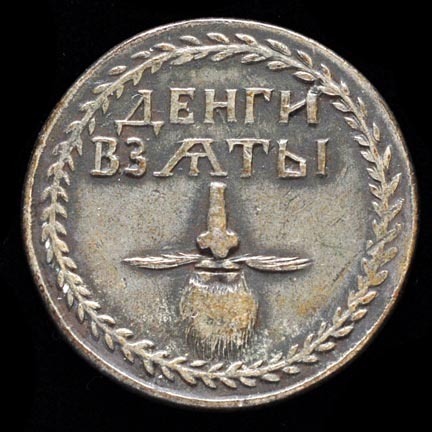 |
| Token showing that the owner had paid his beard tax |
