A small thing: walking to school this morning, I was practicing reading Korean, and I couldn't remember whether ㄱ meant N or G--and I used to know this, and know it rather confidently, as recently as last night even. This shocked me. This small forgetting seemed a prelude for a a much larger forgetting. I will, I realized, someday forget how to read Korean. One day, the things that make up the cloth against which the my days are woven will be--nothing. I will be left with scraps, pieces of torn up and tattered text: what did my room look like? I will wonder. How did I feel when I woke up? Who were my friends?
I cast my memory back to high school and middle school, to elementary school and preschool, and the longer in time my memory reaches, my more blurry the shape that it grabs, the fewer details can I sift from the muddy wreckage of my thought. I am still shocked when I try to remember the names of my friends from Middle school--even though I am friends with all of them on Facebook--and I can't. One day, will I forget them all? Will I forget myself?
But even the best memories will be baffled by death.
And then, walking up the hill to my school, I tried to think of what was happening right then in front of me, because surly I couldn't forget that. It was raining, I was seeing the rain, the gathering of rainclouds against the hills, the school looming in front of me, the tired parade of students walking up the hill in the rain--the play of light against my eyes: and then I thought to my self, what I was feeling; and I thought, well, I can forget this, too. even this is not the moment itself. I take these sensations and process them, so that when they are cast against the screen of my memory, they are already old, they are already past. So I turned my attention to something more basic, the sensation of being alive. But I could not even find that, and hold it, and know that it was now, that it would nto slip away! There I thought I would have hit bedrock, have found a stable place that I could not forget, that I could not lose. But even there, I thought, dizzily, even there you can forget yourself, even there you can lose the sense of being alive. Even there, when you pay attention, the present is constantly slipping away from you: you cannot see it passing, this moment, you can only watch the wake that it leaves behind it.
And I didn't know what else to do, so I kept on walking.

Showing posts with label meditation. Show all posts
Showing posts with label meditation. Show all posts
Wednesday, April 9, 2008

Sunday, October 28, 2007
On The Small Genius Of Everyday Things

When we make our first attempts at a task, our efforts inevitably botch. The new graduate enters the office on the first day, a teenager scribbles her first, shaky lines of poetry, a barista tries to steam milk for the first time: we will fail before we succeed. Yet through practice, hard work, grace, talent and intelligence we can slowly improve ourselves. A child's crayon scrawl will become handwriting - more study renders handwriting calligraphy. Through effort what was messy becomes art.
There is no distinction in kind between the work of art and the work of labor, only a difference in quality. Somehow everyday activities when refined, buffed, and perfected, when their elements are arranged by a careful perception, become more than their merely useful inartistic counterparts. Their meaning spills over from the merely practical, and into the sublime. A man may tell you his opinions about some political problem; but listen to a great orator and that opinion is joined with an aesthetic pleasure that unites a practical goal with an aesthetic joy.
And then, as art is itself a polished version of everyday activity, art itself can be improved upon and become genius. Now, if art provides aesthetic pleasure in addition to a practical goal, genius is a special embodiment in which form and pleasure feed off of each other.
Of course, not everyone can be a genius. Most people who think that they're geniuses - who have the gall and the self-possession to admit out-loud to friends associates and benefactors that their mind and energy are great-souled enough to mark them as one of the blessed - are just assholes. And yet we all and orient our lives by genius' stars, and head off into the deep knowing that we probably will never reach a shore, but that our journey will be useful yet, just for trying.
But I want to tell you that genius is within our reach. The problem is that we fail to recognize the potential for genius in the simpler parts of our life. Can't we be geniuses of friendship? Why don't we recognize the genius in an easy life? There may be a genius in listening, in eating, even in breathing?
-
John Dewey argues in Art As Experience that there is no real distinction between high and low art and the lived experience of our daily activities. In fact, the aesthetic experience is only beautiful because it follows the form of our lived experience: we arrange our lives' meaning from the scattered material of our daily experiences, and art does the same, but arranges its collage of colors and people in a way that is especially pleasing. Indeed, we can and should turn an artistic eye to our own life, to our own crafting of our days. But art, we think, is something that is impractical, removed from the commerce of life, done for its own sake and hidden away in museum galleries and the avant-garde, abstracted away from real life, hung on rich people's walls, inaccessible to the common mob who lack the developed minds and eyes that can appreciate the rarefied heights of culture. No, Dewey says, art is everywhere. Rather than being separate from everyday experience, art is just a really well done type of everyday experience. And once we realize that we can start to take the lessons that artists and art provide us with and apply them to our own lives: looking at our actions with the same lingering sensitivity we would look at a Picasso or read a Dostoyevsky.
-
Before the American Revolution, pretty much everybody thought of work as a curse, something that people would only do if they were coerced into doing it. The gentleman who thought of themselves as the representatives of society were lucky to be free of work, in part so their great sensitive minds could better appreciate the real refined beauties of art, politics, sport and science. But after the Revolution, people began to find a joy in work. Gordon Wood, in his The Radicalism of the American Revolution, quotes John Adams as saying:
"We define Genius to be the innate Capacity, and then vouchsafe this flattering Title only to those few, who have been directed, by their birth, education and lucky accidents to distinguish themselves in arts and sciences or in the execution of the what the World calls great Affairs." But if we apply the title of genius to all those above the median, then, said Adams, we will find that "the world swarms with them." "Planting corn, freighting Oysters, and killing Deer" - these were among the "worthy employments in which most great Geniuses are engaged."
As the Founding Fathers looked out into a freer, more egalitarian society, they realized that the Liberty they fought for - of finding a vocation, of crafting a life - need not mean a freedom for work. That work itself, that rude hunting and fishing could be genius.
-
Look at the cashier scanning your food in the supermarket, the call center staffer working long hours in an Indian business park, a college stoner cutting class to doodle in his art book - we would denigrate these tasks, we would hold them below our aesthetic appreciation, and call them common and flat. They probably are. There is probably little joy to squeeze from those moments. But in doing so, we deny the human potential for infinite improvement. Why can't there be geniuses scanning groceries?
Buddhism points to a more dramatic expression of this point. In paying so attention to the act of breathing, Buddhist meditative practice encourages its adherents to improve upon the most basic and constant act of their lives. If you could develop a genius for the breath - a breath that was enjoyable, loving, aesthetic - then what act of genius could compare? The breath is always with you, it never leaves, if it can be improved upon, then everything else in a life would also be improved upon.
And we can improve upon everything in our lives. I think that with enough effort, we can turn our everyday experience into something finely crafted, something that speaks to us in the same way that great works of art speak to us. If this beauty doesn't seem too convincing, then I think the converse is scary enough to be convincing, too: imagine a life lived blindly, ugly, in which every action was done merely for some end, so that the actual lived moments of each day were as useful and as beautiful as a rusted metal cog in a large continuously profitable machine. Recognizing the potential for genius in our everyday actions, then, can make our lives not something of commerce, but something of art.
Monday, June 18, 2007
Study: Meditation Alters The Structure of the Brain
The WSJ reports (three years ago!) that a study shows meditation has a profound effect on brain activity. Which is cool.
"In a striking difference between novices and monks, the latter showed a dramatic increase in high-frequency brain activity called gamma waves during compassion meditation. Thought to be the signature of neuronal activity that knits together far-flung brain circuits, gamma waves underlie higher mental activity such as consciousness. The novice meditators "showed a slight increase in gamma activity, but most monks showed extremely large increases of a sort that has never been reported before in the neuroscience literature," says Prof. Davidson, suggesting that mental training can bring the brain to a greater level of consciousness."
Via digg.
"In a striking difference between novices and monks, the latter showed a dramatic increase in high-frequency brain activity called gamma waves during compassion meditation. Thought to be the signature of neuronal activity that knits together far-flung brain circuits, gamma waves underlie higher mental activity such as consciousness. The novice meditators "showed a slight increase in gamma activity, but most monks showed extremely large increases of a sort that has never been reported before in the neuroscience literature," says Prof. Davidson, suggesting that mental training can bring the brain to a greater level of consciousness."
Via digg.
On Living Conciously
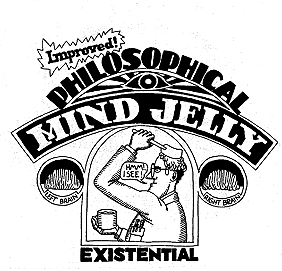
Comic by Bill Kliban!
The outline of our lives is largely up to chance: we are who we are roughly because of the fickle facts of where we were born, who our friends and family are, where we got into college, what job we happen to fall into – we can do little to influence these factors, and thus we have little command over the greater shape of our selves. It is very appealing to call this broad outline our real self, though, because if we do so we are left with a pretty solid self. I am, for instance, a young graduate of Grinnell College interested in writing, living in Boulder.
But the downside of this perspective is that it leaves the larger part of ourselves – our happiness, our dreams – up to chance. Either we accept this chance, or we convince ourselves that we can with brute force of personality alter the outline of our lives – which seems as much folly as whipping the ocean – or, alternatively, we can identify a different part of our lives on which to base our selves.
This rough outline, for all of its explanatory ease, does not account the real beauty and joy of life. It’s a commonplace piece of wisdom that the rich are not necessarily happy, that the old are not necessarily wise. The real insight of this cliché is that the happiness and wisdom a life can afford comes from more subtle, smaller things than the usual markers of human success. And over these small things – the fine details within the broad outline of a life, those details that can actually make us happy – we have a great deal of control. This is a comfort.
-
We are faced with a series of small choices throughout our days, and these small choices can make up a texture that can make the difference between and fulfilled life and a disappointed one, between joy and loneliness, between art and artifice.
But I’m getting too abstract. That’s the danger when we’re talking about philosophy: since we want to explain some essential thing we must abstract away from the embarrassing contingency of our personal experience. But it’s that embarrassing personal experience which forms the edifice of the thought in the mind of the thinker. If it is removed too hastily, the kind of philosophy I’m trying to do here – a conscious, judicious searching for a better way of living – can be confused with another sort of philosophy, one that is intent to stare into an unsolvable Gordian-belly-button of abstraction. Whatever we think about, be it physics or logic or medicine or epistemology, must, in the end – even if we know not how – return to answer the question of how we live our lives.
So let’s get a little specific. I have just got off work, I am sitting on a chair at home, and I have a chunk of free time: I have a decision to make. Let’s make my decision easy: I can either watch TV or read a book. If I read a book (let’s say, for the sake of my argument, that it’s a really good book) I might feel a little richer; if I watch TV (Dancing With The Stars is on) I will gain nothing. But watching TV is easy. And reading a book – God. I deserve some rest today. Who wants to read a book?
We are faced with those small, drastic decisions every day: Should we go out for a run in the morning, or sleep in? Should we see our friends today, or play a video-game? Should we write a letter, or check our e-mail? These examples might not illuminate the crisis nearly as well as I’d like them too, so let me put it into a nutshell before we go any further. What we’re talking about is the choice between an easy-going and a strenuous life.
-
We do not recognize our ability to make these small choices because they are so small they seem insignificant in the rush of our larger daily decisions. The majority of the mental heavy-lifting for these small questions, then, is done underneath the surface of our consciousnesses. But when we bring these choices into the full light of our awareness, we can better see their outcomes.
The easy-going option is one that seems best in the short term. The strenuous option is one which takes more effort, but may be more rewarding.
The problem isn’t that the easy-going option is bad, and the strenuous option good. If that were the case, our lives would be significantly easier, and we would simply chose the good over the bad as easily as we would chose to eat a ripe peach over a rotten one. The problem is that both the easy-going option and the strenuous one can be goods, but they are goods of very different qualities and outcomes. What we have to do is weight the costs and the benefits against one another.
The easy-going options are just so easy. We are not helped by our culture which is so tailored to fulfill our present desires. With a minimum of effort, we can turn on our TV, eat some chips, play a video game, drink a beer. And these things are immediately and definitely pleasurable. Why the hell would you go for a run, or read a book of philosophy, or meditate, or pray, or any of these things that are so damned hard?
Because a lot of times, the strenuous option can provide more pleasure in the long run. If we chose to write a letter instead of watching a TV show, we may not get such a strong immediate sense of satisfaction, but our friendship with whoever we’re writing a letter to might be strengthened.
Even if we do not choose the strenuous option always – and why should we? – thinking consciously about these small decisions can make our lives better. When we are conscious over our inner life, when we take command of the way we think instead of reflexively falling back on the easiest course of action, we can better craft the world we live in.
Which is to say that the strenuous option is always the best. It is only that we face a difficulty of perspective between near and far things, and the easy-going option seems, more often than not, unnaturally better than the strenuous option. It takes a conscious act of thought to correct this skewed perception.
-
This choice between the strenuous and the easy-going option falls into much starker relief when we think of our perceptions. Although the examples above were all decisions about actions, the more common decision we are forced to make is not between one action or another, but between one way of seeing the world or another. We have a choice between whether to view a personal slight as an insufferable affront against our ego, or to laugh at it. We have a choice about whether we walk to work in the morning we think about work, or whether we recognize the beauty to the early morning light. We make these sort of tiny decisions about interpretation of perception en masse thousands of times a day. So the power of being conscious about your perceptions is massive.
And it is thus how we can make a work of art out of our lives. We discover that the fine texture of our days are dependant upon us. Rather than being a still observer to our lives, meant to watch the overall progress only sleepily, we discover we are largely our own authors. And we have then a responsibility to ourselves to live beautifully, much as an artist has a responsibility to consciously craft the flow of a story, or the arrangement of a painting.
If we live our lives unconsciously, for the most part, we will have the same problem with our lives as faces bad art: the problem with the bulk of high-school poetry, is that the poet has simply taken their feelings for granted and placed them on paper, without the least sort of consideration. A mindful life makes us considerate of our very feelings. And, instead of living in a world wherein our feelings and perceptions are largely out of our control, it gives us, little individuals that we are, the ability to craft our feelings and perceptions. And while we have little direct control over the broader course of our life, over these small things we are small kings.
It is not as easy to live consciously as I’ve made it out to be. If our minds are instruments of joy, we have to practice them regularly. Now, it’s far from my purview as an essayist to tell you how to get this practice. I can only point in a general direction. Since the way we make art is much like how we can make our own lives artistically, an artistic life – from arranging flowers to writing stories – no matter if it is done good or bad, can help develop this critical sense. One can pray, or sing, or run. I myself find great solace in meditation.
But the choice of practice, much like the painter’s choice of brush, is purely instrumental. As long as it works, it doesn’t really matter what it is. As long as we practice.
Subscribe to:
Posts (Atom)