
Sunday, January 31, 2016
#toqueville #fomo
"Before [the American' stretches an almost boundless continent and it is as though, already afraid of losing his place, he is in such a hurry not to arrive too late." -- Democracy in America

Friday, January 29, 2016
Fact: How A Failed Colony In Panama Led To The Formation of the United Kingdom
Rapacious, profit-seeking, bloody, Europe conquered the world with sail and gun. History is filled with the brutal successes of the European Imperialist project: the Dutch East India Company sewed up the lucrative spice trade of South East Asia; the British East India company began a process of conquest that would end with the entire Indian subcontinent under British control; Napoleon, at the head of the French army, proverbially shot the nose off Egypt's Sphinx; at the height of European Imperialism, most of the globe was claimed by some power or another.
But European supremacy was never inevitable. Indeed, most imperial adventures failed. There was the much-lamented British South Sea Company. Its promising prospectus to colonize the South Seas became one the first big stock market bubbles and nearly brought down the rickety British government. France's Mississippi Company, pushed by the financial Svengali John Law, left many of Paris' rich and famous poor and destitute. But perhaps the most quixotic of them all was the Darien Company of Scotland.
In the late 17th century Scottish entrepreneurs wanted to get into the imperial game for themselves: they would colonize the thin strip of land along what is now the Panama Canal in order to make money by hauling goods from one coast to the other, from Pacific to Atlantic and back again. This would save ships months that would otherwise be spent making the treacherous iceberg-filled passage south along the southern tip of South America. But the scheme was born under a bad sign. The land claimed by the Darien Scheme was not only already populated by Native Americans, it was claimed by another European Power--Spain, was an ally of the newly installed English and Scottish King William III. English commercial interests weren't happy with the scheme either--what did they want with an upstart competitor? This left the Scots adrift on their own. But the Scots doubled down on the plan--estimates are that a quarter to half of all Scottish wealth became tied up in the Darien scheme.
But once the scheme actually got off the ground, it was plagued with problems. The first fleet of settlement--some 1,200 people--sailed across the ocean and dutifully set up a fort and a city, New Edinburgh, right in the Darien isthmus. But the colony's crops of corn and yam failed, and malaria and dysentery steadily ate away at the ranks of settlers. Things got so bad that the only thing the Darien colonists could eat were the giant turtles padding around the coast. Then the settlers became too weak to hunt the giant turtles, and instead they just starved. After 8 months, the colony was abandoned. The ships returned home--with only 300 survivors.
But news of the failure didn't return home quick enough to prevent a new batch of about 1000 settlers, who lingered at New Edinburgh long enough to face Spanish siege, disease, and hunger before they too went home, in defeat and disgrace. Only a few hundred of the original 2500 colonists survived.
The area is mostly uninhabited today.
Because so much of Scottish wealth had been tied up in the scheme, this left many Scots destitute--and is one reason some historians say that in 1707 the Scots joined the English in the Act of Union creating the new political entity of Great Britain.
But European supremacy was never inevitable. Indeed, most imperial adventures failed. There was the much-lamented British South Sea Company. Its promising prospectus to colonize the South Seas became one the first big stock market bubbles and nearly brought down the rickety British government. France's Mississippi Company, pushed by the financial Svengali John Law, left many of Paris' rich and famous poor and destitute. But perhaps the most quixotic of them all was the Darien Company of Scotland.
In the late 17th century Scottish entrepreneurs wanted to get into the imperial game for themselves: they would colonize the thin strip of land along what is now the Panama Canal in order to make money by hauling goods from one coast to the other, from Pacific to Atlantic and back again. This would save ships months that would otherwise be spent making the treacherous iceberg-filled passage south along the southern tip of South America. But the scheme was born under a bad sign. The land claimed by the Darien Scheme was not only already populated by Native Americans, it was claimed by another European Power--Spain, was an ally of the newly installed English and Scottish King William III. English commercial interests weren't happy with the scheme either--what did they want with an upstart competitor? This left the Scots adrift on their own. But the Scots doubled down on the plan--estimates are that a quarter to half of all Scottish wealth became tied up in the Darien scheme.
But once the scheme actually got off the ground, it was plagued with problems. The first fleet of settlement--some 1,200 people--sailed across the ocean and dutifully set up a fort and a city, New Edinburgh, right in the Darien isthmus. But the colony's crops of corn and yam failed, and malaria and dysentery steadily ate away at the ranks of settlers. Things got so bad that the only thing the Darien colonists could eat were the giant turtles padding around the coast. Then the settlers became too weak to hunt the giant turtles, and instead they just starved. After 8 months, the colony was abandoned. The ships returned home--with only 300 survivors.
But news of the failure didn't return home quick enough to prevent a new batch of about 1000 settlers, who lingered at New Edinburgh long enough to face Spanish siege, disease, and hunger before they too went home, in defeat and disgrace. Only a few hundred of the original 2500 colonists survived.
The area is mostly uninhabited today.
Because so much of Scottish wealth had been tied up in the scheme, this left many Scots destitute--and is one reason some historians say that in 1707 the Scots joined the English in the Act of Union creating the new political entity of Great Britain.
Friday, January 22, 2016
Fact: Thomas Jefferson's Grandchildren
Founding father Thomas Jefferson was a lot of things: red-haired, bookish, founder of the University of Virginia, revolutionary wunderkind, patron saint of the Democratic Party, architect, and author of the first draft of the Declaration of Independence with it's all-too-often-quoted boilerplate of "all men created equal" and their vaunted "pursuit of Happiness." Thomas Jefferson is pretty complicated. Of course all the American political saints are complicated. Franklin seems more Voltaire than Washington--like some 18th century philosophe stumbled onto the set of a war movie and did his best not to smirk while delivering his lines. Washington stands a strange cipher of virtue: the only thing you can be certain about is that he was an important, powerful man, and knew himself to be as much. Hamilton is equal parts martyr and New York City capitalist. If he'd be alive today he'd be reviled like Rahm Emanuel or envied like an Uber engineer. But despite all that, Jefferson has perhaps the most fraught historical legacy.
This is because of his relationship with Sally Hemings, his slave, the mother of his children, his wife's half sister, a relationship that was for a long time controversial, disputed, denigrated, a relationship which brings to light a lot of the complexities of America's tortured history of racial discrimination. His wife, Martha, died at 33 and made Jefferson promise not to marry again because she could not bear to have another woman raise her children. But Jefferson had also inherited more than a hundred slaves from his father-in-law. Amongst those slaves was Martha's half-sister, Sally Hemings.
Hemings and Jefferson had six children. Four survived. They were 7/8s European, and were freed by Jefferson on reaching adulthood. Three of them went on to pass as white. Jefferson's son Eston Hemings moved to Madison, Wisconsin, changed his named to Eston Jefferson and his children and grandchildren entered the white community, claiming some vague relation to some side of the Jefferson family tree. Madison Hemings, on the other hand, remained black, and his descendants considered themselves black. One set of brothers and sisters branched to live out their lives on either side of America's brutal color line.
For more, check out BackStory's history of Racial Passing in America.
This is because of his relationship with Sally Hemings, his slave, the mother of his children, his wife's half sister, a relationship that was for a long time controversial, disputed, denigrated, a relationship which brings to light a lot of the complexities of America's tortured history of racial discrimination. His wife, Martha, died at 33 and made Jefferson promise not to marry again because she could not bear to have another woman raise her children. But Jefferson had also inherited more than a hundred slaves from his father-in-law. Amongst those slaves was Martha's half-sister, Sally Hemings.
Hemings and Jefferson had six children. Four survived. They were 7/8s European, and were freed by Jefferson on reaching adulthood. Three of them went on to pass as white. Jefferson's son Eston Hemings moved to Madison, Wisconsin, changed his named to Eston Jefferson and his children and grandchildren entered the white community, claiming some vague relation to some side of the Jefferson family tree. Madison Hemings, on the other hand, remained black, and his descendants considered themselves black. One set of brothers and sisters branched to live out their lives on either side of America's brutal color line.
For more, check out BackStory's history of Racial Passing in America.
Friday, January 15, 2016
Fact: On Clues
A clue. The minor thing out of place that hints at the truth. The bloody knife. The misplaced handkerchief. The purloined document. The great historian Carlo Ginzburg argued that the job of the humanist and the detective were identical: both looked for clues that could reveal the unknown. Both don't necessarily look at the big details--instead they rifle through the trivial stuff in the background, trying to find a critical clue: a telling cough, an inconvenient allergy to almonds, a whorl of an ear in a renaissance painting, misplaced laughter, a dream about mysterious machinery, massive, but silent.
So what is a clue, anyway? It was originally spelled clew and first referred to a "globular body" (thus the OED.) From there it evolved to mean a ball of thread. This was used in the myth of Theseus and the Minotaur. In this myth Theseus, that Grecian Captain America, stumbled into the confusingly twisty Labyrinth to slay the dreaded Minotaur. Theseus' admirer Adriane gave him a ball of thread--a clue--with which to find his way out of the labyrinth. As Chaucer had it (in the first recorded use of the word in 1385): "By a clewe of twyn as he hath gon The same weye he may returne a-non ffolwynge alwey the thred as he hath come." Or as we would have it, he traced the ball of twine back to where he had come.
 |
| Theseus' modern counterpart, fighting his ancient foe. |
From there, the clew became a metaphor: the small hint that gets us out of a proverbial labyrinth. In 1605, an M. Drayton gave us this pithy one-liner: "Loosing the clew which led vs safely in, [We] Are lost within this Labyrinth of lust." Which sounds like a pretty fun Labyrinth to be lost in. The OED mentions the uses of other Labyrinths: mazes of life, of governmental departments, of obscurities. Regardless, the original metaphor of a ball of twine and Labyrinth was eventually lost and 'clue' just became a thing which helped us figure out a mystery. Its first use like this was in 1665, when a K Digby gives us this: "Seeking in the movements of the heavenly bodies for a clue to the accidents of life." A worthy place to look for a clue indeed.
Thursday, January 14, 2016
Facts: About the History of Coffee
I still can't get my head around the fact that coffee was discovered so late. It was discovered in the Ethiopia sometime in the 14th century (although the exact date is uncertain) and only really hit Europe in the late 16th century. I imagine the generations upon generations of humans who toiled through the dim stupor of life, suffering because they lacked the cup of coffee they couldn't know they needed. Think of what Homer might have written if he'd been able to pound back an espresso shot! Think of the extra plays we might have enjoyed if Shakespeare had enjoyed a French Press. Think of all the extra math Copernicus might have done if he'd been able to order an Americano from his corner cafe!
So why did it take so long to discover coffee? The traditional story is that an Ethiopian goat herder named Kaldi discovered coffee when he spied his goats acting pleasantly jumpy after eating coffee berries from some mountain bush. Another story says that a Sufi sage saw birds eating coffee and flying with particular vigor.
The first coffee house in England was opened in 1652 in London at the sign of the Turk's head. Some contemporaries thought that the dish was unchristian, would spur rebellion, and lead to epidemics of male impotence. One writer called it a devil's drink "that witches tipple out of dead men's skulls." Although the impotence and occult qualities of the drink are pretty hard to understand, the rebellion part of the critique was not all that fanciful. At the time Britain was being ruled by a Republican government which had recently decapitated the rightful king. Besides, you couldn't toast the health to the king with a cup of coffee the same way you could with a jug of beer.
But a lot of people loved coffee, giving it all sorts of magical properties. Some used it as a emetic--shoving it down the throat with a whalebone stick to induce vomiting. (It worked!) But most simply drank it, discovering that it made conversation easier, and that you could talk for longer over that "wakeful drink" than over mugs of beer.
The early coffeehouse was a perpetual fair of learning, discussion, selling, buying, arguments, and fun. Robert Hooke, the first demonstrator of the Royal Society, dissected a porpoise in Garraway's Coffeehouse in the 1660s to prove that the animal was a fish. (He was wrong.) Other coffeehouses catered to businessmen. Lloyd's of London, the insurance market, began as Lloyd's coffeehouse. Still others catered to fops and other fashionable young men who'd smoke, gamble, drink coffee and stay out too late.
So why did it take so long to discover coffee? The traditional story is that an Ethiopian goat herder named Kaldi discovered coffee when he spied his goats acting pleasantly jumpy after eating coffee berries from some mountain bush. Another story says that a Sufi sage saw birds eating coffee and flying with particular vigor.
 |
| Site of the first London coffeehouse, honored by a plaque. |
But a lot of people loved coffee, giving it all sorts of magical properties. Some used it as a emetic--shoving it down the throat with a whalebone stick to induce vomiting. (It worked!) But most simply drank it, discovering that it made conversation easier, and that you could talk for longer over that "wakeful drink" than over mugs of beer.
The early coffeehouse was a perpetual fair of learning, discussion, selling, buying, arguments, and fun. Robert Hooke, the first demonstrator of the Royal Society, dissected a porpoise in Garraway's Coffeehouse in the 1660s to prove that the animal was a fish. (He was wrong.) Other coffeehouses catered to businessmen. Lloyd's of London, the insurance market, began as Lloyd's coffeehouse. Still others catered to fops and other fashionable young men who'd smoke, gamble, drink coffee and stay out too late.
Wednesday, January 13, 2016
Fact: Towards a History of Beards
Beards are so popular these days that scientists have proclaimed a moment 'peak beard.' They argue that having a beard is more attractive to women when the majority of men are clean shaven. (In the elegant language of science, beards are a "negative frequency-dependent sexual selection trait.") Because the proportion of bearded gentlemen increases daily, we will soon hit the point when the majority of men are bearded and so having a beard is no longer attractive. Stock up on razors, guys.
This idea of 'peak beardliness' got me thinking about the history of beards. The thing about beards, of course, is that they only exist because we shave them off. But why do we shave off beards more frequently than other facial or bodily hair? What does the beard mean? Is it a symbol of sophistication or barbarism? Why is having a beard so closely related to philosophers? I remember back in college all of my philosophy major friends sported beards. Me, the lone English major of the lot, went clean shaven.
I'm nowhere close to figuring out answers to these questions. Instead I will offer some scattered facts.
For the ancient Egyptians, kings and queens alike wore a false metal beard called a postiche to connect them to the gods. The hieroglyphic for the divine is a seated man--wearing a false beard.
 |
| Egyptian False Beard |
The ancient Greeks talked about their 'beardless boys'--to grow some stubble was a right of passage separating the boy and the man. In Homer, touching the beard is a sign of entreaty. Supposedly Alexander was the first clean-shaven monarch: a clean face was more militarily expedient (someone could grab hold of a warrior by his whiskers), and the fashion spread from him. The Latins rarely sported beards: the Grecophile Emperor Hadrian shocked contemporaries by letting his beard grow out in the Greek, philosophical manner.
 |
| Emperor Hadrian, the first bearded Emperor |
Beards might symbolize the sophistication of the Greeks or of the philosophy major, but they could also be a sign of barbarism. The Lombards who took over Northern Italy in the 6th century were named for their long beards. (Longo bardi = long beards.) And our own cultural image of the pitiless viking would not be complete without a flowing full beard. (Isn't there some storyline in the Marvel comic Thor about why that normally bearded Norse god goes around as clean shaven as an accountant?)
 |
| Beardless Thor |
Jumping ahead to the 18th century, we continue to see beardiness as a symbol marking the boundaries of a culture. In Peter the Great's time, a big beard was a symbol of Russianess. Peter, in his efforts to push the country to more European lines, instituted a beard tax, going so far as to forcibly shave people who sported a beard in front of him. This did not go over well with the bearded boyars, who paid their taxes, and retained their beards after Peter's death.
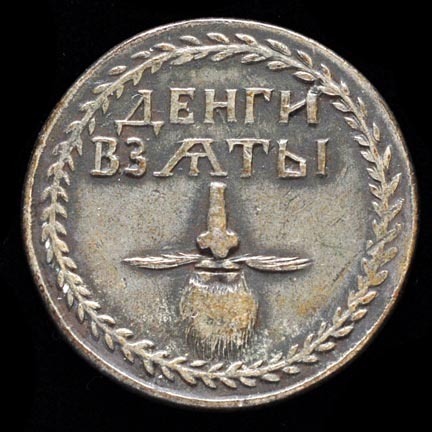 |
| Token showing that the owner had paid his beard tax |
Tuesday, January 12, 2016
Fact: the Bell-Ringing Riot of 1881

England is an island fond of its bells. Since the 17th century groups with names like the College Youths and the London Scholars have clambered up church towers to the bells, not to make music, but to ring a set of particular permutations called 'changes'. Sometimes they'd drink while they were on the job--a 'peal' of 5040 changes could take upwards of three hours to ring, and it was hard, laborious, thirsty work that much deserved a beer.
That the ringing took place in the church tower was often the most religious thing about English bell ringing. Bell ringing societies were more likely to give a peal in honor of someone's birthday or a horse race than to usher in divine service. This all changed in the 1850s when church reformers tried to reconnect the bell tower and the church. The buildings were literally connected after all. They wanted bell ringing to be associated with church functions. And they wanted the bell ringers to quit drinking while they were on the job.
This sometimes did not go over well with the bell ringers, who, like many of us, were fond of their beer.
In 1881, for example, a rector in Devon wanted to stop the bell ringers from ringing throughout the local Revel Week--a weeklong orgy of drunken popular culture. The bell ringers responded by breaking into the bell tower and ringing anyway. They also turned their wrath to the rector, stealing his chickens, throwing stones at his family, and burning down his farm buildings.
History shows us that the West Worlington, Devon, Society of Ringers ain't nothing to fuck with.
Fact gleaned from Ron Johnston's Bell-Ringing, p 233.
Monday, January 11, 2016
Fact: Jobs Are Hard
In 1969, about 80% of newly-minted history PhDs could find a job. In 2011, only half could claim finding 'definite employment' the year after graduation.
.jpg "Figure 3. New History PhDs Reporting Employment or Postgraduate Study at Time of Degree, 1969 to 2012")
From the AHA's 2013 Jobs report.
So I tell people that came to graduate school because I love to teach, and I love to write. But I think another reason is that I love facts. So this year I'm going to try to share my love of facts on this sometimes dormant blog--just one a week, culled (ideally) from the readings I already have to do for coursework.
From the AHA's 2013 Jobs report.
So I tell people that came to graduate school because I love to teach, and I love to write. But I think another reason is that I love facts. So this year I'm going to try to share my love of facts on this sometimes dormant blog--just one a week, culled (ideally) from the readings I already have to do for coursework.
Wednesday, July 22, 2015
Data and Anxiety
 |
| Comic by B. Kliban. |
I have been suffering from anxiety attacks for the past month.
What is anxiety? A tangled ball of thoughts that I can't seem to get out of no matter how much I struggle. A weight that makes my shoulders slump and my molars grind and my fingers twitch and my heart flutter in my chest. A worry that I cannot do anything about, that won't unravel itself, that has tangled itself knotted and confused around my fingers. An emptiness. A cloud. A drowning flood that I can never escape. Sometimes I'm fine and I forget about it completely and I wonder what I was ever afraid of, what I ever worried about. And then it will come again, a fire, a darkness, a switch being flipped.
Anxiety is an evolutionary mistake. My mind (already fast) goes into overdrive, mulling possibilities, rehearsing plans, calculating probabilities. My body gets ready to run, to fight, to survive. Back when my ancestors were threatened by tigers, epidemics, and pogroms, this anxiety helped them survive. It helped them anticipate the unexpected, and act with dispatch when true threats came.
So I inherited this anxiety. But I do not have tigers, epidemics, or pogroms to trouble me. And yet sometimes my brain reaches out and grabs something--something it is afraid of losing--and starts to worry about it, with the same fretful intensity that should only be reserved for those big dire things that can really kill you--those things whose eyes glint out at you from the dark opening of a primordial cave. And I will be trapped in my thoughts like a bug twitching in a spider's web.
It's hard to describe what the thoughts are like, because they are so annoying, so simple, so obviously wrong. But they come, and I can't stop them. I am not loved. I am not good enough. I should never have come to grad school. I have lost my chance for community, for affection, for real life. My girlfriend is going to leave me. My friends don't really like me. I have let down my family. I am a disappointment to my advisors, a secret joke in the halls of the History department, a pleasant fool. Over and over again. Endlessly echoing in the theater of my mind.
The thoughts won't go away. I sit there on my couch, my heart beating, my mind racing through them over and over again, replaying them like an afternoon re-run of the Fresh Prince of Bel Air.
The cause of this bout of anxiety is easy to identify. My fiancée left me a few months ago. Those emotional truths that had once seemed solid--that I am a good person, deserving of love; that the people I love will not leave me--seemed to have melted into air.
I know that this is not fair. I am still a good person, deserving of love; it is still unlikely that the people I care about will suddenly abandon me. Many fine, normal, attractive people go through broken engagements. But the dream-like nature of the worries makes them even more hard to deal with. Because they have very little fact behind them, I cannot grab hold of them and do something about them. Because they are inscrutable, they have become a grand, unsolvable problem, one which has come to take up my every third thought.
A few weeks ago I began an attempt to quantify my life. I wanted to boil my self down into numbers, data-tables, and vectors in order to find the hidden patterns underlying Brendan Mackie. Below are a number of data visualizations which help show what I'm going through.

I have learned a few things already from this project.
I am OK
Look at my daily ratings. There's a perfect 10 in there! None of the days merited lower than a 4.
I may be a bit broken now, but that has not meant that I cannot have wonderful experiences. And my bad days are, from the perspective of the carnage of human history, not super bad.
Friends Are Important
Days when I see friends--for lunch, coffee, or dates--are the best. Conversely, when I'm lonely I'm far more prone to fall into deep anxiety.
Anxiety Happens In The Morning
I wake up with anxiety. But as I go through my day and fill my head and heart with actual, real-life stuff, the anxiety passes.
Understanding It Helps
Being able to see my well-being marked in an impersonal line graph helps. See, here, this dip? This is when I let a whole Sunday morning go by fretting over whether someone actually liked me or was only pretending to. Look--this good day? That was when I made an effort to connect with my friends.
I know that tomorrow morning I will wake up and I will hold today up for judgement. Will I have let another day slip by, tortured by illusory thoughts? Or will I have tried to do something about it?
I'm curious about your comments. How do you deal with anxiety? What more can we learn about ourselves from data?
Monday, June 22, 2015
A Bold And Arduous Project Of Arriving At Moral Perfection

Ben Franklin stands in the pages of history triumphantly mastering electricity, establishing universities, and writing constitutions. He is heroically armed with kite, with beaver hat, and with book. It seems odd to think of him doing something so quotidian as basic arithmetic.
But back in his younger days he was far less exalted: we must imagine him bent over account books, making a reckoning of each day's purchases and sales, furrowing his brow over sums our phones could do in a half second, trying to figure out whether he made a profit or loss on a printing of some evanescent pamphlet.
Accounting was incredibly important for people like Franklin, because accounting allowed merchants and like-minded souls a way of seeing otherwise invisible patterns. People kept accounts of their businesses to tell their profits and loss. They kept accounts of their own finances to see who they owed money to. And many people, like Franklin, or Robert Hooke or Samuel Pepys, tried to do even more. They tried to keep accounts of their own selves.
 |
| A writing blank; from BiblioOdyssey. Note the banker in the lower picture working over the bank's account book. |
Here's Franklin's Autobiography on the origin of his famous moral accounting:
I conceived the bold and arduous project of arriving at moral perfection. I wish'd to live without committing any fault at any time; I would conquer all that either natural inclination, custom, or company might lead me into.... [Bad habits] must be broken, and good ones acquired and established, before we can have any dependence on a steady, uniform rectitude of conduct. For this purpose I therefore contrived the following method.
I made a little book, in which I allotted a page for each of the virtues. I rul'd each page with red ink, so as to have seven columns, one for each day of the week, marking each column with a letter for the day. I cross'd these columns with thirteen red lines, marking the beginning of each line with the first letter of one of the virtues, on which line, and in its proper column, I might mark, by a little black spot, every fault I found upon examination to have been committed respecting that virtue upon that day.
It looked a little something like this:
Monday
|
Tuesday
|
|
Temperance
|
||
Silence
|
*
|
|
Order
|
||
Resolution
|
||
Frugality
|
**
|
***
|
Industry
|
||
Sincerity
|
*
|
|
Justice
|
||
Moderation
|
||
Cleanliness
|
||
Tranquility
|
||
Chastity
|
****
|
|
Humility
|
The contemporary project of the quantified self promises to improve on Franklin's little spreadsheet, turning this thumbnail sketch into a warts-and-all big data portrait of an individual through time. The hype suggests that wearable technology like Fitbits and Apple Watches can turn our daily activity into numbers, and these numbers can be visualized, massaged, mined, and understood in ways we never could have dreamed of. This will allow us to uncover the hidden causes of our unhappiness, to graph our continuous climb towards self-improvement, to crunch regressions that show us just exactly where it all went wrong.
I don't buy the hype, though. Not yet anyway. The new quantified self might be able to measure a lot, but can that data answer many questions? Ben Franklin kept track of his moderation; the Fitbit can only count your heartbeat as you wait for your new girlfriend to pick you up at the BART stop. Ben Franklin accounted for his temperance; the Fitbit can only measure the number of calories you burn on your guilty post-pizza morning runs. Ben Franklin paid attention to his industry; the Fitbit can only tell you how many naps you took in the day, not what dreams you dreamt while napping, not the pleasure you get from putting a pillow over your eyes to block out the afternoon sun.
And it's those hard three in the morning questions that really matter, Am I good? Am I happy? Am I just stumbling through life? Are we anything more than a bunch of over-proud apes clinging desperately to a rock falling forever through the vacuum of space?
Nobody expects Fitbits to answer questions like these. But they are the questions people expect humanities scholars to wrestle with. So what is digital humanities to do with the quantified self?
~*~
I don't know, but I want to take a crack at telling a story of my life through data. Not just a story of how many steps I took or stairs I climbed, but a weighty story about what my life actually means. So this summer I will take an account of each day, and then do some experiments with this data to try to better understand my self and my place in the world.
But which data should I collect?
This is one of the deep problems of digital humanities. We can work real magic with data, but before we can even begin to build a database, we need to come up with a good question to answer. Then we need to figure out which data might help us answer this question.
To that end, I've set up this Google spreadsheet to canvas suggestions from you, my legions of readers, about what I should track over the summer. Should I measure the number of books I've read? The number of meals I've cooked? The number of times I've thought of a butterfly? The minutes I spent pacing through my rooms, daydreaming? Which data really matters? Which data are just noise?
I'll start the data collection in early July. Afterwards I will post with some regularity about my findings. By the end of the summer I will be able to tell a story of my life, graphs and all. If I'm lucky, it will be the kind of story that Ben Franklin might be proud of. If not, at least there will be some pretty graphs.
This post is the part of a Digital Humanities blogging challenge organized by the Berkeley Digital Humanities Working Group.
To that end, I've set up this Google spreadsheet to canvas suggestions from you, my legions of readers, about what I should track over the summer. Should I measure the number of books I've read? The number of meals I've cooked? The number of times I've thought of a butterfly? The minutes I spent pacing through my rooms, daydreaming? Which data really matters? Which data are just noise?
I'll start the data collection in early July. Afterwards I will post with some regularity about my findings. By the end of the summer I will be able to tell a story of my life, graphs and all. If I'm lucky, it will be the kind of story that Ben Franklin might be proud of. If not, at least there will be some pretty graphs.
This post is the part of a Digital Humanities blogging challenge organized by the Berkeley Digital Humanities Working Group.
Monday, March 23, 2015
Content Analysis With Tableau: Intro
Bit of a change of pace here at Raise
High the Roofbeam, Carpenters. Over these next few blog posts, I will write
about how a method borrowed from the harder social sciences called content analysis might be useful for humanities
scholars.
Content analysis takes qualitative data, boils it down into numbers, then
analyzes it. A lot of humanities scholars are already doing content analysis in
some form, largely without realizing it. This post will hopefully begin to bridge
the gap between the ad hoc content
analysis strategies of digital humanists and the formal content analysis of
sociologists and psychologists.
Before we start, you might be asking what the pay-off of all this work is.
My current research uses content analysis to look at 18th century
Christmas. I looked through more than 250 diaries for entries written on or
around Christmas day, which I then coded. Here is a visualization which displays at the percentage of diary entries mentioning a given code, by decade. You can find that here.
Please keep in mind this is only a working example—results are not to be
cited or circulated except as an example of this method.
The following blog series will give you step-by-step instructions into how you can turn your research question into a data visualization like the one above.
The following blog series will give you step-by-step instructions into how you can turn your research question into a data visualization like the one above.
Broadly speaking, content analysis studies communicative activity by
turning qualitative data into quantitative data. At its simplest, a scholar
counts the number of times a particular thing happens in a particular set of
documents across a particular span of time. Kimberly Neuendorf, author of the most
thorough content analysis textbook I’ve read, defines the method like this: “Content
analysis may be briefly defined as the systematic, objective, quantitative
analysis of message characteristics.” The field is thriving—the number of
articles mentioning the method has skyrocketed over the past decade, in part
due to the vast expansion of the number of machine-readable documents
researchers can now access.
The appeal of this method for humanists is obvious. In some ways, content
analysis simply formalizes the narrative synthesis humanists are already so
good at.
But despite this promise, it’s hard to know where the humanist can start with content analysis. Textbooks are pitched towards sociologists, psychologists and scholars in media studies struggling with that wonderful non-stop fire-hose of present-day data. Furthermore, content analysis is pitched towards the harder social sciences, which wrestle with very different questions and hold very different theories of change and action than historians and literary scholars. Unlike other digital humanities methods, like text analysis, social network analysis, or geospatial analysis, there is no single out-of-the-box technical solution for content analysis projects—as far as I know. Finally, there is the problem with the name content analysis itself. It is neither evocative nor punchy. It barely describes what the method does. Frankly, it feels boring, overly technical, and scientistic.
These blog posts will hopefully go some ways to provide the interested humanist with some essential background and tools that will overcome these problems.
But despite this promise, it’s hard to know where the humanist can start with content analysis. Textbooks are pitched towards sociologists, psychologists and scholars in media studies struggling with that wonderful non-stop fire-hose of present-day data. Furthermore, content analysis is pitched towards the harder social sciences, which wrestle with very different questions and hold very different theories of change and action than historians and literary scholars. Unlike other digital humanities methods, like text analysis, social network analysis, or geospatial analysis, there is no single out-of-the-box technical solution for content analysis projects—as far as I know. Finally, there is the problem with the name content analysis itself. It is neither evocative nor punchy. It barely describes what the method does. Frankly, it feels boring, overly technical, and scientistic.
These blog posts will hopefully go some ways to provide the interested humanist with some essential background and tools that will overcome these problems.
A warning first: I am an interested amateur, and these blogs represent merely what I’ve gleaned from trying out my own content analysis projects.
There’s a certain here’s what I learned on my Summer Vacation quality to all of this. Experts in content analysis will likely find many faults with what
follows. Other historians will certainly offer feedback about how I can make
better questions and collect more comprehensive corpora. I look forward to
their corrections.
Table of Contents
Content Analysis With Tableau 1: A Humanistic Map To A Content Analysis Project
This is Part 1 of a 4 part series on content analysis and Tableau. Maybe start with the intro?
Please note that this is a work in progress and I am more amateur than expert. I welcome questions, comments, and corrections.
In this section, I am going to map out the different stages of a content
analysis project. This will be an adaptation (much reduced) of the flowchart found
in Neuendorf's content analysis Textbook.
First off, start with a good
question. Digital humanities methods are great tools—the challenge is in
using them to make great scholarship. Content analysis works particularly well
with looking at the often-glacial changes in social practices over time periods
larger than a human lifetime. As the more humanists gain expertise in content analysis, we will hopefully find new questions to play with.
Then, seek out some kind of body of
texts to look through. You need either a preexisting corpus of material or
a way of selecting material to build this corpus. You also need some way of
sorting through this corpus so you know what material you will be coding.
Next, determine which variables you are
going to be looking for.
Broadly, in my own work I code for demographic
variables and descriptive variables.
Then code! This means that you
read your documents and assign codes to each one. These two steps will be
outlined in part three
Finally, you’re ready for visualization
and analysis.
NEXT: Data Collection!
Content Analysis With Tableau 2: Data Collection
This is Part 2 of a 4 part series on content analysis and Tableau. Things will make more sense if you start with the intro.
Please note that this is a work in progress and I am more amateur than expert. I welcome questions, comments, and corrections.
You have your research question in hand, and you think a content analysis approach
might be useful. What’s next?
The first step is to select which data you want to be working with—your
so-called corpus. This can be a certain kind of source: diaries entries on
December 25th written in the British Isles from 1688 to 1850. Alternatively, it
can be a certain section of an archive: court cases resulting in a hanging. You
may also use search terms to hone in on documents in an larger archive mentioning
a particular word or set of words. In a previous project I found descriptions
of London coffeehouses by searching online archives for material mentioning the
word ‘coffee.’ You may also combine multiple archives into one project, if you
are careful with how you use balance the different biases of each.
Where do you find all this text? There are many digital corpuses available,
some of which have reliable text searching capability. In the British
context (the one I know best) there is an embarrassment of riches—London Lives,
ECCO, the Burney Collection and other fully-searchable archives are all
available to most academic institutions. But you don’t need to use digital
material! You can just as easily code printed books, sheet music, or paintings.
A side note: Remember to be very wary about how you use search in digital
archives. It is easy to think of search as a flat mirror of the archive, but
search engines have their own philosophical assumptions, often occluded
under a miasma of proprietary algorithms. My tips are as follows: Search
for words with fewer letters, to reduce the chances of OCR errors. (The longer
your word or phrase, the greater chance that OCR will garble it up.) Avoid
words with the dreaded long s that can confuse OCR. Be aware that the absence of mentions of a term
over a long period of time might not be reflective of the actual practice
itself, but rather a change in the use of words describing that practice.
Next, you should consider whether the corpus you’ve collected is the right
size. The longer a time period you are working with, the more sources you need.
If you don’t have a very large corpus (and I would prefer to have more than ten
observations per year at the very least) think about expanding your corpus.
But not too much. Content analysis is incredibly time-consuming, as it involves
hand-coding each and every instance of the terms you are dealing with. If your
selection process has given you way too much data, you can select a random
sample of it. (Use a statistical significance calculator to figure out how many
entries you need.) Even doing this, the whole process will likely take solid
weeks of work.
Once you have selected your data collection method, download your sources
and assign each document a unique ID. In my Christmas project, I have done this
by date of publication, as you can see here.

If manually downloading thousands of books doesn’t appeal to
you, keep in mind that some intrepid scholars have written scripts that can
help you automate the process. You will likely need some familiarity with
coding to take full advantage of these tools, and many are in dubious standing
with archives’ Terms of Service.
Now that you have built up your little library of digital (and dead-tree)
books, it’s time to jump into coding!
NEXT: Coding!
NEXT: Coding!
Subscribe to:
Posts (Atom)